
A marketing funnel is a structured model that maps the customer journey from first discovering your brand to making a purchase and becoming a loyal advocate. Every business that converts strangers into paying clients follows some version of this model, whether they know it or not. B2B funnels convert just 3–7% of leads into paying customers, which means the vast majority of your prospects drop off before buying. Understanding where and why that happens is the first step to fixing it. Tools like Salesforce and IBM both use funnel frameworks to align their marketing and sales teams around a shared view of the customer journey.
The marketing funnel definition most professionals use today descends from the classic AIDA model, which dates to 1898 and describes four stages: Attention, Interest, Desire, and Action. Modern frameworks layer on top of this with TOFU (top of funnel), MOFU (middle of funnel), and BOFU (bottom of funnel) language. The core logic remains the same. Prospects enter broadly at the top and narrow down to buyers at the bottom.
What are the stages of a marketing funnel?
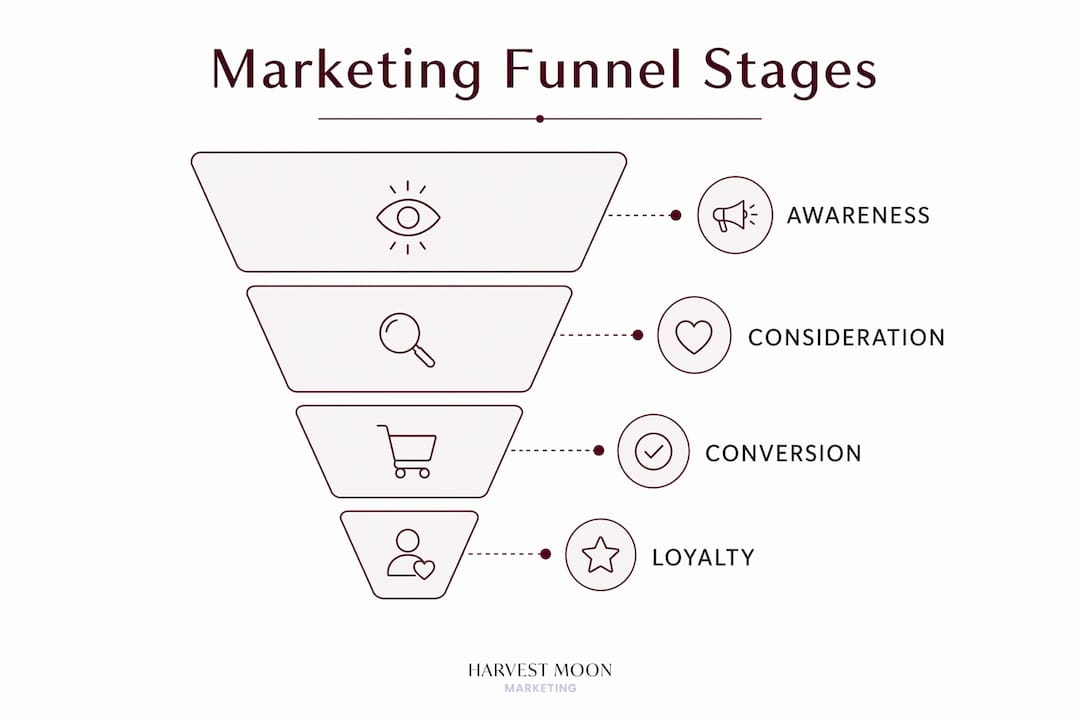
The funnel stages correspond directly to where a prospect sits in their decision-making process. Each stage demands a different approach from your marketing team.

| Funnel Stage | Customer Behaviour | Marketing Tactics |
|---|---|---|
| Awareness (TOFU) | Discovering a problem or brand | Blog posts, SEO, Google Ads, social content |
| Consideration (MOFU) | Researching and comparing options | Case studies, webinars, email sequences |
| Conversion (BOFU) | Ready to buy | Free consultations, demos, limited offers |
| Loyalty | Post-purchase engagement | Follow-up emails, referral programmes, reviews |
At the awareness stage, your job is reach. Prospects do not know you yet, so broad content like blog articles, search ads, and organic social posts bring them into the funnel. At the consideration stage, trust becomes the currency. Prospects are comparing you against alternatives, so proof points like testimonials and case studies carry significant weight.
The conversion stage is where post-purchase engagement becomes a fourth critical element of the modern funnel. Retention and advocacy are not afterthoughts. A customer who refers two friends is worth more than the original sale, and building that loyalty requires deliberate strategy after the transaction closes.
Pro Tip: Write separate content for each funnel stage rather than repurposing one piece across all three. A prospect who just discovered your brand needs education, not a pricing page.
How does a marketing funnel differ from a sales funnel?
The terms are often used interchangeably, but marketing and sales funnels serve distinct functions and are owned by different teams. Confusing them creates gaps in your customer handoff process.
The marketing funnel covers everything from initial brand awareness through to generating Marketing Qualified Leads (MQLs). Your marketing team owns this territory. They attract, educate, and nurture prospects until those prospects show enough intent to warrant a sales conversation.
The sales funnel begins where marketing ends. Once a lead becomes an MQL, the sales team takes over and works to convert that lead into a Sales Qualified Lead (SQL) and ultimately a paying customer. Marketing focuses on brand awareness and engagement, while sales focuses on closing.
Here is where the distinction matters practically:
- Marketing team responsibilities: Content creation, SEO, paid search, lead magnets, email nurturing
- Sales team responsibilities: Discovery calls, proposals, objection handling, closing
- Shared responsibility: Lead scoring, handoff criteria, and feedback loops between teams
When these two funnels are misaligned, leads fall through the cracks. A prospect who is handed to sales too early feels pressured and disengages. A prospect held in marketing nurturing too long loses momentum. Lead scoring solves this by assigning point values to prospect behaviours, such as opening emails or visiting a pricing page, so the handoff happens at the right moment.
Pro Tip: Define your MQL criteria in writing and agree on it with your sales team before launching any campaign. Disagreement on what counts as a qualified lead is the single most common cause of funnel breakdown.
Why does content tailoring determine funnel success?
Failing to tailor content per user intent at each funnel stage significantly reduces conversion efficiency. One message does not work for every stage, and sending the wrong content at the wrong time actively pushes prospects away.
At the top of the funnel, prospects are problem-aware but solution-unaware. Educational content works here: how-to guides, explainer articles, and short videos that address the problem without pitching a product. A service business might publish a blog post titled “Why your website isn’t generating enquiries” to attract business owners at this stage. A well-crafted lead magnet for your business can capture contact details from this audience before they leave.
At the middle of the funnel, prospects are evaluating options. Proof matters most here. Case studies, comparison guides, client testimonials, and webinars all perform well because they answer the question “why you over everyone else?” Effective funnel design demands precise audience segmentation and messaging matched to stage-specific intent.
At the bottom of the funnel, remove friction and create urgency. Common BOFU content types include:
- Free consultations or strategy calls
- Limited-time offers or guarantees
- Detailed service pages with clear calls to action
- Retargeting ads that bring back warm prospects
Converting website visitors requires matching your offer to where the visitor sits in their decision process. A visitor reading a blog post is not ready for a sales call. A visitor on your pricing page likely is.
What are the biggest challenges with modern marketing funnels?
The traditional funnel assumes a linear path from awareness to purchase. Real customer behaviour rarely works that way. Customers frequently loop back or skip stages entirely, which means rigid funnel models can mislead your strategy.
A prospect might discover your brand through a Google search, leave without converting, return three weeks later after seeing a social post, then convert after receiving a follow-up email. That is three different channels and two re-entries into the funnel. Static models do not account for this, and teams that treat the funnel as a one-way street miss the re-engagement opportunities.
Salesforce recommends tracking where prospects drop off in real time and adjusting strategies to address those bottlenecks. This is called dynamic funnel management, and it requires analytics tools that show you stage-by-stage drop-off rates rather than just total conversions.
Static funnel frameworks risk siloing marketing and sales teams, which produces worse customer experiences. HubSpot has advocated for the flywheel model as an alternative. The flywheel replaces the linear funnel with a circular model where existing customers generate momentum that attracts new ones through referrals and advocacy.
Practical steps to address these challenges:
- Audit your funnel monthly to identify the stage with the highest drop-off rate
- Use a CRM like Salesforce or HubSpot to track individual prospect journeys
- Build re-engagement sequences for prospects who went cold at the MOFU stage
- Treat customer reviews and referrals as top-of-funnel inputs, not afterthoughts
Pro Tip: If more than 60% of your leads go cold at the consideration stage, the problem is almost always a lack of proof. Add two or three detailed case studies to your MOFU content and measure the difference over 90 days.
How Harvestmoonmktg builds funnels that actually convert
Understanding the funnel is one thing. Building one that generates consistent leads for your service business is another. Harvestmoonmktg works with service-based businesses across Canada to design and run full-funnel marketing systems. Google Ads drives qualified traffic at the top of the funnel, putting your business in front of people actively searching for what you offer. Local SEO services build long-term visibility for businesses that depend on their community. For the middle and bottom of the funnel, email marketing keeps your brand top of mind with prospects who are not quite ready to buy. If you want a funnel built around your specific business goals, reach out to Harvestmoonmktg for a consultation.
FAQ
What is a marketing funnel in simple terms?
A marketing funnel is a model that shows the stages a prospect moves through from first hearing about your business to becoming a paying customer. It helps marketers identify where to focus their efforts and where prospects are dropping off.
What are the main funnel stages?
The core stages are Awareness (TOFU), Consideration (MOFU), and Conversion (BOFU), with Loyalty added as a fourth stage in modern frameworks. Each stage requires different content and tactics to move prospects forward.
How is a marketing funnel different from a sales funnel?
A marketing funnel covers lead generation and nurturing up to the point of a qualified lead, while a sales funnel takes over from that point to close the sale. Marketing owns awareness and consideration; sales owns conversion.
What is a good b2b funnel conversion rate?
B2B funnels convert 3–7% of leads into paying customers on average. That figure underscores why strong top and middle funnel strategies are critical to generating enough volume for a healthy number of closed deals.
What is the flywheel model and how does it relate to funnels?
The flywheel is an alternative to the traditional funnel that treats existing customers as a source of new business through referrals and advocacy. HubSpot recommends it for businesses where word-of-mouth and retention are primary growth drivers.


