
Pay-per-click advertising, known in the industry as PPC, is a digital advertising model where you pay only when someone clicks your ad. Platforms like Google Ads run this model through real-time auctions, making it one of the most direct ways to put your business in front of people actively searching for what you offer. Unlike traditional advertising where you pay for exposure, PPC targets qualified traffic from the moment your campaign goes live. For business owners and marketers focused on generating leads, understanding what is pay per click is the first step toward using it effectively.
How does pay-per-click advertising work?

PPC operates through an auction system. Every time a user enters a search query on Google, an automated auction runs in milliseconds to determine which ads appear and in what order. Advertisers bid on keywords, and the cost-per-click (CPC) they pay depends on how competitive that keyword is and how relevant their ad is to the search. CPC is the metric that measures what you actually pay per click. PPC is the broader model that governs the entire campaign structure.
Here is how a typical PPC campaign runs from start to finish:
- Choose your platform. Google Ads is the dominant choice for search-based PPC, reaching users at the exact moment they search for a product or service.
- Select your keywords. You bid on terms your potential customers are typing into search engines. Keyword relevance directly affects your ad placement and cost.
- Write your ad. Your headline and description must match what the searcher is looking for. Relevance is rewarded with better placement and lower costs.
- Set your budget. Google Ads allows daily budgets with no minimum spend, so you control exactly how much you commit each day.
- Monitor and adjust. Auction conditions change in real time, so bids that worked last week may underperform today. Regular review keeps your spend efficient.
Pro Tip: Check your auction insights report in Google Ads weekly. It shows who else is bidding on your keywords and at what intensity, so you can adjust bids before costs climb.
What are the key benefits of PPC for business owners?
PPC advertising delivers advantages that most other channels cannot match for direct lead generation. The benefits are concrete and measurable from day one.
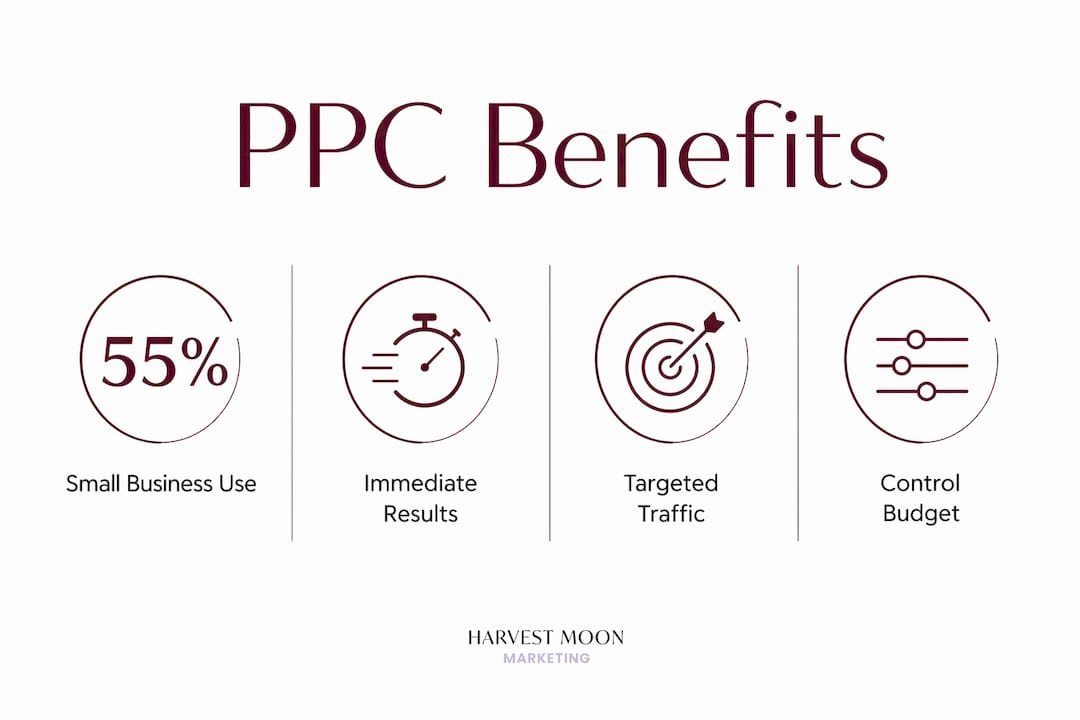
- You pay for interest, not exposure. Every dollar spent goes toward a user who actively clicked your ad. Paying only for clicks means your budget targets people who have already shown intent.
- Precise audience targeting. Keywords act as a filter. Someone searching “emergency plumber Toronto” is far more likely to convert than someone who simply scrolled past a banner ad.
- Immediate visibility. SEO builds over months. A PPC campaign on Google Ads can generate leads on day one. For new businesses or seasonal promotions, that speed matters.
- Full budget control. You set daily and monthly caps. There are no surprise invoices. Budget caps limit your spend, though actual results still depend on keyword choice and competition.
- Measurable ROI. Every click, conversion, and dollar spent is tracked. You know exactly what your advertising is producing.
55% of small businesses invest in PPC advertising. That figure reflects how widely business owners have recognised its value for generating qualified leads at a controllable cost.
Pro Tip: Write your ad copy to mirror the exact language your searcher used. If someone types “affordable roof repair Ottawa,” your headline should reflect that phrase directly. Alignment between search query and ad copy lifts click-through rates and lowers your CPC.
PPC vs. SEO: how do they fit together?
Search Engine Marketing (SEM) is the umbrella term for all efforts to gain visibility on search engines. SEM includes both paid and organic strategies, meaning PPC and SEO are both components of a complete search marketing approach. PPC is the paid side. SEO is the organic side. They are distinct tactics with different timelines, costs, and strengths.
Relying solely on PPC limits your long-term search visibility. Relying solely on SEO means waiting months for results. The most effective approach for service businesses combines both. Harvestmoonmktg recommends PPC as the primary driver of direct leads and SEO for local businesses looking to build lasting organic presence.
| Feature | PPC | SEO |
|---|---|---|
| Speed to results | Immediate | 3–6 months typically |
| Cost model | Pay per click | Time and content investment |
| Traffic type | Paid, stops when budget ends | Organic, ongoing once established |
| Targeting control | High, keyword and location specific | Moderate, based on content relevance |
| Best for | Direct lead generation | Long-term local visibility |
| Measurability | Precise, real-time data | Slower to attribute |
One important distinction: CPC and PPC are related but not identical. CPC is a metric within PPC campaigns. Understanding the difference helps you read campaign reports accurately and make better decisions about where to adjust spend.
How to set up and manage an effective PPC campaign
Setting up a PPC campaign is straightforward. Running one profitably requires ongoing attention. These are the areas that separate campaigns that generate leads from those that drain budgets.
Keyword research is your foundation. Generic keywords like “plumber” attract broad traffic at high cost. Specific keywords like “drain cleaning service Mississauga” attract buyers with clear intent at lower competition. Use Google’s Keyword Planner to identify terms with strong intent and manageable cost. You can also explore types of paid advertising to understand where search keywords fit within a broader paid strategy.
Ad relevance determines your cost. Google assigns a Quality Score to every ad based on how well it matches the keyword and landing page. A higher Quality Score lowers your CPC and improves placement. This means strategy and ad relevance matter more than simply outbidding competitors.
Conversion tracking is non-negotiable. Without conversion data, you cannot tell which clicks are producing leads and which are wasting money. Set up Google Ads conversion tracking before your campaign launches, not after. Link it to your CRM or contact form so every lead is attributed to the correct keyword.
Landing pages must match the ad. Sending paid traffic to your homepage is one of the most common and costly mistakes in PPC. Build a dedicated landing page for each campaign that mirrors the ad’s promise and makes it easy for visitors to take action.
Common mistakes to avoid:
- Ignoring search term reports, which show the actual queries triggering your ads
- Setting a budget and walking away without weekly performance reviews
- Running broad match keywords without negative keyword lists to filter irrelevant traffic
- Measuring success by clicks alone rather than cost per lead or cost per conversion
For a practical look at how PPC delivers results for service businesses, the ROI PPC guide for 2026 breaks down real campaign benchmarks worth reviewing before you set your first budget.
Ready to run PPC campaigns that generate real leads?
Harvestmoonmktg specialises in Google Ads campaign management for service-based businesses across Canada. The team builds campaigns grounded in keyword intent, ad relevance, and conversion tracking so every dollar you spend is working toward a measurable outcome. PPC is Harvestmoonmktg’s most requested service because it delivers leads directly and quickly. For businesses that also want to build long-term search visibility, Harvestmoonmktg pairs PPC with local SEO services to cover both immediate and sustained growth. Reach out to discuss a custom campaign strategy built around your market and budget.
FAQ
What is the pay per click definition in simple terms?
Pay-per-click (PPC) is an online advertising model where advertisers pay a fee each time a user clicks their ad. You pay for traffic rather than for ad impressions.
How much does pay-per-click advertising cost?
The cost varies by keyword competitiveness and bidding strategy. CPC fluctuates with market conditions, so expect variable costs rather than a fixed price per click.
Is PPC better than SEO for generating leads?
PPC generates leads immediately and suits direct lead generation for service businesses. SEO builds organic visibility over time and works best for long-term local search presence. Most businesses benefit from using both.
What is the difference between PPC and CPC?
PPC is the overall advertising payment model. CPC is the specific metric that measures what you pay for each individual click within a PPC campaign.
How do i know if my PPC campaign is working?
Conversion tracking is the definitive measure. Track form submissions, phone calls, or bookings tied to your ads so you can calculate cost per lead and assess true campaign performance.


