
Online reputation management (ORM) is the practice of monitoring, building, responding to, and correcting your business’s digital presence across Google, review platforms, and AI search outputs. For service businesses, where trust drives every sale, your reputation is your most valuable sales asset. A single unanswered negative review or a thin Google Business Profile can cost you leads before a prospect ever calls. Harvestmoonmktg works with service providers across Canada to build the kind of digital presence that converts searchers into paying clients.
How to manage online reputation in your service business
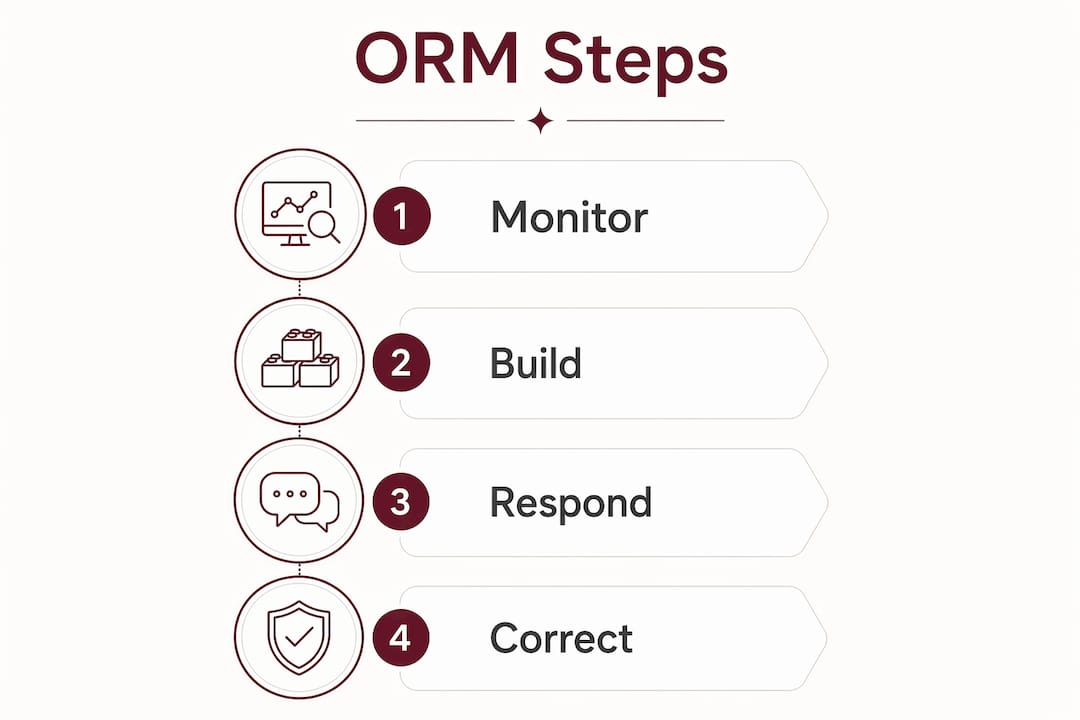
ORM is a proactive discipline built on four pillars: monitoring, building, responding, and correcting. Most service businesses only react when something goes wrong. That reactive posture is the single biggest mistake in digital reputation management. A complete online reputation strategy treats all four pillars as ongoing, parallel activities, not sequential steps.
Your reputation lives in more places than you think. Google Search, Google Maps, Facebook, Yelp, Houzz, HomeStars, and increasingly in AI tools like ChatGPT and Perplexity all surface your business name. Each of those channels shapes how a prospect decides whether to call you or your competitor. Ignoring any one of them creates a blind spot.

The payoff for getting this right is direct. A stronger brand image means higher conversion rates from every lead source, whether that is paid search, local SEO, or word of mouth. Service businesses that manage their online reputation systematically spend less per acquired client over time.
What tools do you need to monitor your online reputation?
Continuous monitoring is the foundation of any online reputation strategy. Manually checking dozens of platforms daily is not feasible without systems in place. Alerts and monitoring tools centralise reputation signals into one manageable workflow.
The two most accessible starting points are Google Alerts and Brand24. Google Alerts is free and sends email notifications whenever your business name appears in new web content. Brand24 is a paid tool that tracks mentions across social media, news sites, blogs, and forums in near real time.
| Tool | Coverage | Alert type | Integrations | Best for |
|---|---|---|---|---|
| Google Alerts | Web, news | Email digest | Gmail, Sheets | Budget monitoring |
| Brand24 | Social, web, news | Real-time push | Slack, Teams | Active monitoring |
| Mention | Social, web | Real-time push | Slack, HubSpot | Mid-size teams |
Set up alerts for your business name, your owner’s name, your key service keywords, and common misspellings of your brand. That combination catches the mentions most businesses miss entirely. Assign one team member to review alerts weekly so nothing falls through the cracks.
Pro Tip: Set a recurring 30-minute calendar block every Monday morning for your designated reputation monitor to review all alerts from the previous week and flag anything requiring a response.
How do you generate authentic reviews that build your reputation?
Systematic review generation funnels produce far stronger social proof than waiting for organic reviews to trickle in. A white-hat review funnel is a repeatable, ethical process for asking satisfied clients to share their experience on the platforms that matter most to your business.
The funnel works because timing and personalisation drive response rates. A generic “please leave us a review” email sent two weeks after a job closes gets ignored. A specific, personal request sent within 24 hours of a positive interaction gets results. Here is a practical process to build into your service delivery:
- Complete the job and confirm the client is satisfied before asking for anything.
- Send a personal follow-up by text or email within 24 hours, referencing the specific work completed.
- Include a direct link to your Google Business Profile review page. Remove every extra click.
- Ask for Google first, then Facebook or a trade-specific platform as a secondary option.
- Follow up once if you receive no response after five days. One follow-up is professional; two is pressure.
Spread your review requests across multiple platforms. A business with 80 Google reviews and nothing elsewhere looks thinner than one with 60 Google reviews, 20 Facebook reviews, and 15 HomeStars reviews. Diversification builds credibility and improves your visibility in local search. For a broader look at how review generation fits into your overall client acquisition process, the lead generation checklist from Harvestmoonmktg covers the full picture.
Pro Tip: Personalise every review request by naming the specific service or technician involved. “Hi Sarah, glad the kitchen renovation went smoothly” outperforms “Hi, thanks for your business” every time.
What are the best practices for responding to online reviews?
Responding promptly and professionally to every review, positive and negative, directly improves customer loyalty and brand perception. Silence reads as indifference. A well-crafted response to a critical review often impresses prospects more than the negative review itself damages you.
Follow these guidelines for every response:
- Positive reviews: Thank the client by name, reference the specific service, and invite them back. Keep it warm and brief. Do not paste the same template on every review.
- Negative reviews: Acknowledge the concern without admitting fault prematurely. Apologise for the experience, offer to resolve it offline, and provide a direct contact. Never argue publicly.
- False or unfair reviews: Respond calmly and factually. State that you cannot locate a record of the interaction and invite the reviewer to contact you directly. This signals credibility to readers.
AI tools can draft personalised responses quickly, which helps teams maintain brand tone without spending hours on each reply. The key is human approval before posting. AI speeds up the drafting; a real person ensures the tone stays right. Avoid defensive language, all-caps, or responses that escalate the conflict publicly. Those patterns consistently make the situation worse.
How do you correct or suppress harmful online content?
Correcting harmful content relies on two legitimate methods: using platform mechanisms to dispute inaccurate content, and publishing positive content that pushes negative results down in search rankings. Ethical ORM never involves fake reviews, paid review removal, or deceptive tactics.
Here is how to handle harmful content at each level:
- Inaccurate reviews: Use the platform’s reporting tool to flag content that violates community guidelines, such as reviews from non-customers or reviews containing false factual claims.
- Outdated negative press: Publish fresh, positive content including blog posts, case studies, and updated business profiles to suppress older negative results in Google Search.
- Negative social media mentions: Respond publicly and briefly, then move the conversation to a private channel for resolution.
- Persistent or escalating issues: Consult a legal professional if content is defamatory. Document everything before taking action.
Monitor for new negative mentions continuously so you catch problems early. A mention that sits unanswered for two weeks does far more damage than one addressed within 48 hours. Understanding how content fits into your marketing funnel helps you prioritise which positive assets to publish first. For service businesses building their reputation from scratch, the connection between email marketing and staying top of mind with existing clients also plays a supporting role in keeping your brand visible and trusted.
How Harvestmoonmktg helps service businesses protect their reputation
Harvestmoonmktg is a full-suite digital marketing agency that works specifically with service businesses across Canada. The agency combines Google Ads for direct lead generation with social media engagement to build the kind of consistent online presence that makes reputation management easier over time. A steady flow of new clients, generated through paid search, means more opportunities to collect positive reviews and grow your brand image organically. Harvestmoonmktg also serves a wide range of service industries, from contractors to home services, with marketing approaches built around how clients in those sectors actually search and decide. If you want leads and a stronger reputation working together, that is the combination worth exploring.
FAQ
What does online reputation management mean for service businesses?
ORM is the practice of monitoring, building, responding, and correcting your business’s presence across Google, review platforms, and social media. For service businesses, it directly affects how many prospects choose to contact you.
How much does reputation management cost?
Small business owners can manage ORM themselves with roughly 2–3 hours per week at minimal cost. Professional reputation management services range from $500 to $3,000+ monthly, depending on volume and complexity.
How quickly should I respond to a negative review?
Responding within 24–48 hours is the standard for professional reputation management. Delays signal indifference and give the negative review more time to influence prospects without a counterpoint.
Which review platforms matter most for service businesses?
Google Business Profile is the highest priority for most service businesses because it directly affects local search rankings and visibility. Secondary platforms depend on your trade: HomeStars and Houzz for home services, Facebook for community-based businesses.
Can I remove a false review from Google?
You can flag a review that violates Google’s policies, but removal is not guaranteed. The most reliable approach is to respond professionally and publish positive content to reduce the review’s relative impact in search results.


