
Contractor lead generation online is the process of attracting qualified potential clients through digital marketing channels, including Google Local Services Ads (LSAs), lead marketplaces like Angi, and local SEO. The most effective contractors in 2026 do not rely on a single source. They combine paid and organic methods to build a pipeline that produces consistent, high-quality work. This guide breaks down the top contractor lead sources, how to set them up, and how to manage them so you spend less time chasing bad leads and more time booking jobs.
How do Google Local Services Ads work to get contractor leads online?
Google Local Services Ads are pay-per-lead ads that charge you only when a homeowner contacts you directly, not when someone simply clicks your listing. That distinction matters enormously for your budget. LSAs average about $60 per lead in 2026, which is typically below the cost of standard Google search ads. For most trades, that cost per lead is difficult to beat through any other paid channel.
Setting up LSAs requires completing Google’s verification process, which includes background checks for the business owner and all field workers, plus confirmation of your licences and insurance. Verification typically takes 3 to 4 weeks, and name inconsistencies between your licence and insurance documents can add another 2 to 3 weeks of delays. Getting your paperwork aligned before you apply saves significant time.

Once verified, your profile earns the Google Guaranteed badge, which appears directly on your listing and signals trust to homeowners. LSAs appear before the map pack and organic results on mobile searches, where 76% of local contractor searches happen. That placement puts you in front of the most motivated buyers before any competitor without a verified LSA profile.
Here is how to set up and manage your LSA campaign effectively:
- Complete all licence, insurance, and background check documents before submitting your application.
- Set a monthly budget between $500 and $2,000 depending on your trade and market size to generate meaningful lead volume.
- Respond to every lead within minutes. Speed to contact directly affects your ad ranking.
- Dispute invalid leads promptly through the LSA dashboard to recover wasted spend.
- Collect reviews through the Google LSA platform to improve your profile’s ranking and conversion rate.
The results from LSAs speak clearly. Out of 107,189 LSA leads analysed, 43.5% booked an appointment, and 66.8% of resulting revenue came from new customers. That booking rate is well above what most contractors see from shared lead marketplaces.
Pro Tip: Keep all technicians background-checked and compliant at all times. A single lapsed worker can pause your entire LSA campaign and cut off your lead flow without warning.
Are shared lead marketplaces like Angi and Thumbtack worth it?
Shared lead marketplaces connect homeowners with multiple contractors at once. When a homeowner submits a request on Angi or Thumbtack, that same lead is sent to 3 to 5 or more contractors simultaneously. You are not buying exclusive access. You are buying a chance to compete, which changes the ROI calculation significantly.
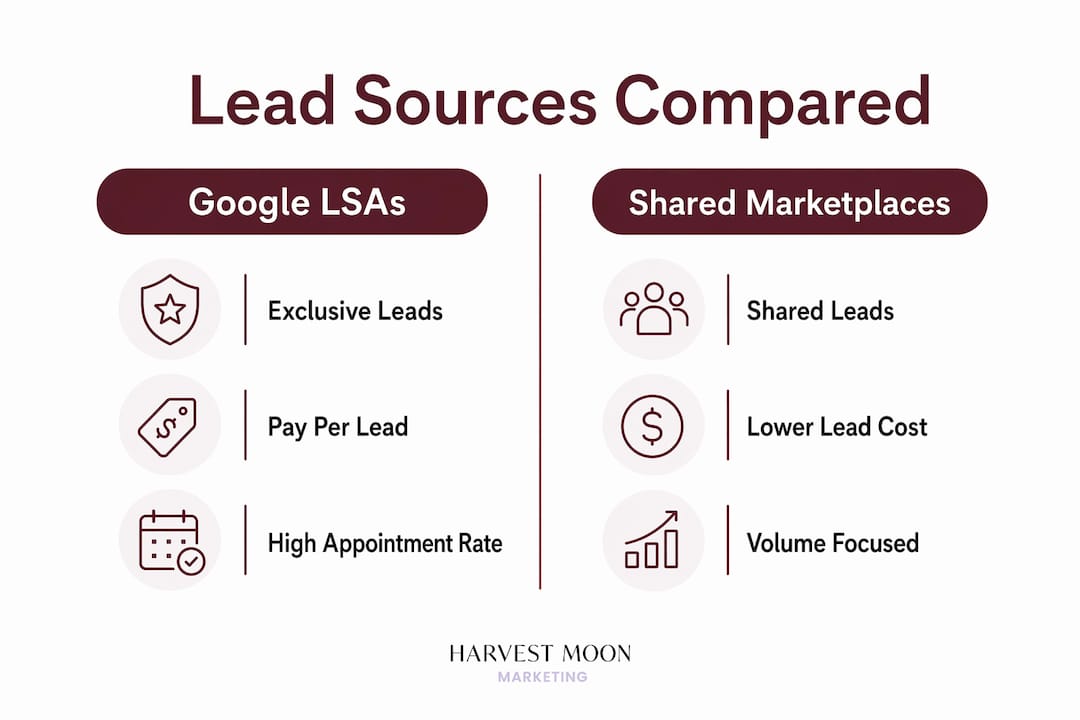
The table below summarises the key differences between shared lead platforms and Google LSAs:
| Feature | Google LSAs | Angi / Thumbtack |
|---|---|---|
| Lead exclusivity | Exclusive to your profile | Shared with 3 to 5+ contractors |
| Cost model | Pay per valid contact | Pay per lead regardless of outcome |
| Lead intent | High (actively searching) | Variable |
| Google Guaranteed badge | Yes | No |
| Booking rate | ~43.5% | Lower due to competition |
| Best for | Most trades, all market sizes | High-volume trades, new markets |
Shared platforms are not without value. They work best when you are entering a new market and need volume quickly, when your trade has high average job values that justify the competition, or when you have a fast follow-up system in place. Fast response times are critical on these platforms. Contractors who contact a shared lead within five minutes book significantly more jobs than those who wait even an hour.
The honest tradeoff is this: shared leads cost less per lead but more per booked job once you account for the win rate. Track both numbers before deciding whether a marketplace fits your business.
How can local SEO help contractors generate and own their leads?
Local SEO is the practice of optimising your online presence so your business appears in Google searches from people in your service area. Unlike paid ads, organic leads do not stop when your budget runs out. They compound over time, making local SEO one of the most cost-effective marketing strategies for contractors over a 12 to 24 month horizon.
Optimising your Google Business Profile and accumulating customer reviews significantly improves both your visibility and your conversion rate from organic search. A complete profile with accurate hours, service areas, photos, and a consistent stream of five-star reviews outperforms a bare listing in every local market.
Key organic tactics that produce consistent contractor leads include:
- Google Business Profile: Fill every field, post updates regularly, and respond to every review, positive or negative.
- Customer reviews: Ask every satisfied client for a Google review immediately after the job. Volume and recency both affect your local ranking.
- Website content: Answer the questions your clients actually search for, such as “how much does a bathroom renovation cost in [city]” or “licensed electrician near me.” These pages attract high-intent visitors.
- Local citations: Keep your name, address, and phone number identical across Google, Yelp, HomeStars, and every other directory where your business is listed.
- Referral programmes: A structured referral incentive turns your existing clients into a lead source that costs you nothing until a job is booked.
Pro Tip: Add a FAQ section to your website that answers the five most common questions your clients ask before hiring you. These pages rank well in local search and pre-qualify leads before they ever call.
Organic methods work best alongside paid channels. LSAs and Google Ads generate leads immediately while your SEO builds authority. Over time, organic traffic reduces your dependence on paid spend.
What are best practices for managing and converting contractor leads?
Generating leads is only half the work. How you manage them determines your actual revenue. The contractors who win consistently are not always the ones with the most leads. They are the ones with the tightest follow-up process.
Follow these steps to build a lead management system that converts:
- Set up instant notifications. Every lead source, whether LSA, Angi, or your website contact form, should trigger an immediate text or email alert so you can respond within minutes.
- Use a CRM or lead tracking spreadsheet. Record the source, date, status, quoted amount, and outcome for every lead. This is the only way to know which channels are actually profitable.
- Track your full funnel. True ROI requires tracking not just cost per lead but also contact rate, quote rate, and close rate. A $30 lead that never answers the phone costs more than a $90 lead that books immediately.
- Dispute invalid leads promptly. LSAs allow you to dispute leads that do not meet your service criteria. Ignoring this step wastes budget every month.
- Follow up after every completed job. Ask for a review, offer a referral incentive, and add the client to an email list for seasonal promotions. Repeat business costs a fraction of new lead acquisition.
| Metric to track | Why it matters |
|---|---|
| Cost per lead | Measures channel efficiency |
| Contact rate | Reveals lead quality by source |
| Quote rate | Shows how well leads are pre-qualified |
| Close rate | Measures your sales conversion |
| Cost per booked job | The true ROI number |
Lead tracking by source, status, and revenue is what separates contractors who scale from those who stay stuck guessing which marketing is working.
What I have learned running lead generation for contractors
Working with contractors across multiple trades, the pattern I see most often is this: businesses invest in lead generation before they have a system to handle the leads. They sign up for Angi, get flooded with shared leads, respond slowly, win nothing, and conclude that online leads do not work. The problem was never the channel. It was the process.
The contractors who see the best returns from digital marketing treat it like a trade. They measure everything, they optimise based on data, and they are patient with organic channels while using paid ads to keep the pipeline full in the short term. LSAs are the strongest paid starting point for most trades because the pay-per-lead model reduces wasted spend compared to traditional PPC. But LSAs alone are not a strategy. They are one tool.
The contractors I have seen grow fastest combine LSAs for immediate volume, local SEO for long-term cost reduction, and email marketing to stay top of mind with past clients. None of those channels is complicated. All of them require consistency.
— Harvest
How Harvestmoonmktg helps contractors build a real lead pipeline
Harvestmoonmktg is a full-suite digital marketing agency that works specifically with contractors and service-based businesses to build lead generation systems that produce measurable results. From setting up and managing Google Ads and LSA campaigns to building local SEO authority and email marketing programmes that keep past clients coming back, Harvestmoonmktg handles the channels that actually move the needle for contractors. If you are ready to stop guessing and start tracking real ROI from your marketing, explore the full range of contractor marketing services and get a strategy built around your trade and market.
FAQ
How much does it cost to get contractor leads online?
Costs vary by channel. Google Local Services Ads average about $60 per lead, while shared lead marketplaces charge variable rates per lead regardless of whether you win the job. Your true cost per booked job depends on your contact, quote, and close rates across each source.
What is the fastest way to start generating contractor leads online?
Google Local Services Ads produce leads the fastest once your profile is verified, typically within 3 to 4 weeks of applying. They appear at the top of mobile search results and charge only when a homeowner contacts you directly.
Are shared lead platforms like Angi worth using?
Shared lead platforms can work for high-volume trades or when entering a new market, but the same lead goes to 3 to 5 or more contractors at once. Fast response times and strong reviews are required to compete effectively and achieve a positive return.
How long does local SEO take to generate contractor leads?
Local SEO typically produces meaningful results within 6 to 12 months of consistent effort. It works best as a long-term complement to paid channels like LSAs, gradually reducing your cost per lead as organic traffic grows.
What metrics should contractors track for online leads?
Track cost per lead, contact rate, quote rate, close rate, and cost per booked job for every lead source. These five numbers tell you which channels are profitable and where to focus your marketing budget.


