
Contractor digital marketing is the strategic use of online channels, including search ads, local listings, SEO, and email, to generate qualified leads and grow a contracting business. Google Local Services Ads (LSAs) stand out as one of the highest-ROI tools available, charging contractors only for valid leads rather than clicks. Meanwhile, 45% of consumers used AI for local business recommendations in 2026, up from just 6% previously. That shift alone changes how contractors need to think about their entire online presence.
What are the essential digital marketing strategies for contractors?
Contractor digital marketing explained properly means separating brand awareness from direct lead generation. Most contractors need leads now, not logo recognition. The channels below each serve a distinct purpose, and mixing them up wastes budget.
- Local SEO: Optimising your Google Business Profile and website for location-based searches builds organic visibility over time. Local SEO services are particularly strong for contractors who serve a defined geographic area and want steady inbound traffic without paying per click.
- Google Local Services Ads (LSAs): These pay-per-lead ads sit above traditional search results and connect contractors directly with high-intent customers. They are the most direct path to qualified leads in most trades.
- Pay-per-click (PPC) advertising: Traditional Google Ads target high-intent keyword searches with precise control over budget, geography, and service type. Google Ads campaigns require active keyword management and negative keyword lists to avoid wasted spend, but they deliver fast, measurable results.
- Email marketing: Staying top of mind with past clients through periodic email campaigns is one of the lowest-cost retention tools available. A past client who books again or refers a neighbour costs far less to acquire than a cold lead.
- Social media: Platforms like Instagram and Facebook build brand familiarity and trust through project photos and client stories. Social media is an engagement channel, not a direct lead generator for most contractors.
Pro Tip: Treat each channel as a separate budget line with its own goal. Mixing lead generation spend with brand awareness spend makes it impossible to measure what is actually working.
How do Google Local Services Ads work for contractors?

Google LSAs are purpose-built for service businesses, and they operate differently from every other ad product Google offers. Understanding the mechanics is the first step to getting real value from them.
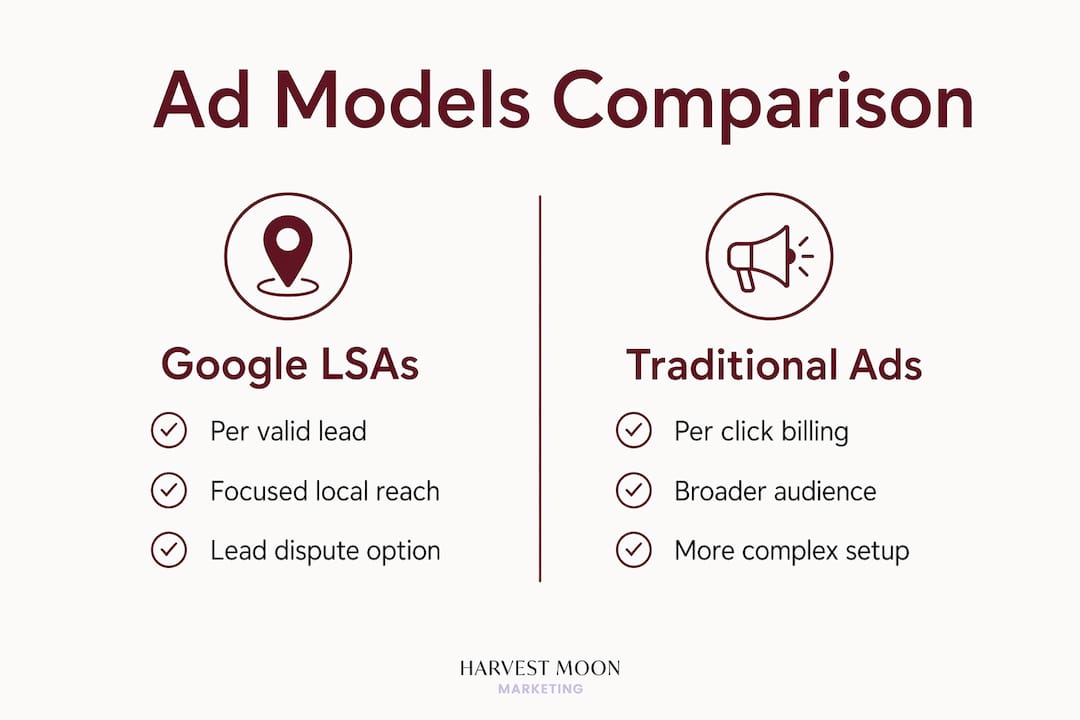
LSAs charge per valid lead, meaning calls and messages from real customers, not for clicks that go nowhere. The average LSA cost per lead sits around $60, compared to roughly $70.11 for traditional search ads. That $10 difference compounds quickly across dozens of leads per month.
Here is how the setup and optimisation process works:
- Complete your business profile fully. LSAs generate ads automatically from your profile data, covering thousands of relevant searches without requiring keyword research or ad copy testing. Incomplete profiles produce poor matches.
- Set your service area precisely. Mismatched leads, meaning calls from the wrong trade or the wrong geography, are the single biggest cost failure for contractors using digital ads. Accurate service area settings prevent this directly.
- Earn the Google Verified badge. Passing Google’s background and licence checks earns a green “Google Screened” or “Google Guaranteed” badge. This badge increases consumer trust and improves your ranking within the LSA results.
- Collect reviews consistently. Review volume and recency affect your LSA ranking. A contractor with 80 reviews outranks one with 12, even at the same budget level.
- Set your budget to hit volume targets. Aiming for about 20 leads per week is the recommended starting point. Budget directly controls lead volume under the pay-per-lead structure, so underfunding the campaign starves it of data.
| Feature | Google LSAs | Traditional Google Ads |
|---|---|---|
| Billing model | Per valid lead | Per click |
| Setup complexity | Low (profile-driven) | High (keyword and copy testing) |
| Lead quality control | Dispute invalid leads | Negative keywords required |
| Trust signal | Google Verified badge | No equivalent |
| Best for | Local service contractors | Broader or competitive markets |
Pro Tip: Dispute any lead that does not match your listed services or service area. Google reviews disputes and credits your account for invalid leads, which keeps your effective cost per lead accurate.
What role does AI-driven discovery play in contractor marketing today?
AI is changing where consumers start their search for local contractors, and the shift is faster than most business owners realise. 40% of consumers actively use generative AI when searching online, with usage reaching 64% among adults aged 30 to 44. That age group represents a core home renovation and construction client demographic.
AI tools like ChatGPT pull contractor recommendations from multiple data sources, not just Google. Relying solely on Google reviews risks invisibility to AI-driven tools that aggregate information from Yelp, Houzz, HomeStars, and other platforms. A contractor with 200 Google reviews but no presence elsewhere may simply not appear in an AI-generated recommendation.
What contractors must do to stay visible in AI-powered results:
- Keep business name, address, phone number, and service descriptions identical across every platform where you are listed.
- Build reviews on multiple platforms, not just Google. HomeStars and Houzz carry weight in Canadian home services searches.
- Update your Google Business Profile with current photos, service categories, and hours at least quarterly.
- Write website content that answers specific service questions clearly. AI-powered search models cite your Google Business Profile and website as authoritative sources. Missing or inaccurate data causes direct invisibility.
“Contractors who treat their Google Business Profile as a set-and-forget listing are already invisible to a growing share of their potential customers.” — BrightLocal Local Consumer Review Survey 2026
The practical implication is straightforward. Reputation management is no longer just about responding to bad reviews. It is about maintaining a consistent, accurate, and active presence across every platform that AI models draw from.
How can contractors optimise digital marketing for better leads and ROI?
Lead quality beats lead volume every time. A contractor who receives 30 mismatched leads per month spends more time on the phone declining work than a contractor who receives 15 well-matched leads and closes 10 of them. Optimisation is about closing that gap.
- Tighten your service area settings. If you do not serve a particular postal code, remove it. LSA profile accuracy directly reduces the volume of leads that waste your time and budget.
- Match your budget to your sales capacity. If your team can handle eight new jobs per month, do not run a campaign generating 40 leads. Unworked leads lower your LSA responsiveness score over time.
- Follow up within minutes, not hours. Conversion rates improve as responsiveness to leads increases. A lead that goes unanswered for four hours has likely already called your competitor.
- Use a CRM to track lead sources. Tools like HubSpot, Jobber, or ServiceTitan let you attribute revenue back to specific campaigns. Without this, you are guessing which channel is actually paying for itself.
- Review your campaign data weekly. Budget, service categories, and service area settings should be treated as living variables, not one-time decisions.
Pro Tip: Ask every new client how they found you. Even with CRM tracking, self-reported data fills gaps and often reveals channels you did not expect to be performing.
What I have learned running contractor marketing campaigns
After working with contractors across multiple trades, the pattern is consistent. The businesses that get the best results from digital marketing are not the ones with the biggest budgets. They are the ones who treat lead quality as a discipline.
The contractors who struggle most tend to focus on volume. They want more calls, more clicks, more impressions. But a roofing contractor in Mississauga getting calls from Ottawa is not a marketing win. It is a profile problem that costs money every time the phone rings.
The other mistake I see regularly is treating digital marketing as separate from the sales process. A well-run LSA campaign can deliver a qualified lead to your phone in under an hour. If nobody answers, or if the follow-up takes two days, the campaign looks like it is failing when the real problem is internal. Digital marketing and your sales process have to work together, or neither performs well.
AI-driven discovery is the shift I am watching most closely right now. Contractors who keep their business data clean, collect reviews across multiple platforms, and answer specific service questions on their website are already building the foundation that AI models reward. Those who do not will find themselves invisible to a growing share of their market without understanding why.
— Harvest
How Harvestmoonmktg helps contractors get more from digital marketing
Harvestmoonmktg works with contractors and service-based businesses across Canada to build digital marketing programmes that generate real, measurable leads. From local SEO that builds long-term organic visibility to Google Ads campaigns that put your business in front of high-intent searchers today, every service is built around lead quality and transparent ROI reporting. If you are ready to stop guessing which channels are working and start seeing clear results, explore the full range of contractor marketing services available through Harvestmoonmktg and find the right fit for your business.
FAQ
What is contractor digital marketing?
Contractor digital marketing is the use of online channels, including SEO, Google Ads, LSAs, and email, to attract qualified leads and grow a contracting business. It focuses on lead generation rather than broad brand awareness.
Are Google Local Services Ads worth it for contractors?
Yes. LSAs charge per valid lead rather than per click, with an average cost per lead of around $60 compared to $70.11 for traditional search ads. They are one of the most cost-efficient lead generation tools available to contractors.
How does AI affect how contractors get found online?
45% of consumers used AI for local business recommendations in 2026, up from 6% previously. Contractors need consistent, accurate business information across multiple platforms to appear in AI-generated local recommendations.
What is the biggest mistake contractors make with digital ads?
The most common and costly mistake is poor service area and service type targeting, which generates mismatched leads. Accurate LSA profile settings directly reduce wasted spend and improve lead quality.
How quickly should contractors follow up on digital leads?
As quickly as possible. Conversion rates improve significantly with faster response times, and a lead left unanswered for several hours has likely already contacted a competitor.


