
Content is the primary vehicle through which search engines understand, evaluate, and rank your website. Without content that directly answers what your audience is searching for, no amount of technical SEO will move the needle. Google’s algorithms, and increasingly AI-powered answer engines, judge your site on the quality, depth, and trustworthiness of what you publish. Understanding the role of content in SEO means understanding that rankings are earned by genuinely serving the reader, not by gaming a system.
How does content quality affect SEO rankings?
Content quality is the single biggest factor separating pages that rank on page one from those that never get found. Google’s Helpful Content system actively demotes pages written for search engines rather than people. That means thin, generic, or recycled content gets pushed down, regardless of how many backlinks point to it.
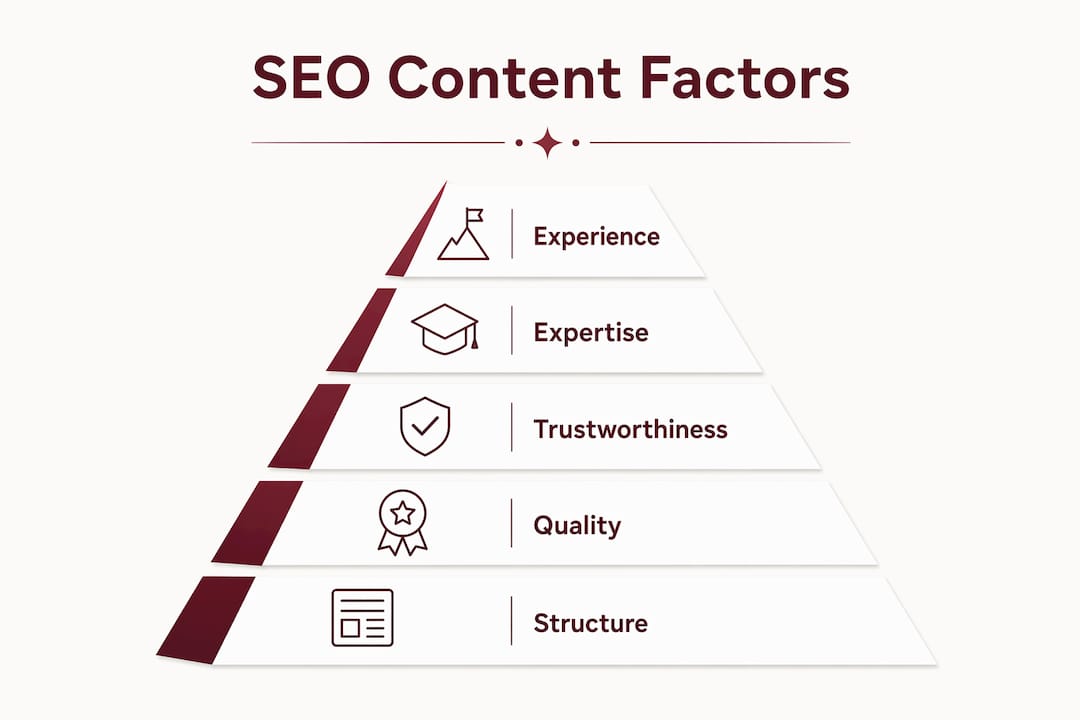
Pages that demonstrate real experience, genuine expertise, and trustworthiness rank significantly higher. This is not a soft preference. It is a hard algorithmic signal. A local accountant who writes a detailed guide on GST filing from firsthand experience will consistently outrank a content farm that scraped the same topic from five other sites.

User engagement reinforces this. When readers stay on a page, scroll through it, and click to learn more, search engines interpret that as a signal of relevance. Clear, informative content produces that behaviour naturally. Vague or padded content drives readers away, and that exit signal hurts rankings.
Here is what separates content that ranks from content that does not:
- Originality: The content presents a perspective, data point, or example not found elsewhere.
- Specificity: Answers are direct and detailed, not broad and hedged.
- Structure: Headings, short paragraphs, and clear formatting make content easy to scan.
- Author credibility: Named authors with verifiable expertise signal trust to both readers and algorithms.
- Intent match: The content format matches what the searcher actually wants, whether that is a how-to guide, a comparison, or a definition.
Pro Tip: Before publishing any new page, ask whether a reader would bookmark it or close the tab within 30 seconds. If the honest answer is the latter, the content needs more depth or a sharper angle.
What is the role of content in AI-powered search in 2026?
AI answer engines have changed how content gets surfaced and cited. Traditional search engines prioritise backlinks and technical SEO signals. AI engines prioritise topical depth, clarity, and content that is easy to extract and quote directly. These are two different games, and your content strategy needs to account for both.
AI-powered answer engines select from only 2–7 primary sources when generating a response. That is a very small pool. To earn a spot in it, your content must have clear entity references, direct answers at the start of each section, and a structure that a machine can parse without ambiguity.
A dual-surface audit is now a standard part of any serious content strategy. This means reviewing your content against two separate sets of criteria:
- For traditional search: keyword relevance, backlink profile, page speed, mobile usability, and internal linking.
- For AI citation: entity clarity, extraction-friendly formatting, topical completeness, and direct answers in the opening sentences of each section.
Authority mapping should precede keyword research in any 2026 content plan. Before deciding what to write, define the specific expertise area your brand genuinely owns. Without that clarity, your content competes in too many directions and wins in none.
The practical implication is significant. A business that publishes 50 shallow articles on broad topics will lose to a business that publishes 15 deep, well-structured articles within a clearly defined authority area. Depth and focus beat volume every time.
SEO content best practices for ranking and getting cited
The most effective SEO content strategy maps every piece of content to a specific user intent. Intent alignment is more important than keyword volume. A page targeting “how to choose a commercial HVAC system” needs to be a detailed buying guide, not a 300-word blog post with a contact form.
There are four intent categories to plan around:
- Informational: The reader wants to learn something. Deliver a thorough explanation with examples, definitions, and context.
- Navigational: The reader is looking for a specific brand or resource. Make sure your brand pages are clear and complete.
- Commercial: The reader is comparing options before buying. Provide honest comparisons, criteria, and evidence.
- Transactional: The reader is ready to act. Remove friction and make the next step obvious.
Structure matters as much as substance. Lead every section with a direct answer, then expand with evidence. Use H2 and H3 headings that mirror the questions your audience actually types into search. Schema markup increases the likelihood of AI engines citing a page by 2.5 times by making content machine-readable. Adding Article, FAQ, or HowTo schema to your pages is one of the highest-return technical moves available.
Internal linking builds content clusters that signal topical authority to search engines. A well-linked cluster of five related articles on a single topic tells Google you own that subject. A collection of disconnected posts tells it nothing. The importance of content in SEO extends to how your pages relate to each other, not just how each page performs individually.
Pro Tip: Demonstrating real experience beats superficial research every time. If you have firsthand knowledge of a topic, say so explicitly. First-person examples, original data, and direct quotes from practitioners all signal genuine expertise to both readers and algorithms.
How do you measure and refine your content strategy?
Measuring content performance requires tracking signals across two surfaces. Traditional SEO metrics tell you how content performs in Google. AI citation metrics tell you how often your content gets referenced in AI-generated answers.
| Metric | What it measures | Review frequency |
|---|---|---|
| Organic traffic | Overall search visibility | Monthly |
| Keyword rankings | Position for target queries | Monthly |
| Conversion rate | Traffic that becomes leads | Monthly |
| AI citation frequency | Mentions in AI answers | Quarterly |
| Bounce rate | Content relevance and quality | Quarterly |
| Pages per session | Internal link effectiveness | Quarterly |
Updating existing content consistently outperforms publishing new content. Existing pages carry age, backlinks, and indexing history that new pages lack. A focused content audit, where you identify high-potential pages and improve their depth, structure, and entity clarity, delivers faster ranking gains than a publishing sprint of new articles.
Prioritise pages that rank in positions 5–15 for valuable queries. These pages are close to the top and respond well to targeted improvements. Cut or consolidate pages with no traffic and no clear purpose. A smaller, tighter site with strong topical focus outperforms a bloated site with hundreds of weak pages.
Quarterly reviews keep your content strategy for SEO aligned with how search is actually changing. The gap between businesses that review and refine versus those that publish and forget grows wider every year.
How Harvest Moon Marketing helps you build content that ranks
Harvest Moon Marketing works with digital marketers, business owners, and content creators who want their content to do more than fill a page. The team builds SEO content strategies grounded in authority mapping, intent alignment, and technical best practices, covering both traditional search and AI-powered surfaces. For businesses that also want immediate lead generation alongside organic growth, Google Ads management runs alongside SEO to capture demand at every stage. Reach out to Harvest Moon Marketing to discuss a content and search strategy built around your specific industry and goals.
FAQ
What is the role of content in SEO?
Content is the primary signal search engines use to determine what a page is about and whether it deserves to rank. Without quality content that matches user intent, a website cannot rank for meaningful queries regardless of its technical setup.
How does content affect SEO rankings?
Longform, well-structured content combined with proper technical SEO consistently outperforms thin or generic pages. Google’s algorithms reward content that demonstrates experience, expertise, and genuine helpfulness.
What makes content rank in AI-powered search?
AI answer engines favour content with clear entity references, direct answers at the start of each section, and extraction-friendly formatting. Schema markup and topical depth significantly increase the chance of being cited.
How often should you update existing SEO content?
A monthly review of traffic and rankings, combined with a quarterly content audit, keeps pages competitive. Updating high-potential pages delivers faster results than publishing new content from scratch.
Does content length matter for SEO?
Length matters only when it reflects genuine coverage depth. A 2,000-word article that fully answers a question outranks a 500-word article that skims it, but a 2,000-word article padded with filler performs no better than the short one.


