
A service business website is a conversion system, not an online brochure. 94% of first impressions come from website design, and over 70% of customers research a service provider’s website before making contact. When you build a service business website, you are building your first sales conversation. Every page either moves a visitor toward booking or calling, or it loses them to a competitor. Harvestmoonmktg works with service businesses daily on exactly this problem, and the pattern is consistent: clarity and purpose win every time.
What do you need before you build a service business website?
The most common mistake service owners make is jumping straight into design before defining what the site must do. Your website needs one clear job before it needs a colour scheme.
Start by answering three questions:
- What is your primary service? Name it specifically. “Plumbing” is too broad. “Emergency plumbing repair in Ottawa” is a service page.
- Who is your ideal customer? A residential homeowner has different concerns than a property manager. Your site must speak to one audience clearly.
- What is the one action you want visitors to take? Request a quote, book a consultation, or call a number. Pick one and build toward it.
Once you have those answers, you can plan the features your site actually needs.
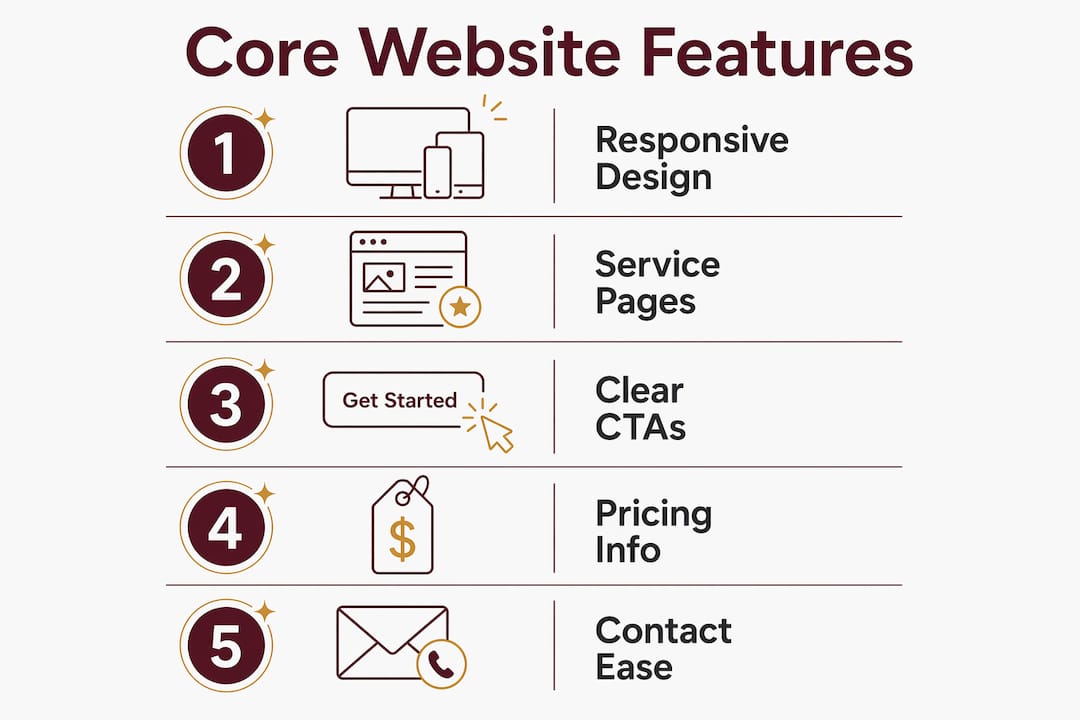
Core features every service website requires

| Feature category | Purpose | Priority |
|---|---|---|
| Service pages | Describe each offer with pricing signals and CTAs | High |
| Contact or booking page | Capture leads directly | High |
| Mobile-first layout | Serve the majority of visitors on phones | High |
| Testimonials or reviews | Build trust before the first call | Medium |
| FAQ sections | Reduce friction and answer objections | Medium |
| About page | Establish credibility and local presence | Medium |
Mobile-first responsive design and 3-click navigation are the two non-negotiable design standards for 2026. If a visitor cannot find your phone number or booking form within three clicks, you will lose them. That rule applies whether you are a landscaper, a bookkeeper, or a cleaning company.
Pro Tip: Write your homepage headline before you touch any design tool. If you cannot explain what you do and who you serve in one sentence, your site will not convert.
How do you create and design your service website step by step?
Step 1: Choose a hosted website builder
Hosted website builders handle maintenance, security, and hosting automatically. That matters because service business owners should spend time on their trade, not on troubleshooting server errors. Hosted platforms let you focus entirely on conversion-driven content instead.
Step 2: Build your homepage around three questions
Your homepage must answer what you do, who you serve, and how fast someone can contact you. Visitors decide within seconds whether to stay or leave. Put your primary service, your service area, and a contact button above the fold. Everything else is secondary.
Step 3: Treat every service page as a lead-generation machine
Service pages that convert include a distinct hero section, pricing context, a short FAQ, and a clear call-to-action. Generic “Services” pages with a bulleted list do not work. A plumber who builds separate pages for drain cleaning, water heater installation, and emergency repairs will capture far more search traffic than one who lists all three under a single heading. Each page targets a specific customer with a specific problem.
Pro Tip: Add a pricing range to every service page, even if it is just “starting from $X.” Visitors who see no pricing signal often assume the service is out of their budget and leave without contacting you.
Step 4: Build a frictionless contact page
Your contact page is where leads are won or lost. Keep it simple: name, phone number, service needed, and a submit button. Every additional field you add reduces the number of people who complete the form. If you offer bookings, embed a calendar tool directly on the page so visitors can act immediately.
Step 5: Focus on clarity over aesthetics
Experts consistently confirm that visitors must grasp what you do, who you serve, and how to reach you within seconds of landing on your site. A visually impressive site that buries the contact button or uses vague language will underperform a plain site with direct copy every time. Your site’s job is to convert website visitors into booked appointments, not to win design awards.
How do you test and launch your service website?
Testing before launch is not optional. A broken contact form or a page that loads slowly on a phone can cost you leads from day one.
Work through this checklist before you publish:
- Navigation test: Click through every page from a phone. Can you reach the contact page in three clicks or fewer?
- Form test: Submit your contact form yourself. Confirm the notification arrives in your inbox.
- Load speed test: Use Google PageSpeed Insights to check your homepage. Slow pages lose visitors before they read a word.
- Mobile display check: View every page on at least two different screen sizes. Text that overlaps or buttons that are too small to tap will cost you leads.
- CTA visibility check: Is your primary call-to-action visible without scrolling on a phone screen?
Common pitfalls before launch include overly complex design, ignoring mobile users, and failing to update content after the site goes live. The third one is the most damaging long-term because a stale site signals to both visitors and search engines that the business is inactive.
Pro Tip: Ask someone unfamiliar with your business to find your contact page on their phone without any guidance. If they struggle, your navigation needs work before you launch.
How do you maintain and grow your service website over time?
A service website is not a one-time project. Regularly updating content such as testimonials, pricing, and FAQs sustains lead generation and keeps your site relevant as customer needs shift. The good news is that hosted builders make these updates straightforward without needing a developer.
Build a simple maintenance routine around these habits:
- Add new testimonials monthly. Fresh reviews signal an active, trusted business to new visitors.
- Review your service pages quarterly. Pricing changes, new services, and seasonal offers should appear on your site promptly.
- Check your analytics monthly. Which pages get the most traffic? Which ones have the highest exit rate? Those numbers tell you where to focus your next update.
- Test new calls-to-action. Swap “Contact us” for “Get a free quote” and measure whether more visitors click. Small copy changes can produce meaningful results.
- Expand your service pages as you grow. Adding a new service area or a new offering? Build a dedicated page for it rather than adding a line to an existing page.
Ongoing content iteration driven by visitor analytics and direct customer feedback is what separates service websites that generate leads consistently from those that plateau after launch. Your lead generation checklist should include a site review at least once per quarter.
How Harvestmoonmktg helps service businesses get more from their websites
Harvestmoonmktg is a full-suite digital marketing agency focused on lead generation for service-based businesses. Building a website is the foundation, but the leads come when that site is paired with the right traffic strategy. Google Ads management is Harvestmoonmktg’s most popular service because it delivers direct, measurable leads to service businesses quickly. For local service businesses, SEO builds long-term visibility in the areas you actually serve. Harvestmoonmktg handles website design and development alongside these traffic channels so your site and your marketing work together from day one. Contact Harvestmoonmktg to find out what a lead-focused website can do for your business.
FAQ
What is the most important element of a service business website?
Clarity is the most critical element. Visitors must understand what you do, who you serve, and how to contact you within seconds of arriving on your site.
How many pages does a service business website need?
A service website needs at minimum a homepage, one dedicated page per core service, a contact or booking page, and an about page. Each service page should function as a standalone lead-generation page.
Should I use a hosted website builder or hire a developer?
Hosted website builders are the right choice for most small service businesses. They handle security and maintenance automatically, letting you focus on content and conversion rather than technical upkeep.
How do I get visitors to my new service website?
Google Ads delivers the fastest results for direct lead generation. Local SEO builds visibility over time for service businesses targeting a specific area. Both strategies work best when your website is already built for conversion.
How often should I update my service website?
Update testimonials and pricing at least quarterly. Check your analytics monthly and adjust pages with high exit rates. Fresh content signals to both visitors and search engines that your business is active.


