
Bid-based advertising is a real-time auction process where advertisers compete for ad impressions by submitting bids, paying based on the auction outcome rather than a fixed rate. Platforms like Google Ads and programmatic networks powered by Demand-Side Platforms (DSPs) run these auctions millions of times per day. Understanding how bid based ads work gives you a direct advantage: you stop guessing at budgets and start making decisions grounded in how the system actually prices your placements.
How does the bid auction process work?
Every bid-based ad placement starts with a single trigger: a user loads a webpage or opens an app. That action sends a bid request into the auction system, carrying data about the user’s location, device, browsing behaviour, and the page context. Supply-Side Platforms (SSPs) package this data and broadcast it to competing DSPs.
Here is the sequence from trigger to ad served:
- Bid request issued. The SSP sends the impression opportunity to multiple DSPs simultaneously.
- DSP evaluation. DSPs evaluate bid requests against targeting rules and campaign goals within milliseconds to decide whether to bid and at what price.
- Bids submitted. Each DSP returns its bid to the SSP or ad exchange.
- Auction clears. The highest qualifying bid wins. The pricing model, either first-price or second-price, determines what the winner actually pays.
- Ad served. The winning creative loads in the placement before the page finishes rendering.
The entire process takes roughly 100–300 milliseconds. That is faster than a human blink.
Pro Tip: If you are running Google Ads, your bid is never evaluated in isolation. Ad Rank, which combines your bid with Quality Score, determines your position. A lower bid with a strong Quality Score can outplace a higher bid with a weak one.

First-price vs. second-price auctions: what is the difference?
The auction model determines what you pay after you win. The two models produce very different cost outcomes, and confusing them leads to wasted spend.
| Feature | Second-Price Auction | First-Price Auction |
|---|---|---|
| What winner pays | Just above the second-highest bid | Exactly their own bid |
| Main platform | Google Ads (modified version) | Programmatic display and video |
| Bidding strategy | Bid your true value | Use bid shading to avoid overpaying |
| Transparency | Lower cost predictability | Higher cost transparency |
| Risk of overpaying | Low | Higher without bid shading |
Google Ads runs a modified second-price auction that incorporates Quality Score, meaning advertisers rarely pay their full maximum bid. This model rewards relevance over raw spend. Second-price auctions encourage advertisers to bid their true value, which simplifies strategy and improves auction efficiency overall.
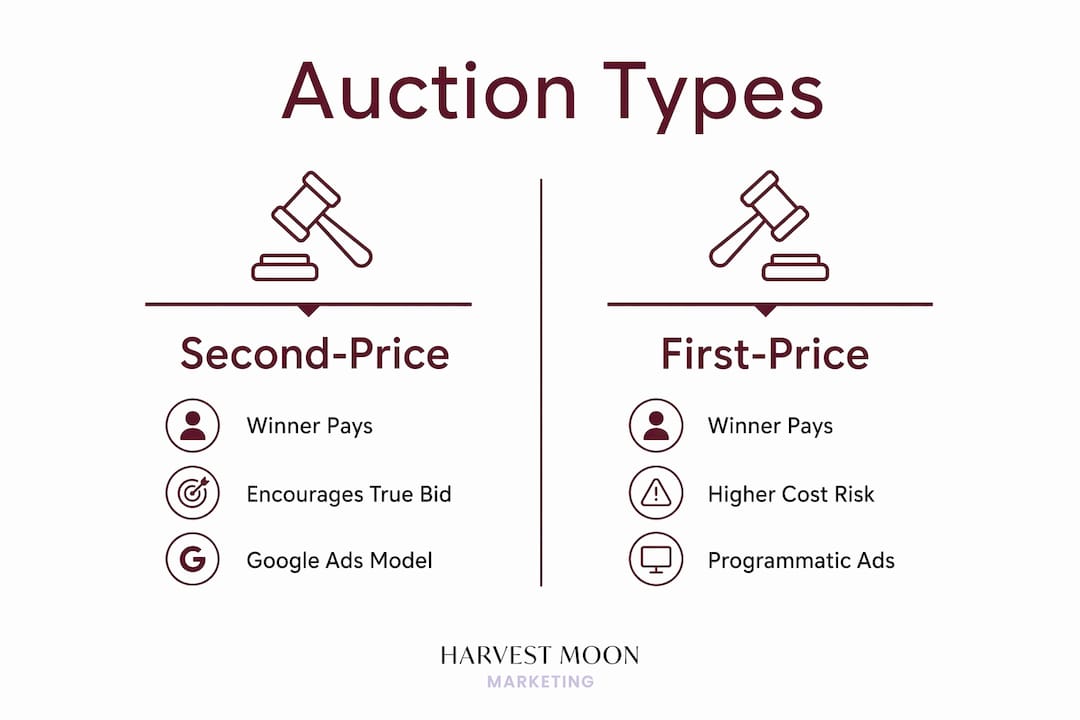
Programmatic display and video advertising tells a different story. First-price auctions now dominate the programmatic landscape, replacing the older second-price model. Google completed its own programmatic transition to first-price auctions in 2019, and the rest of the industry followed. That shift means the strategy that worked five years ago, bidding your true maximum and letting the system sort it out, now costs you more than it should.
Pro Tip: In a first-price environment, never submit your maximum willingness to pay as your actual bid. Use a DSP with bid shading built in, or manually reduce bids by 15–25% and monitor win rates to find your efficient range.
What role do quality scores, floor prices, and bid shading play?
Winning an auction is not purely about who bids the most. Three factors shape outcomes in ways that catch many advertisers off guard.
Quality Score in Google Ads
Ad Rank incorporates bid amount and Quality Score components like landing page relevance and ad experience, meaning higher bids do not always win. A well-structured Google Ads campaign with a high Quality Score can achieve better placement at a lower cost per click than a competitor spending more. This is one of the most underused advantages available to small and mid-sized advertisers.
Publisher Floor Prices
Publishers set floor prices as a minimum CPM to avoid undervaluing their inventory. If your bid falls below the floor, your ad does not serve regardless of whether it is the highest bid in the room. Setting floors too high reduces fill rates for publishers, but for advertisers, floors set a baseline you must clear before your targeting even matters.
Bid Shading
Bid shading algorithms analyse historical auction data, competitor behaviour, and floor prices to submit optimal bids below your maximum in real time. This capability is non-negotiable in first-price auction environments. Without it, you consistently overpay for impressions you could have won at a lower price. Most major DSPs and programmatic advertising platforms now include bid shading as a standard feature, but you need to confirm it is active in your campaigns.
Common pitfalls to avoid:
- Ignoring Quality Score improvements while only raising bids
- Bidding below publisher floor prices and wondering why impressions are low
- Running first-price programmatic campaigns without bid shading enabled
- Setting bids based on gut feel rather than conversion value data
How to use bidding ads effectively in your campaigns
Understanding the mechanics is step one. Applying them to your actual campaigns is where the return on investment comes from. Here is how to put the auction knowledge to work.
-
Anchor bids to conversion value. Calculate what a click or lead is worth to your business before setting a maximum bid. If a new customer is worth $500 and you close one in ten leads, a lead is worth $50. Your bid ceiling follows from that number, not from what competitors appear to be spending.
-
Match bid strategy to campaign goal. Google Ads offers automated strategies like Target CPA (cost per acquisition) and Target ROAS (return on ad spend) that adjust bids in real time using auction signals you cannot manually track. Use manual bidding only when you have limited data or are testing a new campaign structure.
-
Monitor auction insights regularly. Google Ads provides an Auction Insights report showing how your impression share, overlap rate, and position above rate compare to competitors. This data tells you when a competitor has increased their bids and is pushing you down the page.
-
Review Google Ads optimisation tactics regularly. Auction dynamics shift with seasonality, competitor budgets, and platform algorithm updates. A bid strategy that performed well in Q1 may need adjustment by Q3.
-
Avoid the “set and forget” trap. Automated bidding tools are powerful, but they require sufficient conversion data to function well. Campaigns with fewer than 30–50 conversions per month often perform better with manual or enhanced CPC bidding until the data volume builds.
The types of paid advertising available to businesses today all involve some form of auction mechanics. Knowing how the auction works means you spend less time reacting to poor results and more time making deliberate adjustments.
How Harvestmoonmktg helps you win in bid-based advertising
Harvestmoonmktg is a full-suite digital marketing agency that specialises in Google Ads campaign management for service-based businesses focused on direct lead generation. The team builds bid strategies grounded in auction mechanics, not guesswork. That means Quality Score improvements, bid shading awareness, and conversion-anchored bidding from day one. If your current campaigns are burning budget without producing qualified leads, the problem is almost always in the auction strategy. Explore Harvestmoonmktg’s Google Ads services to see how a properly structured campaign performs, or book a call to talk through your specific situation.
FAQ
What are bid-based ads?
Bid-based ads are digital advertisements placed through a real-time auction where advertisers submit bids for the right to show their ad to a specific user. The highest qualifying bid wins the impression, and the winner pays based on the auction model in use.
How does a second-price auction differ from a first-price auction?
In a second-price auction, the winner pays just above the second-highest bid, which rewards bidding your true value. In a first-price auction, the winner pays exactly their submitted bid, making bid shading a necessary tactic to avoid overpaying.
Does a higher bid always win in google ads?
No. Google Ads uses Ad Rank, which combines your bid with Quality Score factors like landing page relevance and ad experience. A lower bid with a strong Quality Score can outrank a higher bid with poor quality.
What is bid shading and do i need it?
Bid shading is an algorithm that reduces your submitted bid below your maximum to avoid overpaying in first-price auctions. It analyses historical data and floor prices to find the lowest bid that still wins. It is a standard requirement for any programmatic display or video campaign running in 2026.
What is a publisher floor price?
A publisher floor price is the minimum CPM a publisher will accept for an impression. Bids below the floor are rejected outright, regardless of how they compare to other bids in the auction.


