
Local search marketing is the practice of promoting your business to nearby customers through both organic search and paid advertising, so your business appears when someone searches for what you offer in your area. It combines local SEO strategies, Google Business Profile management, online reviews, geo-targeted ads, and community engagement into one connected approach. 46% of all Google searches carry local intent. That means nearly half of every search on Google is an opportunity for a local business to be found. If your business is not showing up in those results, you are handing customers to your competitors.
What is local search marketing and how does it differ from traditional SEO?
Local search marketing and traditional SEO share the same foundation: getting your business found on Google. The difference is focus. Traditional SEO targets broad keywords and competes nationally or globally. Local search engine optimisation targets geographic intent, meaning it connects your business to people searching within a specific city, neighbourhood, or region.
Local SEO focuses on geographic intent and local signals rather than broad global keywords. Those signals include Google Maps rankings, the local 3-pack (the three business listings that appear at the top of local search results), local directory listings, and online reviews.

Here is how the two approaches compare:
| Factor | Local search marketing | Traditional SEO |
|---|---|---|
| Geographic focus | Yes, city or region specific | No, broad or national |
| Google Maps ranking | Core priority | Not applicable |
| Review management | Required | Optional |
| Google Business Profile | Central to strategy | Rarely used |
| Local citations and NAP | Required | Not required |
| Keyword targeting | Location-based phrases | Broad or niche terms |
Local search marketing also includes paid tactics. Combining organic local SEO with paid local ads accelerates visibility and generates leads faster than organic alone. Traditional SEO rarely incorporates this local paid layer.
What are the key components of local search marketing?
Local search marketing combines organic SEO with paid ads, geo-targeting, reputation management, and community engagement. Each component plays a specific role in how your business appears and how customers perceive it.
-
Google Business Profile optimisation. Your Google Business Profile is the single most visible asset in local search. Keep your name, address, and phone number accurate. Add photos, post updates regularly, and respond to every review. An incomplete profile signals neglect to both Google and potential customers.
-
Local citations and NAP consistency. NAP stands for Name, Address, and Phone number. Every directory listing, from Yelp to Yellow Pages to your local Chamber of Commerce, must show identical information. Inconsistent NAP confuses search engines and lowers your local rankings.
-
Online review management. Reviews are a direct ranking signal and a trust signal. Ask satisfied customers to leave a Google review after every job. Respond to negative reviews professionally. A business with 50 recent reviews outranks a competitor with 10 old ones.
-
Geo-targeted paid advertising. Google Ads with location targeting puts your business in front of customers the moment they search. This is the fastest path to local leads. Paid ads provide immediate results while organic SEO builds over months.
-
Localised website content and structured data. Create dedicated landing pages for each city or neighbourhood you serve. Add Schema markup so Google can read your location, services, and hours as structured data. Modern local search engines use entity-based indexing, which means your site needs to clearly signal what you do and where you do it.
-
Community engagement. Sponsoring a local hockey tournament or volunteering at a community event builds real-world prominence. Offline efforts like sponsoring local events contribute to Google’s ranking signals by building business prominence.
Pro Tip: Add your service area cities to your Google Business Profile under the “Service areas” section. This tells Google exactly where you operate, even if customers do not come to a physical location.
Why is local search marketing important for small and mid-sized businesses?
Local search marketing is the most direct path between a nearby customer and your business. When someone searches “plumber near me” or “best dentist in Guelph,” they are ready to buy. Showing up at that moment is not a branding exercise. It is a revenue decision.
“Consumers perceive local businesses as those genuinely invested in their community through employment, volunteering, and supporting local causes.” — U.S. Chamber of Commerce
Consumers who see local businesses as community pillars show stronger trust and preference. That trust translates directly into phone calls, booked appointments, and walk-in traffic.
The importance of local search shows up in several concrete ways:
- Foot traffic and phone inquiries. Customers who find you through local search are already in buying mode. They are not browsing. They are deciding.
- Competitive visibility. Appearing in the local 3-pack puts your business above organic results. Most users never scroll past it.
- Trust through reviews. A business with a strong review profile wins the click even when a competitor ranks slightly higher.
- Cost-effective reach. Local SEO targets a specific geography, so your effort and budget go toward the customers most likely to convert.
For small and mid-sized businesses with limited marketing budgets, local search marketing delivers a focused return. You are not competing with national brands for broad keywords. You are competing for the customer two kilometres away who needs what you offer today.
How to build a local search marketing strategy in 2026
A strong local search marketing strategy in 2026 requires both digital precision and real-world presence. AI-powered search tools now analyse entire web presences, including reviews, social signals, and local news, to determine local rankings. A Google Business Profile alone is no longer enough.
-
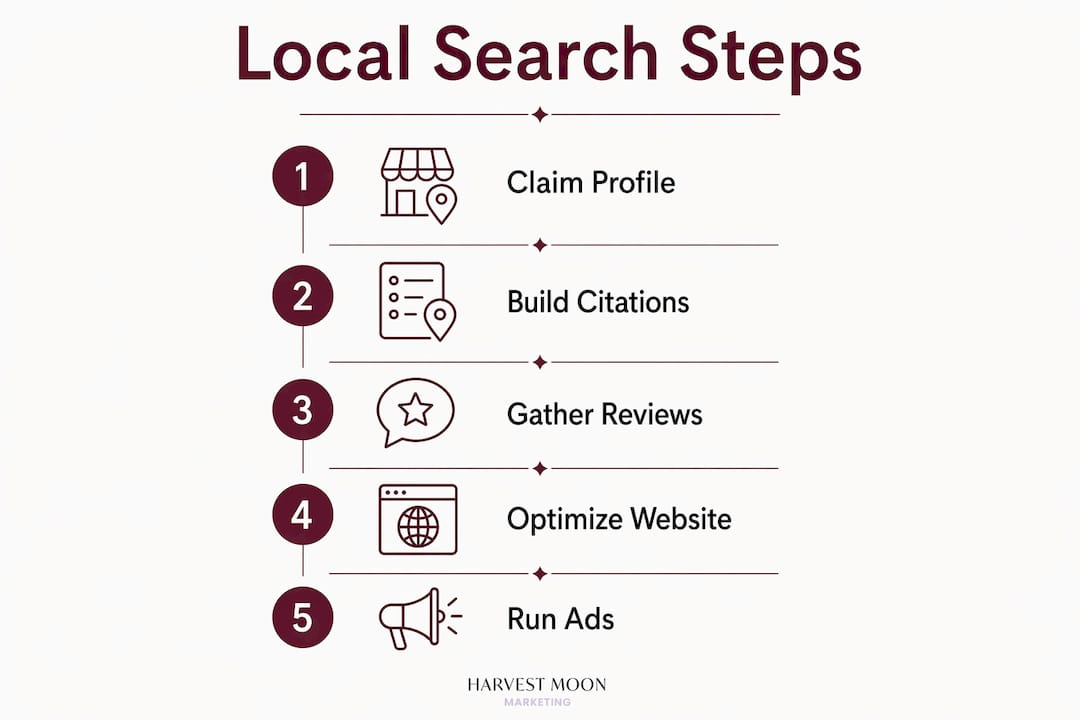
Start with your Google Business Profile. Claim it, verify it, and fill every field. Add your services, hours, photos, and a business description that includes your city and what you do. This is your digital storefront.
-
Build location landing pages. If you serve multiple cities, create a separate page for each one. Include the city name, your services in that area, local testimonials, and an embedded Google Map. Entity-based indexing requires your site to clearly link your business to specific locations and services.
-
Run Google Ads with location targeting. Set your campaigns to show only within your service area. Use call extensions so mobile users can phone you directly from the ad. This is the fastest way to generate local leads while your organic rankings build. Review the local SEO ranking factors that matter most in 2026 to align your organic and paid efforts.
-
Build local citations. Submit your business to Google Business Profile, Yelp, Bing Places, and your local Chamber of Commerce directory. Keep NAP identical across every listing.
-
Engage in your community. Sponsor a local event, partner with a neighbouring business, or volunteer with a local charity. Offline activities build authentic local prominence, which search engines increasingly value as a ranking signal.
-
Monitor and adapt. Track your Google Business Profile insights monthly. Watch which search terms bring visitors to your site. Adjust your content and ad targeting based on what is working.
Pro Tip: Use Google’s free Search Console to see exactly which local search queries are driving traffic to your site. Filter by city name to find gaps in your location-based content.
How Harvestmoonmktg helps local businesses get found
Harvestmoonmktg works with small and mid-sized businesses across Canada to build local search marketing programmes that generate real leads. The agency’s local SEO services cover Google Business Profile management, location landing pages, citation building, and review strategy. For businesses that need leads now, Harvestmoonmktg’s Google Ads management targets customers in your service area at the exact moment they are searching. Both services work together: paid ads deliver immediate inquiries while SEO builds long-term visibility. If you want nearby customers to find your business before they find your competitors, Harvestmoonmktg is worth a conversation.
FAQ
What is local search marketing in simple terms?
Local search marketing is the process of making your business visible to nearby customers when they search on Google or Google Maps. It includes both free tactics like Google Business Profile and paid tactics like Google Ads.
How does local SEO differ from regular SEO?
Local SEO targets customers in a specific geographic area using location-based signals like Google Maps, reviews, and local directories. Regular SEO targets broader keywords without a geographic focus.
How do I optimise for local search?
Start by claiming and completing your Google Business Profile, then build consistent citations across directories, collect customer reviews, and create location-specific pages on your website.
Why does local search marketing matter for small businesses?
46% of Google searches have local intent, meaning nearly half of all searches are from people looking for nearby businesses. Appearing in those results puts your business in front of customers who are ready to buy.
Do I need paid ads for local search marketing?
Paid ads are not required, but they accelerate results. Organic local SEO builds visibility over months, while geo-targeted Google Ads can generate local leads within days of launching a campaign.


