
Most businesses treat social media as a broadcasting tool. Post something, hope people see it, repeat. That approach confuses activity with strategy, and it’s the reason so many brands feel like they’re spinning their wheels online. Understanding what is organic social media, and how it actually works in 2026, is the difference between building a brand people genuinely follow and shouting into a void.
What organic social media means for your brand
The definition of organic social media is straightforward: it is any content you publish on social platforms without paying to distribute it. No ad budget, no sponsored labels. Your posts, stories, Reels, videos, and comments reach audiences purely through platform algorithms, follower relationships, hashtags, and shares.
That definition sounds simple. The reality is more textured.
Organic social media includes a wide spectrum of content types and activities that most businesses do not fully use:
- Standard posts and updates: Text, images, and carousels published to your page or profile
- Stories and short-form video: Instagram Stories, Facebook Stories, LinkedIn video updates
- Long-form and Reels content: Original video created for algorithmic discovery
- User-generated content (UGC): Customer photos, reviews, and testimonials your brand reshares
- Employee advocacy: Team members posting about the business from their personal accounts
- Community interactions: Commenting on others’ posts, replying to DMs, participating in conversations
How organic reach actually happens is worth understanding clearly. When you post, the algorithm first shows your content to a small slice of your existing followers. If those followers engage, comments, saves, shares, watch time, the algorithm interprets that as a signal that the content is worth showing to more people. Followers of your followers may see it. Hashtags and keyword associations can extend it further.
Engagement signals like comments, saves, and watch time directly influence how far your content travels. This is not a passive process. Brands that actively build conversations see measurably better distribution than those that simply publish and disappear.
Pro Tip: The most overlooked organic tactic is employee advocacy. When five employees each share a company post to their personal networks, you’ve multiplied your organic reach without spending a dollar. Start with one or two team members and make it easy for them.
Organic vs. paid social media: key differences
Understanding the difference between organic and paid social media clarifies what each is actually built for. They are not competing approaches. They serve different purposes, and conflating them leads to poor strategy.
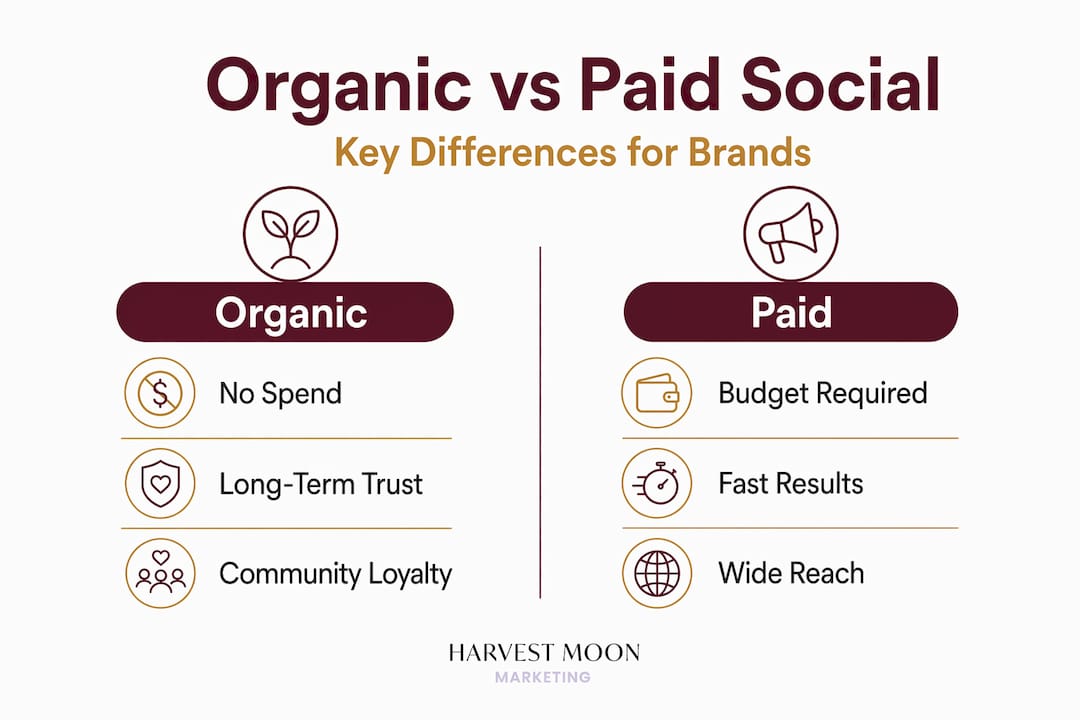
Here is a direct comparison:
| Factor | Organic social media | Paid social media |
|---|---|---|
| Cost | No media spend required | Requires ongoing ad budget |
| Reach | Followers and algorithm distribution | Targeted audiences you define |
| Speed | Slow build over time | Immediate visibility |
| Control | Limited, algorithm-dependent | High, audience and placement control |
| Purpose | Trust, community, long-term loyalty | Direct response, lead generation, scaling |
| Longevity | Content compounds over time | Stops when spend stops |
| Measurement | Engagement, followers, brand sentiment | Clicks, conversions, cost per result |
Organic builds trust and relationships while paid scales reach quickly. Think of organic as the long conversation that turns a stranger into a loyal customer, and paid as the introduction that gets someone to your door in the first place.
A few things businesses consistently misread about this distinction:
- Organic is not free. It costs time, creative effort, and consistent attention. The absence of ad spend does not mean it is without cost.
- Paid does not replace organic. A business with no organic presence running paid campaigns will see weaker results because there is no credibility for visitors to land on.
- Organic content compounds engagement over time, generating sustained interaction well beyond the initial post date. Paid campaigns stop the moment the budget runs out.
Pro Tip: Before you put money behind any post, let it run organically for 48 to 72 hours. If it generates strong engagement on its own, that is a signal worth amplifying. You’re spending budget on something that already has proof of resonance.
Why organic reach keeps declining
If you have noticed your posts reaching fewer people than they did three years ago, you are not imagining it. Organic reach has been contracting across every major platform for years, and the trend has continued into 2026.
The numbers are striking. Facebook’s organic reach fell from 16% of followers in 2012 to roughly 1 to 2% in 2025. Instagram reach dropped 12% between 2024 and 2025. LinkedIn organic reach declined by 34% over the same period. Across the board, platforms are showing your unpaid content to a shrinking share of your own audience.
“Algorithm changes and the prioritisation of paid content are the primary drivers of declining organic reach. Brands need to recalibrate expectations and focus on quality engagement over raw numbers.” — Hootsuite
Why is this happening? Platforms are businesses, and advertising revenue is their core product. More paid placements mean more inventory in the feed, which means less room for organic content. The algorithm also increasingly favours content that keeps users on the platform longer, rewarding video, original storytelling, and content that generates genuine back-and-forth conversation.
| Platform | Organic reach 2012 | Organic reach 2025 |
|---|---|---|
| ~16% of followers | 1 to 2% of followers | |
| High, chronological | Down 12% from 2024 | |
| Strong early | Down 34% from 2024 |
Meta made a significant move in late 2025. The platform began doubling views and watch time for original creators on Facebook Feed and Reels compared to 2024 figures. Content that adds genuine creative value gets rewarded. Content that simply reposts or minimally edits someone else’s work gets deprioritised, and in some cases demonetised.
This shift matters for brands. Repackaging competitor content or reposting viral videos without your own commentary or creative contribution will not move the needle. Original storytelling, your team’s perspective, your customers’ real experiences, your brand’s unique point of view: that is what platforms are paying attention to now.
Organic social media strategies that actually work
The importance of organic social media is not in raw reach. It is in building the kind of audience that actually shows up for your brand, purchases repeatedly, refers others, and forgives the occasional misstep. That kind of relationship requires a different approach than chasing impressions.
Here is a practical framework built on what actually works in 2026:
-
Lead with original content. Your brand’s perspective, your team’s expertise, your customers’ real stories. Platforms reward original creators and deprioritise recycled content. Create it yourself, or work with a partner who understands your brand voice well enough to do it authentically.
-
Prioritise engagement over publishing frequency. Posting twice a week and responding thoughtfully to every comment will outperform posting daily and ignoring replies. The algorithm reads engagement as a quality signal. Treat your comments section as a conversation, not a broadcast log.
-
Build a content programme, not a posting calendar. There is a real difference. A posting calendar tells you when to publish. A content programme tells you what themes, formats, and narratives you will return to consistently over weeks and months. Consistency builds algorithmic trust and audience habit simultaneously.
-
Actively encourage user-generated content. Ask customers to share their experiences. Feature their content. Make them feel seen. UGC functions as social proof and generates organic reach through networks you would never access through your own followers alone.
-
Use employee advocacy intentionally. Equip your team with shareable content and a simple process for posting it. Each team member’s network is an organic distribution channel. A five-person company with active employee advocates can reach more people than a brand page with ten thousand followers.
The benefits of organic social media compound when you treat it as a relationship programme rather than a content treadmill. Long-term brand loyalty and repeat engagement come from consistent, genuine presence, not volume.
Pro Tip: Platform-specific adaptation matters more than it used to. LinkedIn rewards long-form professional insights and employee thought leadership. Instagram and Facebook reward short-form video and Reels with original storytelling. Tailor your content format to the platform’s algorithm preferences, not just its audience.
When organic content proves itself with strong engagement, that is the right time to consider selective paid amplification through Google Ads or other direct-response channels that complement your social presence without replacing the organic relationship you have built.
My honest take on organic social in 2026
I have worked with businesses that obsess over reach numbers and brands that have quietly built loyal, engaged communities with a fraction of the follower count. Every time, the engaged community wins.
In my experience, the biggest mistake brands make with organic social is treating it like a megaphone. They push messaging out and measure success by how many people theoretically saw it. But organic social media is fundamentally about relationships, not broadcasting. The brands that get this right are the ones where a real person shows up in the comments, asks follow-up questions, and makes customers feel like they are talking to someone who actually cares.
What I have learned is that the decline in organic reach is not the crisis it is made out to be. Yes, your posts reach a smaller percentage of followers than they did five years ago. But a smaller engaged audience is worth more than a large passive one. If your content is genuinely original, your engagement is real, and you show up consistently, the algorithm will find ways to distribute your content to people who want it.
The brands I have seen struggle with organic social are almost always the ones trying to shortcut the relationship. They repurpose content without adding any creative value. They post without responding. They chase trends instead of building a distinctive voice. Brands that misjudge organic by focusing on reach instead of engagement rarely build the kind of audience that translates into actual business results.
My view is that organic social works best as part of a broader digital presence alongside SEO for local visibility and email marketing to stay top of mind with people who already know and trust your brand. Organic social introduces and reinforces. Other channels convert and retain. That combination, not any single channel, is how sustainable growth actually happens.
— Harvest
How Harvestmoonmktg can help you build organic presence
At Harvestmoonmktg, we help businesses develop organic social media strategies grounded in original content, real engagement, and platform-specific thinking. We do not believe in generic posting schedules or recycled content. We build programmes tailored to your brand’s voice and your audience’s actual behaviour.
For businesses that want to stay top of mind with customers between social touchpoints, our email marketing services work alongside organic social to create a consistent, trusted presence across channels. Social builds the relationship. Email keeps it warm. Together, they form the kind of digital presence that generates real, long-term value for your business. Reach out to the Harvestmoonmktg team to talk through what that could look like for your brand.
FAQ
What is organic social media?
Organic social media is any content published on social platforms without a paid advertising budget, relying on platform algorithms, follower relationships, and engagement to reach audiences. It includes posts, stories, videos, user-generated content, and community interactions.
What is the difference between organic and paid social media?
Organic social media reaches audiences through algorithms and existing followers at no media cost, while paid social media uses an ad budget to target defined audiences for immediate visibility and direct response outcomes.
Why is organic reach declining on platforms like Facebook and Instagram?
Organic reach has declined significantly due to algorithm changes that prioritise paid content and high-engagement original content. Facebook’s organic reach dropped from 16% in 2012 to roughly 1 to 2% in 2025, with Instagram and LinkedIn showing similar downward trends.
What are the main benefits of organic social media for businesses?
Organic social media builds long-term brand trust, fosters community loyalty, and generates compounding engagement over time. Unlike paid campaigns that stop when the budget runs out, strong organic content continues to generate interaction well after it is published.
How can businesses improve their organic social media reach?
Focus on publishing original, high-value content that adds genuine creative perspective, respond actively to comments and messages, encourage user-generated content and employee advocacy, and build a consistent content programme rather than sporadic posts.


