
Most business owners track followers like a scoreboard. More followers means winning, right? Not quite. Follower count tells you almost nothing about whether your audience actually cares about what you post. Social media engagement — the likes, comments, shares, saves, and direct messages your content receives — is the real signal that separates brands people ignore from brands people trust. This article breaks down why engagement is the metric worth obsessing over, how platforms use it to decide who sees your content, and what you can practically do to build something that lasts.
Why social media engagement matters more than followers
Before getting into strategy, it helps to understand what engagement actually is. Active audience participation includes every deliberate action a person takes in response to your content: a like, a comment, a share, a save, clicking a link, tagging you in a post, or sending a direct message. Each of these actions signals something different, and together they paint a picture of how deeply your content connects with the people seeing it.
Follower count, by contrast, is a static number. It tells you how many people once chose to follow you. It says nothing about whether those people are still paying attention, whether they trust you, or whether they would ever spend money with you.
The importance of social media engagement becomes clearest when you look at how platforms actually distribute content. Algorithms on Instagram, Facebook, LinkedIn, and TikTok do not give equal visibility to every post. They actively reward content that generates strong engagement signals by pushing it to more people. Think of it as a feedback loop: high engagement means more reach, more reach brings new potential followers, and new followers bring the possibility of even more engagement.
Instagram head Adam Mosseri confirmed this directly. Likes and shares carry different algorithmic weight depending on who is seeing the content. Likes influence visibility with people who already follow you. Shares, on the other hand, are what push your content to people who have never heard of you. That distinction matters enormously if you are trying to grow.
- Likes: Reinforce content with your existing audience
- Comments: Signal deep interest and trigger conversations
- Shares/reposts: Extend your content to unconnected audiences
- Saves: Tell the platform your content has lasting value
- Direct messages: Indicate the highest level of personal interest
- Mentions and tags: Generate organic word-of-mouth exposure
Pro Tip: Don’t chase total engagement numbers blindly. Track which engagement types are growing. If your shares are climbing, you are reaching new audiences. If saves are up, you are producing reference-worthy content. Both are strong signals, but they point to different business outcomes.
The real business benefits of social media interaction
Once you understand that engagement drives distribution, the downstream benefits for your business become much clearer. The impact of engagement on social media goes far beyond the platform itself.

Organic reach that compounds over time
Every time someone shares or comments on your content, their network sees it. This is organic amplification you do not pay for. Engagement drives compounding distribution in a way that raw impressions simply do not. A post with 10,000 impressions and 5 comments has far less momentum than a post with 2,000 impressions and 80 comments.
Trust that advertising cannot buy
Here is a number worth sitting with: 71% of consumers say what people say about a brand matters more than what the brand says in its own advertising. Social media engagement is where those peer conversations happen in public. A post full of genuine, positive comments is social proof that no paid promotion can replicate. It tells a prospective customer that real people have had real experiences with your brand, and they thought it was worth talking about.
Brand loyalty built through two-way conversation
Authentic two-way communication turns passive followers into advocates. When you respond to a comment thoughtfully, or acknowledge a customer’s question in public, you are not just serving that one person. Everyone who sees that interaction learns something about how you treat people. That kind of consistent behaviour builds loyalty at scale, and loyalty is what creates repeat business and referrals.
Customer intelligence you cannot get from surveys
Your audience’s comments, questions, and reactions are a live data feed of what they care about. What are they confused by? What language do they use to describe their problems? What content makes them want to share? You get none of this from follower counts or impressions.
“Visibility without meaningful interaction won’t build loyalty. Engagement is a customer experience capability, not just a metric.” Sprinklr Social Index, 2026
That quote reframes the entire conversation. Social media engagement is not a marketing function sitting off to the side. It is part of how your customers experience your brand.
Understanding engagement types and their marketing impact
Not all engagement actions carry the same weight, and treating them as interchangeable is a mistake many marketers make early on. The reasons to prioritise social media engagement differently by type come down to what each action actually signals about your audience and your content.
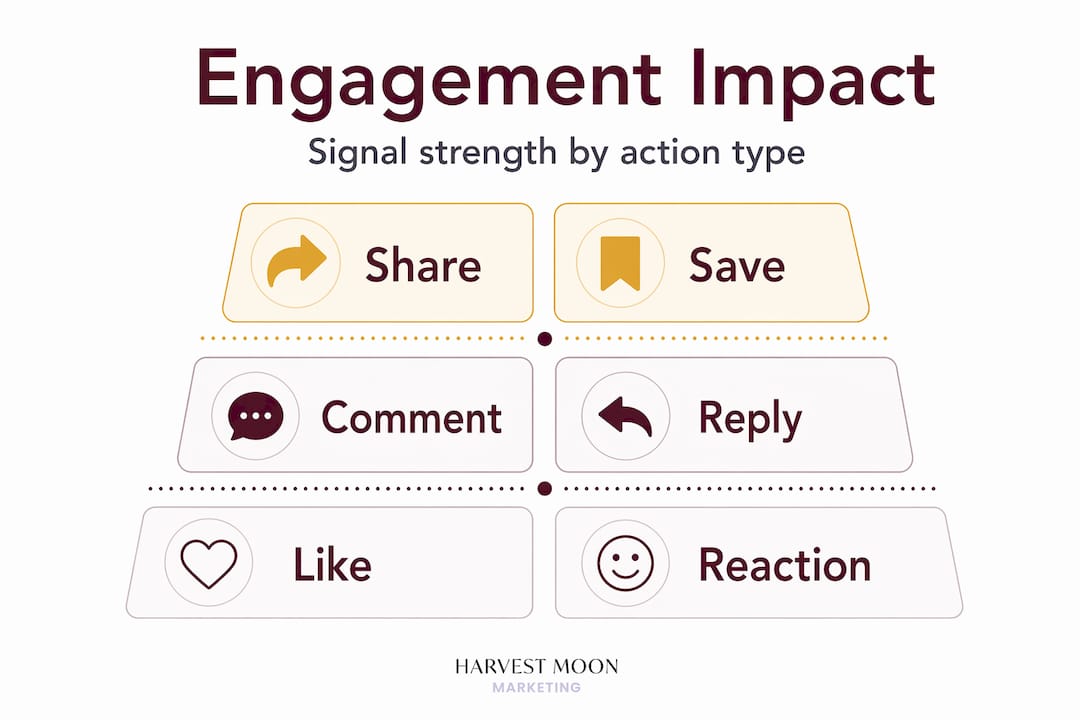
| Engagement type | What it signals | Primary marketing impact |
|---|---|---|
| Like / reaction | Low-effort approval | Reinforces content with existing followers |
| Comment | Active interest, question, or opinion | Builds community; triggers further algorithmic distribution |
| Share / repost | Content deemed valuable enough to pass on | Expands reach to unconnected audiences |
| Save | High-value content worth revisiting | Signals lasting relevance; boosts algorithmic favourability |
| Click (link) | Intent to learn or act | Drives traffic; signals purchase or decision intent |
| Direct message | Deep personal interest or query | Highest-quality lead signal; indicates relationship potential |
| Mention / tag | Organic word-of-mouth | Brand awareness with no production cost |
Instagram’s algorithm explicitly uses these signals differently depending on whether the content is being served to followers or non-followers. Shares and saves carry the most weight for reaching new audiences. Likes and comments carry more weight for keeping your existing audience engaged. If you want to grow, you optimise for shares. If you want to retain and deepen relationships, you optimise for comments and replies.
This is also why social media engagement metrics should never be reduced to a single rate. Reviewing which types of engagement are growing tells you whether your strategy is working for the goal you actually have.
Pro Tip: Set up a simple monthly review of your top five posts by engagement type, not by total likes. A post with 200 saves and 30 shares will outperform a post with 500 likes over time. Let the data tell you what your audience genuinely values.
Practical engagement strategies that actually work
Understanding the theory is useful. Applying it is where growth actually happens. These social media engagement strategies are grounded in what consistently works for businesses, not just content creators.
-
Ask specific questions, not open-ended ones. “What do you think?” gets ignored. “Which of these two approaches have you tried?” gets answered. The more specific your question, the lower the barrier to respond.
-
Reply to every comment, especially early. The first hour after posting is when platforms decide whether your content deserves wider distribution. Responding quickly to early comments signals active engagement and increases the post’s visibility. Speed matters here.
-
Use your comments and DMs as a content brief. If the same question comes up three times in your comments, that is a future post. Your audience is literally telling you what they need. Engagement as a diagnostic tool means treating your comment section like a focus group.
-
Encourage user-generated content deliberately. Feature customers, share their posts with credit, and create conditions where your audience wants to tag you. UGC generates trust with new audiences because it comes from peers, not the brand.
-
Respond to criticism with the same care as praise. How you handle a complaint in public tells your audience far more about your brand values than any marketing copy. A measured, helpful response to a frustrated customer is one of the highest-value pieces of content you will ever produce.
-
Prioritise content that has a strong reason to be shared. Social proof strategies that centre on your community tend to outperform purely promotional content by a significant margin. Shares happen when someone feels your content reflects positively on them or helps someone they know.
For businesses looking to build a clear plan around authentic audience interaction, Harvestmoonmktg’s social media approach is a useful starting point.
Pro Tip: Do not try to be everywhere. Pick one or two platforms where your audience is most active and engage deeply there. A brand with genuine community on LinkedIn and Instagram will consistently outperform a brand with a hollow presence across five platforms.
What I’ve learned watching businesses get this wrong
I’ve seen a lot of businesses pour real money into growing their follower count and then wonder why nothing converts. The numbers look good on a report. The reality is that they have built an audience that was never actually interested.
The uncomfortable truth is that most social media underperformance comes from treating platforms as a broadcast channel. Post content, wait for results, post more content. There is no dialogue, no responsiveness, no sense that a real person is on the other side. Visibility without interaction does not build the kind of trust that changes purchase behaviour.
What I have seen work, consistently, is businesses that treat their social media presence the same way they treat a customer service conversation. Fast responses. Genuine answers. A willingness to be a bit human. The brand that replies to a comment at 8pm on a Tuesday builds more loyalty in that single moment than a month of polished posts.
I also think people underestimate how much engagement tells you about whether your broader marketing is working. If your posts about a new service generate only likes, but your educational posts about customer problems generate saves and shares, your audience is telling you what kind of brand relationship they want. That intelligence should shape your email marketing, your website copy, and how you improve user engagement across every channel.
Social media is not where most service businesses close deals. But it is absolutely where trust is built or lost, and trust is the prerequisite for every sale that follows.
— Harvest
How Harvestmoonmktg helps you build real engagement
Building genuine audience relationships on social media takes consistency, strategy, and a clear understanding of which metrics actually move your business forward. At Harvestmoonmktg, we work with business owners and marketers to develop social media approaches that connect meaningfully with their audience, not just accumulate followers. Our social media services are built around engagement that complements your broader marketing mix, whether that includes email marketing to stay top of mind with existing customers or Google Ads for direct lead generation. If you want a strategy built around your specific goals, book a call with our team.
FAQ
What counts as social media engagement?
Social media engagement includes any deliberate audience interaction with your content: likes, comments, shares, saves, clicks, mentions, and direct messages. These actions collectively signal content relevance and community health more accurately than follower count alone.
Why does engagement matter more than follower count?
Engagement reflects active interest from real people, while follower count is a passive, historical number. Platforms like Instagram algorithmically reward high engagement by distributing content to larger audiences, meaning engagement directly affects your reach and visibility.
Which type of engagement has the biggest impact on reach?
Shares and saves carry the most weight for expanding reach to new, unconnected audiences. According to Instagram head Adam Mosseri, likes primarily influence visibility with existing followers, while shares are what push content beyond your current community.
How often should businesses respond to comments?
Responding within the first hour of posting has the greatest algorithmic benefit, as early engagement signals prompt platforms to distribute content more broadly. Beyond that, consistent responsiveness builds trust and loyalty with your existing audience over time.
Can social media engagement help with brand loyalty?
Yes. Research from Emplifi confirms that authentic two-way communication through social media transforms passive followers into advocates, and the Sprinklr Social Index notes that engagement functions as a customer experience capability that directly influences long-term loyalty.


