
A home services ad is advertising content created specifically for local home-service businesses to generate immediate leads by connecting with customers who are actively searching for services like plumbing, electrical work, or HVAC repair. Google’s Local Services Ads (LSAs) are the dominant format in this category, appearing at the top of search results for location-based queries like “plumber near me.” Unlike traditional pay-per-click campaigns, these ads use a pay-per-lead model, meaning you only pay when a customer contacts your business directly through the ad. For home service business owners and marketers, understanding how these ads work is the difference between a calendar full of booked jobs and a marketing budget that quietly drains away.
What is a home services ad and how does it generate leads?
Home services advertising through Google LSAs works by placing your business in front of customers at the exact moment they need help. These ads sit above organic results and above traditional PPC listings, capturing the highest-intent traffic on the page. A homeowner searching for an emergency electrician at 9 p.m. is not browsing. They are ready to hire. That placement captures that urgency directly.

The pay-per-lead model is what separates LSAs from nearly every other form of online advertising. You pay only when a customer calls, messages, or books through the ad. This means your budget is tied directly to actual customer contacts, not to clicks that may or may not convert. Google’s own guidance confirms that LSAs simplify lead generation by aligning cost with contact, which reduces wasted spend on non-converting traffic.
Each ad displays a specific set of information to the customer:
- Business name and service category
- Hours of operation and service area
- Customer star ratings and number of reviews
- The Google Guaranteed or Licence Verified badge
This combination of detail and trust signals is what drives a customer to choose your business over a competitor listed just below. The Google Guaranteed badge signals that your business has passed background and licensing checks, and it backs that up with homeowner reimbursement coverage up to $2,000. That is a meaningful commitment that increases consumer confidence and conversion rates.
Pro Tip: Respond to every lead within minutes, not hours. Google’s algorithm factors your responsiveness directly into how often your ad is shown. A slow response rate lowers your visibility even if your budget is generous.
How do home services ads differ from traditional online ads?
The operational difference between LSAs and traditional Google Ads is significant enough to change how you staff and manage your business, not just your marketing.
| Feature | Home services ads (LSAs) | Traditional Google Ads (PPC) |
|---|---|---|
| Payment model | Pay per lead (call, message, booking) | Pay per click |
| Ad management | No keyword bidding or ad copy required | Requires keyword research and copy writing |
| Visibility factor | Based on verification and responsiveness | Based on bid amount and Quality Score |
| Trust signals | Google Guaranteed or Licence Verified badge | None built in |
| Lead quality | Higher intent, direct contact | Variable, depends on landing page |
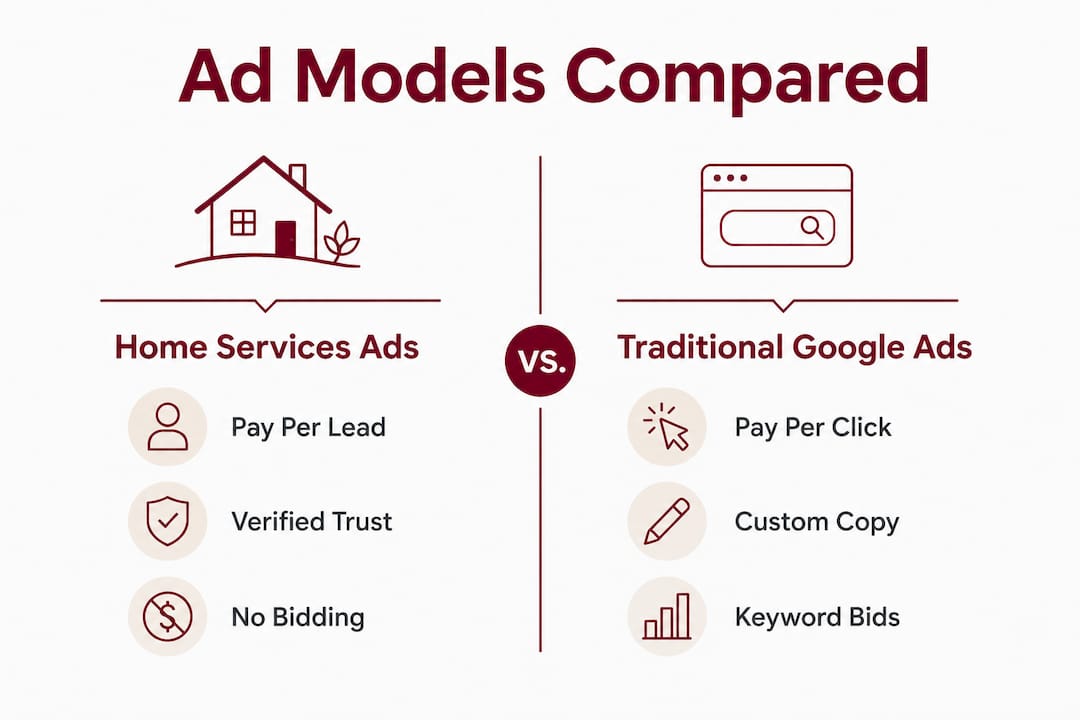
Traditional PPC campaigns give you more creative control. You write the ad copy, select keywords, and manage bids. That flexibility is valuable for brand-building and broader awareness campaigns. LSAs trade that control for simplicity and a direct connection to lead volume. Visibility in LSAs depends on Google’s verification of your business and how quickly you respond to incoming leads, not on how well you write ad copy or how aggressively you bid.
For most home service businesses, LSAs produce higher-quality leads because the customer has already seen your ratings, your service area, and your trust badge before they contact you. They are not clicking out of curiosity. They are reaching out because they are ready to book.
Pro Tip: Run LSAs and traditional Google Ads simultaneously rather than choosing one. LSAs capture immediate high-intent leads while PPC campaigns can target broader service terms and build brand recognition over time. The two formats complement each other well.
Best practices for creating and managing effective home services ads
Getting your LSA set up correctly from the start prevents wasted spend and missed leads. Follow these steps to build a strong foundation.
-
Set accurate service categories. Google matches your ad to searches based on the service categories you select. Choosing too broadly wastes budget on irrelevant leads. Choosing too narrowly limits your reach. Select only the categories that reflect the work you actually do and want to book.
-
Define your service area precisely. Your ads will show to customers within the geographic area you set. If you serve specific cities or postal codes, define them clearly. Showing your ad to customers outside your travel range generates leads you cannot fulfil.
-
Keep business hours current. LSAs display your hours directly in the ad. If a customer contacts you during hours you have listed as open and no one answers, Google registers that as a missed lead. Missed leads hurt your ad ranking.
-
Respond to every lead immediately. Operational responsiveness is the single most important factor in LSA performance. Google rewards businesses that respond quickly with higher placement. This is not a marketing task. It is an operational one.
-
Dispute invalid leads promptly. If you receive a lead that is outside your service area, for a service you do not offer, or is clearly spam, dispute it through the LSA dashboard. Google reviews disputes and credits valid ones back to your account.
-
Monitor your lead feedback regularly. Review the leads you receive each week. Identify patterns in the types of jobs coming in and adjust your service categories or area if the quality is consistently off-target.
Effective home service ad campaigns are not set-and-forget. The businesses that see the best results treat their LSA dashboard the same way they treat their dispatch board. Regular attention to lead quality and response speed compounds over time into lower cost per booked job.
Home service ad examples that actually work
The most effective home services advertising strategies share a few consistent characteristics, regardless of the trade or service category.
- Plumbing and HVAC companies using LSAs in urban markets report that the Google Guaranteed badge alone increases call volume because customers trust the verification. A plumber in a competitive city who displays that badge stands out immediately against unlicensed competitors.
- Electrical contractors benefit from the urgency-driven nature of LSA placement. When someone searches “electrician near me” after a breaker trips, the first result they see with a verified badge and strong ratings wins the call. Smart targeting and clear trust signals are what separate booked jobs from budget drains.
- Landscaping and cleaning businesses use LSAs to fill seasonal gaps by adjusting their service area and hours during peak periods, then pulling back during slower months to control spend.
- General contractors combine LSAs with local SEO efforts to dominate both the paid and organic sections of local search results, creating multiple points of contact for customers at different stages of their decision.
The common thread across all of these examples is that the ad itself is only part of the equation. The business behind the ad must be ready to answer, respond, and book. The Google Guaranteed badge and strong customer ratings are built through real service delivery, not marketing tactics alone.
What I’ve learned about home services ads after working with contractors
After working with home service businesses across multiple trades, the pattern I see most often is this: a business sets up their LSAs correctly, gets verified, and then loses ground within a few weeks because their operations cannot keep up with the leads. The phone rings during a job, no one answers, and Google quietly drops their ranking. The marketing worked. The business was not ready for it.
The second thing I have observed is that best-performing advertisers do not rely on LSAs alone. They use LSAs for immediate lead volume, PPC for broader visibility, and SEO to build long-term authority in their local market. Each channel serves a different purpose, and together they lower the overall cost per booked job significantly. Treating LSAs as a standalone solution is a common mistake that limits results.
The businesses I have seen succeed with home services advertising treat their ad performance as an operational metric, not just a marketing one. Response time, lead quality, and review volume are tracked the same way job completion rates are tracked. That discipline is what separates the contractors who consistently fill their calendars from those who cycle through marketing agencies looking for a fix.
— Harvest
How Harvestmoonmktg helps home service businesses get more leads
Harvestmoonmktg works with home service businesses to build and manage Google Ads campaigns that generate real, bookable leads. From LSA setup and verification to full PPC campaign management, the focus is always on cost per lead and calendar fill rate, not vanity metrics. For businesses that want to stay top of mind with existing customers between jobs, email marketing rounds out the strategy by keeping your name in front of past clients when they need you again. If you are ready to stop guessing and start booking, explore the full range of marketing services built specifically for home service companies.
FAQ
What is a home services ad?
A home services ad is a targeted online advertisement designed to generate local leads for home-service businesses by connecting them with customers searching for immediate help. Google’s Local Services Ads are the most widely used format, appearing at the top of search results above organic and traditional PPC listings.
How does the pay-per-lead model work in LSAs?
With Google Local Services Ads, you pay only when a customer contacts your business through the ad via a call, message, or booking. This means your spend is tied directly to actual customer contacts rather than clicks that may not convert.
What is the Google Guaranteed badge?
The Google Guaranteed badge indicates that a business has passed Google’s background and licensing checks. It also provides homeowner reimbursement coverage up to $2,000, which increases customer confidence and drives higher contact rates from ads.
How are LSAs different from regular Google Ads?
LSAs use a pay-per-lead model and require no keyword bidding or ad copywriting. Visibility is determined by your verification status and responsiveness, whereas traditional Google Ads rely on bid amounts, keyword selection, and Quality Score.
How can I improve my home services ad performance?
Respond to every lead as quickly as possible, keep your service categories and hours accurate, and dispute invalid leads promptly. Operational responsiveness is the primary factor Google uses to determine how often your ad is shown.


