
Converting website visitors to leads is the process of turning anonymous traffic into identifiable, contactable prospects through deliberate engagement and optimised user journeys. For service businesses, this is the most measurable checkpoint in your entire marketing funnel. Traffic without conversion is just noise. The visitor-to-lead rate tells you whether your website is doing its job or quietly losing revenue every day. Tools like HubSpot’s conversion funnel framework, Baymard Institute’s form research, and live chat platforms all point to the same truth: most service websites leave significant lead volume on the table through fixable, structural problems.
What does it take to convert website visitors to leads?
Before you can turn visitors into customers, you need three things in place: a clear picture of who your visitor is, the right tools to capture their interest, and a system to qualify what you capture.
Buyer personas and visitor intent are the starting point. A visitor searching “emergency plumber near me” has different intent than one browsing “how to maintain my HVAC system.” Designing the same landing page for both is a conversion killer. Mapping your personas to specific pages and offers is what separates a website that generates leads from one that generates pageviews.
The core tools every service business needs are:
- Optimised landing pages with a single, focused call to action
- Short, validated contact forms that ask only for what you need
- Live chat or callback widgets to capture visitors who won’t fill out a form
- Lead magnets such as free estimates, checklists, or guides that exchange value for contact details
Tracking and lead scoring complete the picture. Tracking funnel steps from visitor to lead, lead to marketing-qualified lead, and marketing-qualified lead to sales-qualified lead helps you pinpoint exactly where prospects drop off. For service businesses with longer sales cycles, this diagnostic capability is not optional. It is how you find the leak.
| Element | Purpose | Key detail |
|---|---|---|
| Buyer persona map | Aligns content to visitor intent | Segment by service type and urgency |
| Optimised landing page | Focuses visitor action | One CTA per page |
| Contact form | Captures lead data | Three to five fields maximum |
| Live chat widget | Reduces friction for hesitant visitors | Respond within 60 seconds |
| Lead scoring system | Qualifies and routes leads | Score by behaviour and fit |
Pro Tip: Build a separate landing page for each core service you offer. A single “Contact Us” page forces visitors to self-identify, and most won’t bother.
How to design a funnel that matches buyer intent stages
The lead funnel stages that reliably convert visitors into leads follow three phases: awareness (TOFU), consideration (MOFU), and decision (BOFU). Each phase requires a different type of content and a different type of ask.
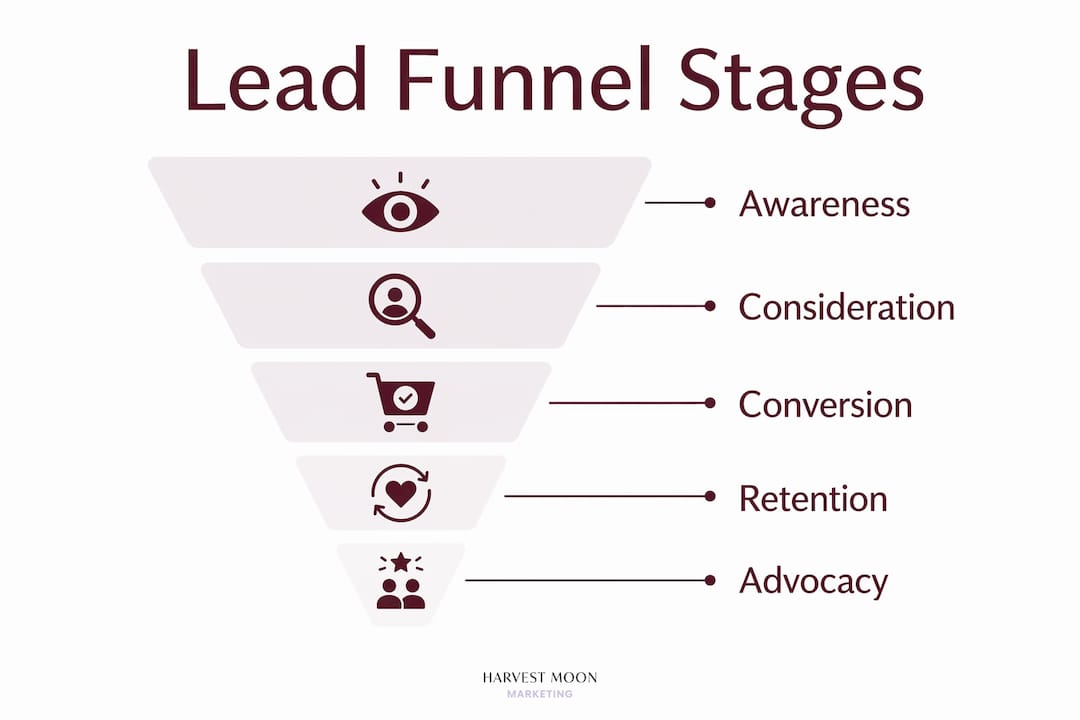
At the awareness stage, visitors are problem-aware but not solution-aware. Blog posts, local SEO content, and educational guides work here. The goal is not to sell. It is to establish credibility and capture an email address or a micro-conversion like a guide download. A well-crafted lead magnet for your service business is one of the most cost-effective tools at this stage.
At the consideration stage, visitors are comparing options. This is where case studies, comparison pages, and free consultation offers perform. Your call to action shifts from “learn more” to “see how we helped a business like yours.” Testimonials and real client results belong here, placed above the fold where they are seen before a visitor decides to scroll or leave.
At the decision stage, visitors are ready to act. Friction is your only enemy. A phone number that is easy to find, a form with three fields, and a clear statement of what happens next after submission are the only things standing between you and a new lead.
The critical mistake most service businesses make is treating the funnel as linear. Real buyers loop back. Someone who downloaded your guide six weeks ago may return ready to book. High-performing lead systems integrate routing rules with lead scoring and timing logic so that returning visitors are recognised and served the right offer at the right moment.
- Map each service page to a specific funnel stage
- Use behavioural signals (pages visited, time on site, return visits) to adjust the offer
- Set up automated follow-up for leads who do not convert on first contact
- Review digital marketing metrics monthly to identify stage-level drop-off
Pro Tip: Add a “What happens next?” section directly below your contact form. Visitors who know what to expect after submitting are significantly more likely to complete the form.
How to optimise your website to increase lead conversion rates
Conversion rate optimisation (CRO) is a measurement-driven process that refines content, user experience, and workflows to increase the percentage of visitors who take action. It does not require a full website redesign. The highest-impact changes are almost always small and structural.
Landing pages should do one thing: convert. Remove navigation menus from dedicated landing pages. State the benefit in the headline, not the feature. Load speed matters more than most business owners realise. A slow page loses leads before they even read your offer.

Forms are where most conversions are lost. The Baymard Institute finds that average online forms contain 40% more fields than necessary. Cut your form to name, phone or email, and one qualifying question. Multi-step forms, where you ask one question at a time, consistently outperform single-page forms for service businesses because they reduce the perceived effort of completing them.
Live chat is no longer a nice-to-have. 44% of online consumers say live chat access during a purchase decision is one of the most important website features. For service businesses where a visitor may have a specific question before committing, live chat captures leads that a form never would. 79% of businesses report positive impacts on sales and customer loyalty from live chat implementation.
Trust signals placed above the fold, including client logos, photo testimonials, security badges, and real project numbers, reduce visitor hesitation and increase form submissions. Generic stock photography does the opposite.
| Conversion lever | Impact level | Implementation effort |
|---|---|---|
| Shorten contact form fields | High | Low |
| Add live chat widget | High | Low to medium |
| Remove navigation from landing pages | Medium | Low |
| Add trust signals above the fold | High | Low |
| Implement multi-step forms | Medium | Medium |
| Run A/B tests on headlines and CTAs | High | Medium |
Pro Tip: Use lead funnel automation to route high-intent leads directly to a sales rep within minutes of submission. Speed of follow-up is one of the strongest predictors of lead conversion in service businesses.
What mistakes are killing your visitor-to-lead conversions?
The biggest impediment to converting visitors is optimising for traffic volume rather than intent-based engagement. More visitors do not fix a broken conversion process. They amplify it.
The most common blockers that service businesses overlook are:
- Hidden contact information. If your phone number is not visible in the header on mobile, you are losing leads to the competitor whose number is.
- Vague messaging. “We provide quality solutions” tells a visitor nothing. “We install and service commercial HVAC systems across the Greater Toronto Area” tells them everything they need to decide.
- No pricing context. You do not need to publish exact rates. A “starting from” figure or a “request a free estimate” offer removes the uncertainty that stops visitors from enquiring.
- Scattered or missing CTAs. Every page needs one primary call to action. If a visitor has to decide between three different buttons, they often choose none.
- Broken tracking. If your Google Analytics or CRM is not correctly recording form submissions, you are making decisions based on incomplete data.
Pro Tip: Audit your website on a mobile device once a month. Most conversion problems, including hidden phone numbers, broken forms, and slow load times, are only visible on mobile.
What I’ve learned about conversion after years of working with service businesses
The most common conversation I have with new clients at Harvestmoonmktg goes like this: they are running Google Ads, getting traffic, and wondering why the phone is not ringing. Nine times out of ten, the traffic is fine. The website is the problem.
What I have found is that service businesses consistently underestimate the gap between “someone visited my site” and “someone trusted me enough to submit their information.” That gap is not closed by more traffic. It is closed by removing every possible reason for a visitor to hesitate. That means faster pages, shorter forms, clearer messaging, and a phone number that is impossible to miss.
The other thing I have learned is that marketing and sales teams need to agree on what a “lead” actually means before optimising for one. I have seen businesses celebrate a 200% increase in form submissions, only to discover that half were spam and the other half were too early in the buying process to convert. Defining a qualified lead first, then designing your funnel around that definition, is what separates businesses that grow from those that just get busier.
— Harvest
How Harvestmoonmktg helps service businesses generate more leads
If your website is getting traffic but not generating enquiries, the strategies in this article are your starting point. Harvestmoonmktg works with service businesses across Canada to build lead generation systems that actually convert. Our Google Ads management drives high-intent traffic directly to optimised landing pages, while our email marketing service keeps your business top of mind for prospects who are not ready to buy today. For a full picture of how we approach lead generation for service businesses, explore our full services offering or get in touch for a personalised assessment of your current funnel.
FAQ
What is a good visitor-to-lead conversion rate for service businesses?
Most service business websites convert between 2% and 5% of visitors into leads, with well-optimised landing pages reaching 10% or higher. The rate varies significantly by traffic source, with paid search typically outperforming organic traffic because of higher visitor intent.
How do I capture leads from visitors who don’t fill out a form?
Live chat and callback widgets capture visitors who have questions before committing. 44% of consumers rate live chat as one of the most important features during a purchase decision, making it a direct alternative to form-based lead capture.
How many fields should a lead generation form have?
Three to five fields is the standard for service business contact forms. Research from the Baymard Institute shows that average forms carry 40% more fields than necessary, and reducing them directly improves completion rates.
What is the difference between CRO and SEO for lead generation?
SEO increases the volume of visitors arriving at your site, while CRO improves the percentage of those visitors who become leads. Both matter, but CRO focuses on reducing friction at key steps rather than increasing traffic, making it the faster path to more leads from your existing audience.
Why is my website getting traffic but not generating leads?
The most common causes are vague messaging, hidden contact information, slow page load times, and forms with too many fields. Conversion blockers like these can be fixed without a full redesign and often produce immediate improvements in lead volume.


