
Social media algorithms are automated ranking systems that score and sort content to personalise each user’s feed based on predicted engagement and behaviour. Platforms like Instagram, TikTok, Facebook, and LinkedIn each run their own version of this system, and every post you publish is evaluated by it before a single person sees it. For digital marketers and small business owners, understanding social media algorithms is not optional. It is the foundation of every organic content decision you make.
How social media algorithms work: the four-stage process
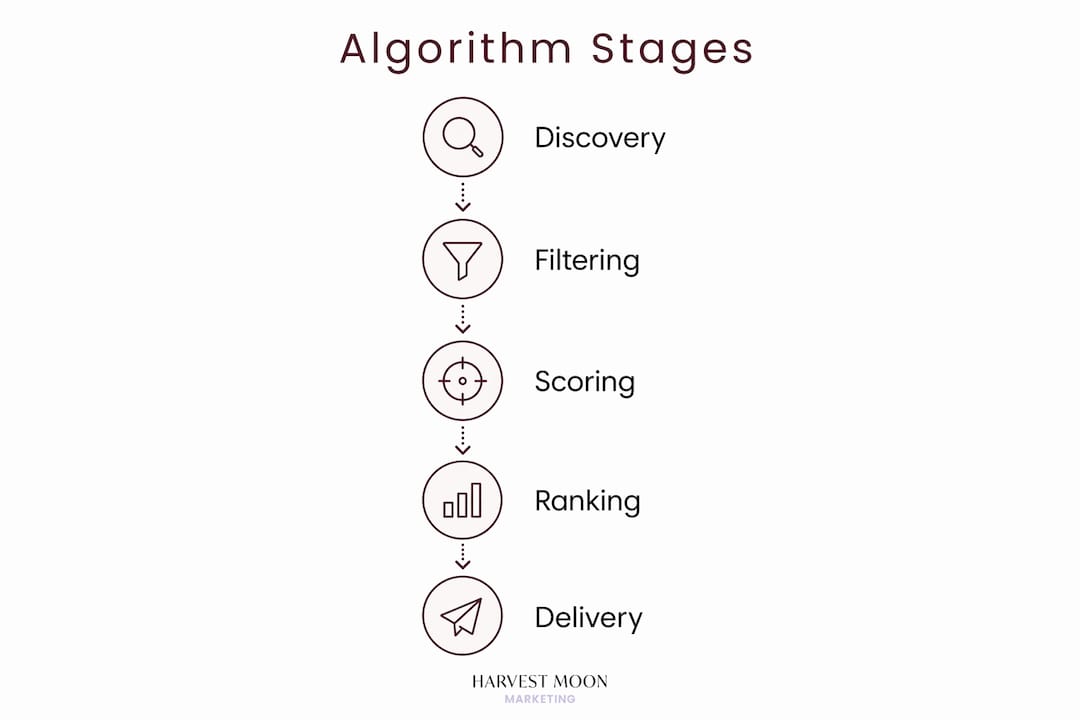
Every major platform runs content through a structured ranking process before anything appears in a user’s feed. Algorithms process roughly 500 posts per session, filtering and ranking them within milliseconds. That speed and scale means your content is competing against hundreds of others every time someone opens an app.
The four stages work like this:
- Candidate pool gathering. The algorithm pulls a pool of roughly 500 posts from accounts you follow, ads, and recommended content.
- Violation filtering. Content that breaks community guidelines or platform policies is removed before scoring begins.
- Engagement scoring. Machine learning models predict immediate engagement probability for each post, using hundreds of behavioural signals. No human editor is involved.
- Personalised ranking. Posts are ordered by score and delivered to the feed in a sequence designed to maximise time on platform.
Each stage narrows the field. By the time content reaches a user, it has already been evaluated against their specific history, preferences, and relationship with the creator.
Pro Tip: Map your content calendar to this four-stage process. If your posts consistently fail at the scoring stage, the problem is usually low early engagement, not content quality. Focus on the first 30 minutes after posting.

What are the key ranking signals algorithms use?
Ranking signals are the data points algorithms use to score content. Dwell time impacts ranking even when no interaction occurs. A user who stops scrolling to read your caption sends a positive signal, even if they never tap a button.
The most influential signals across platforms include:
- Engagement metrics: likes, comments, shares, and saves all contribute, but share velocity and comment depth carry more weight than passive likes
- Watch time: for video content on TikTok, Instagram Reels, and YouTube Shorts, the percentage of a video watched is a primary signal
- Relationship strength: how frequently a user interacts with a specific account directly affects how often that account’s content appears
- Keywords and hashtags: approximately two-thirds of US consumers use social media search, making keyword placement in captions and hashtags critical for discovery
- Content format: each platform rewards formats that keep users on the app longest
Signal weighting varies significantly by platform. Here is how the major platforms compare:
| Platform | Top signal | Secondary signal | Content format priority |
|---|---|---|---|
| TikTok | Watch time and completion rate | Trending audio and shares | Short video |
| Saves and shares | Relationship strength | Reels and Stories | |
| Meaningful interactions | Comment depth | Video and Groups | |
| Dwell time and comments | Professional relevance | Text posts and articles | |
| X (Twitter) | Retweet velocity | Reply engagement | Threads and timely posts |
Platforms differ in signal weights and content preferences based on their own user data and business goals. TikTok prioritises watch time and trending audio over follower count. Facebook favours meaningful interactions, particularly comments that generate replies. Knowing which signals matter most on each platform lets you build content that fits the system rather than fighting it.
How algorithms influence user behaviour and content strategy
Algorithms do not just sort content. They shape what users believe is worth seeing, and over time, they reshape behaviour. Algorithmic exposure causes lasting behaviour changes, training audiences in ways that affect future feed content. The following patterns shaped by algorithm exposure persist even after users return to chronological feeds. This means the content you publish today influences the audience you build tomorrow.
Research on platform X found that right-leaning content increased by 2.9 percentage points and policy priority shifts by 4.7 percentage points among users exposed to algorithmic feeds. That is a measurable shift in attitude driven entirely by ranking decisions. For marketers, this is a warning about the feedback loops you create.
Emotionally activating content drives higher dwell time and comment velocity, but it carries real brand risk. Algorithms aim to maximise time on platform, which means they inherently surface content that provokes strong reactions. Outrage, fear, and controversy perform well by algorithmic standards. Brands that chase those signals without guardrails can find their content appearing alongside polarising or extreme material.
“Optimising for engagement without considering brand safety can align a brand with extreme or polarising content environments.” — ScienceDirect research on algorithmic engagement
Strategies to manage this risk include:
- Set engagement benchmarks that include sentiment, not just volume
- Monitor comment quality alongside comment count
- Avoid publishing content designed to provoke controversy for its own sake
- Review where your content is being shared and by whom
Pro Tip: Track share velocity and sentiment alongside likes. A post with 200 shares and negative sentiment is a liability. A post with 50 shares and positive sentiment is a community asset. The algorithm rewards the first one short term. Your brand pays the price long term.
Understanding the impact of algorithms on social media behaviour is the first step toward building an audience that actually serves your business goals.
How to optimise for social media algorithms in 2026
Organic reach is not dead, but it is earned differently now. High follower counts no longer guarantee reach. Every post is tested cold against a sample audience, and distribution is determined by how that sample responds. A brand with 50,000 followers and weak early engagement will reach fewer people than a newer account that earns strong reactions on every post.
Here are the most effective optimisation practices for 2026:
- Publish when your audience is active. Early engagement velocity is a primary distribution signal. A post that earns 20 comments in the first 30 minutes performs better than one that earns 200 comments over three days.
- Use keywords in captions and alt text. With two-thirds of consumers using social search, keyword placement is now a discoverability tool, not just an SEO habit.
- Prioritise saves and shares over likes. These signals indicate that content is genuinely useful, which algorithms interpret as a reason to show it to more people.
- Match format to platform. Reels on Instagram, short-form video on TikTok, long-form text on LinkedIn. Publishing the same content everywhere in the same format ignores how each platform scores content.
- Engage with comments immediately after posting. Replying to comments within the first hour signals activity and extends the post’s scoring window.
- Track the right metrics. Engagement rate and share velocity are better indicators of algorithmic visibility than raw like counts.
A practical content workflow for small businesses can help you build these habits into a repeatable system rather than relying on guesswork. Consistency matters because algorithms reward accounts that post regularly and earn consistent engagement, not accounts that go viral once and disappear.
How Harvestmoonmktg helps you build content that algorithms reward
Harvestmoonmktg is a full suite digital marketing agency that works with small businesses and growing brands to build social media strategies grounded in how platforms actually rank content. The team focuses on organic reach, engagement quality, and content formats that match each platform’s ranking priorities. Rather than chasing vanity metrics, Harvestmoonmktg helps clients build audiences that convert. If you want a clearer picture of how your current content stacks up against platform ranking signals, explore the social media strategy services at Harvestmoonmktg and see where your content can improve.
FAQ
What are social media algorithms?
Social media algorithms are automated ranking systems that score and sort content to personalise each user’s feed based on predicted engagement, relationship strength, and behavioural signals. Platforms like Instagram, TikTok, and Facebook each run their own version of this system.
Why does my reach drop even when I post consistently?
High follower counts no longer guarantee reach because each post is evaluated cold against a test audience. Weak early engagement limits distribution regardless of your follower count.
Which engagement signals matter most in 2026?
Shares, saves, and comment depth carry more algorithmic weight than likes. Dwell time also impacts ranking even when no direct interaction occurs.
Do hashtags still help with social media discoverability?
Yes. With approximately two-thirds of US consumers using social media search, keywords and hashtags remain critical for matching content to user intent and improving organic discovery.
Is TikTok’s algorithm different from Instagram’s?
TikTok prioritises watch time and trending audio over follower count, while Instagram weights saves, shares, and relationship strength more heavily. Each platform applies different signal weightings based on its own user data and platform goals.


