
An email marketing campaign is a planned sequence of emails sent to a defined list of subscribers to achieve a specific business outcome, whether that is driving repeat purchases, re-engaging dormant customers, or welcoming new ones. Platforms like Mailchimp, Klaviyo, and Constant Contact have made the technical side accessible to small businesses, but the setup decisions you make before sending a single message determine whether your campaign earns revenue or lands in junk. This guide covers every step to set up an email marketing campaign that actually works, from technical authentication to automation flows and measurement.
What tools and prerequisites do you need before launching?
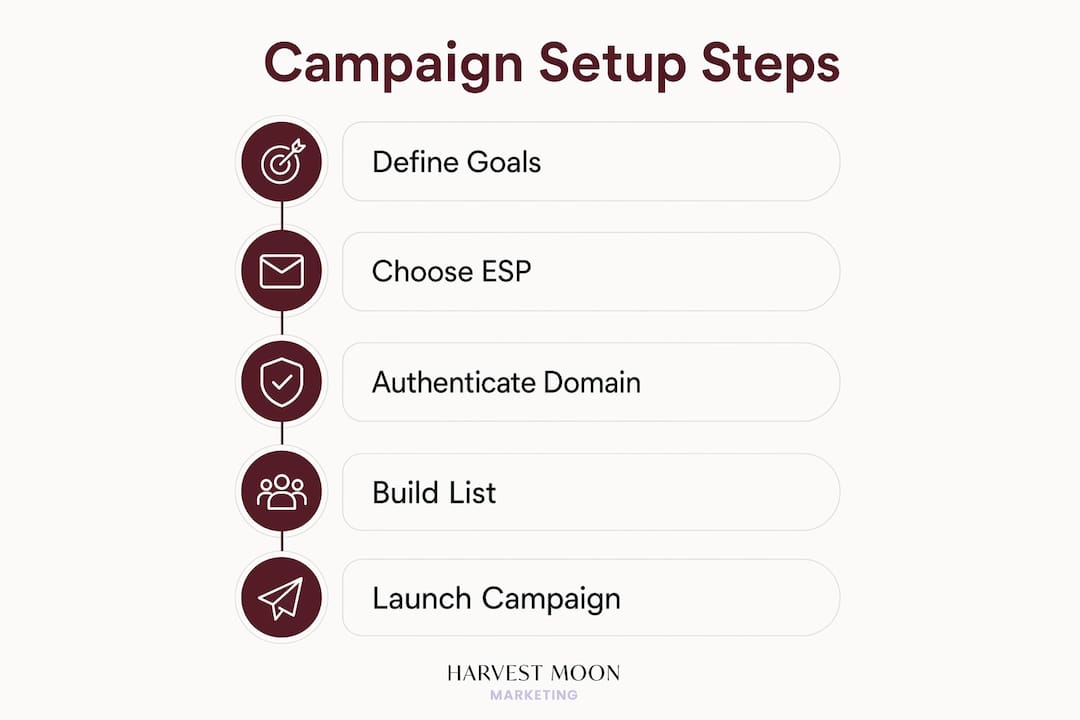
Choosing the right Email Service Provider (ESP) is the first real decision. Your ESP handles sending, list management, automation, and reporting. Mailchimp suits beginners with its free tier and drag-and-drop editor. Klaviyo is built for data-driven segmentation and is popular with product-based businesses. Constant Contact is a reliable choice for service businesses that want simplicity without sacrificing deliverability.
Before you send anything, set up domain authentication. SPF, DKIM, and DMARC are mandatory for inbox delivery with all major providers since february 2024. Without these records configured in your domain’s DNS settings, Gmail and Yahoo will block or filter your messages regardless of how good your content is.

Building your list the right way matters as much as the technical setup. Use opt-in forms on your website, at checkout, and in post-service follow-ups. Never buy a list. Purchased addresses produce spam complaints, and email lists decay at 22–23% annually. That decay rate means roughly one in five contacts on a year-old list is already invalid, which drives up bounce rates and damages your sender reputation.
Pro Tip: Use a tool like Cleanlist to scrub your list before your first send. Removing invalid addresses upfront protects your deliverability from day one.
ESP comparison at a glance
| ESP | Best for | Starting price | Automation |
|---|---|---|---|
| Mailchimp | Beginners | Free tier available | Basic flows |
| Klaviyo | Data-driven marketers | Free up to 250 contacts | Advanced |
| Constant Contact | Service businesses | Paid plans only | Moderate |
How to define goals and segment your audience
Every campaign needs a clearly defined business outcome. Twilio’s email strategy research states that marketers must define a six-word goal for every send. “Reactivate lapsed customers from last quarter” is a goal. “Send a newsletter” is not. Without a specific outcome, you cannot measure success or write focused content.
Your primary goals will fall into four categories: revenue generation, new subscriber activation, customer retention, and reactivation of dormant contacts. Each goal maps to a different type of email and a different audience segment.
Segmentation is where most beginners go wrong. Experts recommend starting with 4–5 core segments aligned to your business goals before adding complexity. Over-segmenting a small list creates management overhead without meaningful performance gains. Practical starting segments for a small business include:
- New subscribers (within the last 30 days)
- Active customers (purchased in the last 90 days)
- Lapsed customers (no purchase in 6+ months)
- High-value customers (top 20% by spend)
- Leads who have never purchased
Pro Tip: Review your segments every quarter. As your list grows past 2,000 subscribers, add behavioural triggers like browse activity or email engagement to refine who receives what.
What content and automation flows drive the most revenue?
Automated flows are the highest-return part of any email programme. Automation generates roughly 41% of total email revenue while accounting for only about 5% of total emails sent. That ratio makes automation the single most efficient use of your email marketing budget.
A well-designed welcome email goes out within minutes of sign-up, when subscriber intent is at its peak. That first message sets the tone for the entire relationship. After the welcome, the most valuable flows to build are:
| Automated flow | Trigger | Primary goal |
|---|---|---|
| Welcome series (3 emails) | New sign-up | Activation and first purchase |
| Abandoned cart | Item left in cart | Revenue recovery |
| Post-purchase | Order confirmed | Retention and upsell |
| Re-engagement | 90+ days inactive | Reactivation or list clean |
For non-automated sends, your content mix should balance value and promotion. A useful rule is two value-driven emails (tips, guides, updates) for every one promotional email. This ratio keeps unsubscribe rates low and trains subscribers to open your messages.
Subject lines determine whether your email gets opened at all. Use curiosity (“What most business owners miss about follow-up”), urgency (“Your offer expires tonight”), or clear value (“Three ways to reduce your next invoice”). Test one approach at a time so you know what actually moved the needle.
Pro Tip: Use a marketing automation checklist to map out each flow’s trigger, delay, and goal before building it in your ESP. Building without a plan leads to gaps and duplicate sends.
How do you measure and improve campaign performance?
Open rates are no longer a reliable primary metric. Since Apple’s Mail Privacy Protection launched, open data is inflated by machine pre-loading. Focus instead on click-through rates, conversion rates, and revenue per email. These metrics reflect actual subscriber behaviour, not automated pings.
Set up UTM parameters on every link so your email traffic shows up correctly in Google Analytics or your analytics platform of choice. This connects email clicks to on-site actions and revenue, giving you a full picture of campaign ROI. A simple dashboard tracking clicks, conversions, and unsubscribes per send is enough to spot problems early.
A/B testing is the fastest way to improve results, but only when done correctly. Test one variable per experiment with at least 1,000 recipients per variant to get statistically valid results. Testing subject line length against send time in the same experiment tells you nothing useful. Isolate the variable, run the test, then apply the winner before testing the next element.
Sending volume also affects deliverability. Increase your volume no more than 20% per week to avoid triggering spam filters. Jumping from 500 to 5,000 sends overnight signals suspicious behaviour to inbox providers. Consistent, gradual growth protects your sender reputation over time. For more on which marketing metrics matter most, tracking the right numbers makes the difference between guessing and knowing.
Pro Tip: Check your spam complaint rate monthly. A rate above 0.3% triggers automatic blocking by Gmail and Yahoo. If you hit that threshold, pause sending and clean your list before resuming.
What mistakes should you avoid for long-term email success?
Buying or scraping email lists is the fastest way to destroy your sender reputation. Every address on a purchased list is a potential spam complaint or bounce. Permission-based opt-in is not optional. It is the foundation of email marketing best practices that keep your campaigns running long-term.
Avoid these common mistakes that undermine otherwise solid campaigns:
- Sending without a defined business goal for each email
- Ignoring list hygiene until bounce rates spike
- Increasing send volume too quickly after a quiet period
- Testing multiple variables at once and drawing false conclusions
- Sending only promotional content with no value for the subscriber
- Neglecting mobile formatting when the majority of email opens happen on phones
Consistency matters more than frequency. Sending once a week reliably builds more trust than sending five times one week and going silent for a month. ISPs read consistent volume as a positive signal. Erratic sending patterns raise flags.
How Harvestmoonmktg can help with your email campaigns
Harvestmoonmktg works with small businesses across Canada to plan, build, and manage email marketing campaigns that keep customers engaged between purchases. The team handles the technical setup, including domain authentication, ESP configuration, and automation flow builds, so you are not piecing it together from tutorials. If you already have a list but are not seeing results, Harvestmoonmktg audits your current setup and identifies exactly where performance is breaking down. Email marketing works best as a retention channel alongside SEO and paid search, and Harvestmoonmktg builds programmes that fit into that broader picture.
FAQ
What is an email marketing campaign?
An email marketing campaign is a series of planned emails sent to a subscriber list to achieve a specific business goal, such as driving sales, re-engaging customers, or welcoming new subscribers.
How do I start building an email list from scratch?
Add opt-in forms to your website, checkout process, and post-service follow-ups. Never purchase a list. Permission-based sign-ups produce far better deliverability and engagement.
Why are my emails going to spam?
Missing SPF, DKIM, or DMARC authentication is the most common cause. Since february 2024, all major inbox providers require these records. High spam complaint rates above 0.3% also trigger automatic filtering.
How often should I send marketing emails?
Consistency matters more than frequency. One well-planned email per week outperforms erratic bursts. Increase volume gradually, no more than 20% per week, to protect your sender reputation.
What is the best automated email to set up first?
A welcome series is the highest-priority automation for any new programme. It reaches subscribers at peak intent and sets the tone for the entire customer relationship.


