
Social media reach is defined as the total number of unique users who see your content at least once during a given period. It is the foundational metric for understanding how many distinct people your brand is actually in front of, as opposed to how many times your content appeared on a screen. Platforms like Instagram, Facebook, and LinkedIn all report reach natively in their analytics dashboards. Understanding this number is the starting point for every meaningful conversation about brand visibility, content performance, and audience growth.
What is social media reach and how is it calculated?
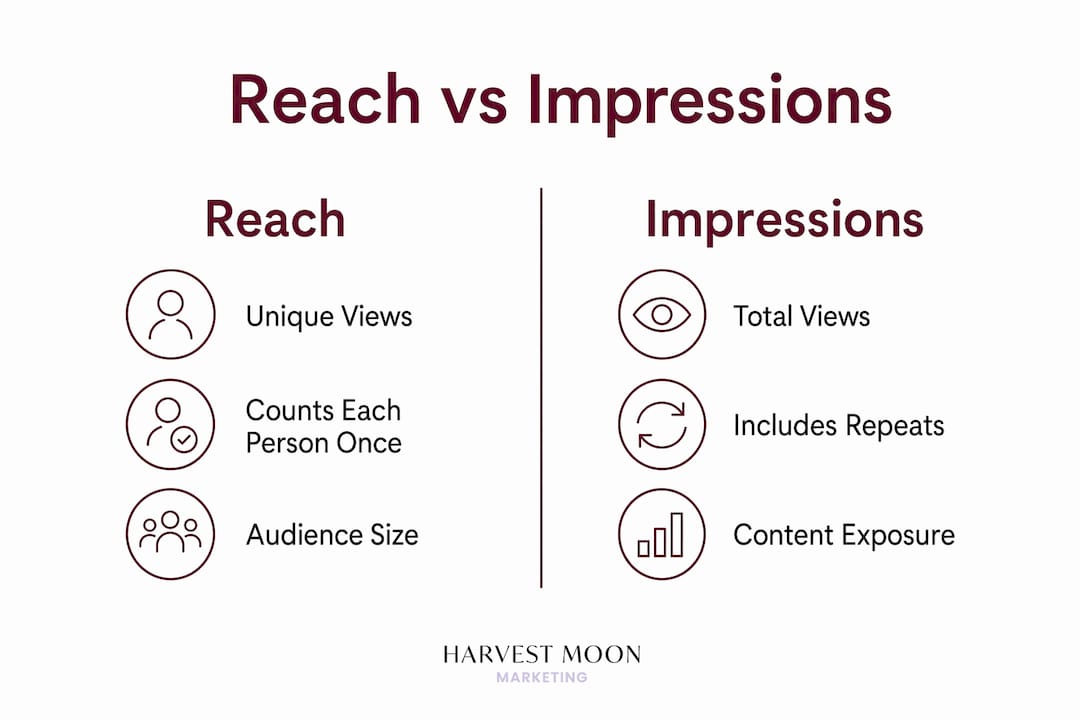
Social media reach counts each person once, regardless of how many times they saw your post. Reach counts unique viewers; impressions count every view, including repeats. If 500 people each see your post twice, your reach is 500 and your impressions are 1,000. That distinction matters enormously when you are trying to understand whether your content is finding new people or just cycling in front of the same ones.
When native analytics are unavailable, you can calculate reach manually. Reach equals impressions divided by average frequency. For example, 50,000 impressions with an average frequency of 2 produce a reach of 25,000. That formula is a useful estimate, but it is less precise than what Facebook Insights or Instagram’s native analytics deliver directly.

Reach breaks down into three distinct types.
| Reach type | Definition | Example platform |
|---|---|---|
| Organic reach | Non-paid exposure to followers and their networks | Facebook, LinkedIn |
| Paid reach | Exposure driven by advertising spend | Facebook Ads, LinkedIn Ads |
| Viral reach | Exposure generated through shares and reposts | Instagram, TikTok |
LinkedIn organic reach typically ranges from 5–10% of a page’s follower count, though this varies by industry and content type. That figure illustrates why relying on follower count alone to predict visibility is a mistake.
Pro Tip: Use your platform’s native analytics as your primary source for reach data. Third-party tools estimate differently, and proprietary unique user counting methods mean native numbers are always more accurate.
What is the difference between reach, impressions, and engagement?
These three metrics are related but measure completely different things. Confusing them leads to misreading your content’s actual performance.
Reach measures audience size; impressions measure how often content appeared. Engagement measures interactions: likes, comments, shares, saves, and clicks. A post can rack up 10,000 impressions while reaching only 2,000 people, meaning each person saw it an average of five times. That is useful frequency data, but it tells you nothing about how many distinct individuals your brand touched.
Here is how the three metrics compare side by side:
| Metric | What it measures | Counts repeats? | Best used for |
|---|---|---|---|
| Reach | Unique viewers | No | Audience size, brand awareness |
| Impressions | Total content views | Yes | Frequency and exposure volume |
| Engagement | Interactions with content | Yes | Content resonance and audience response |
A few key distinctions worth keeping in mind:
- Reach is your audience size for a given piece of content or campaign.
- Impressions tell you how hard your content is working in terms of total exposure.
- Engagement tells you whether the people who saw it actually cared.
Tracking all three together gives you the full picture. Reach without engagement context can mislead you into thinking a campaign performed well when it only reached people who scrolled past. Engagement without reach context hides whether you are speaking to a broad audience or a small, loyal one.
Why does social media reach matter for your brand?
Reach is the denominator behind your engagement rate. Engagement rate is calculated as total interactions divided by reach, then multiplied by 100. Without an accurate reach figure, your engagement rate is meaningless. This is why reach sits at the centre of digital marketing metrics worth tracking.
Reach also reflects how algorithms are treating your content. Platforms like TikTok and Instagram Reels now prioritise content discovery based on viewer interests rather than follower relationships. This means a small business with 800 followers can reach tens of thousands of people if the algorithm decides the content is relevant. Follower count no longer guarantees organic reach, which changes how you should set visibility goals.
Segmenting reach by channel, demographic, or location adds another layer of value. Focusing on high-reach channels produces better visibility outcomes than spreading effort evenly across every platform. If your Instagram reach consistently outperforms LinkedIn for your audience, that data tells you where to concentrate your content effort.
Pro Tip: Reach alone is not a success metric. High reach with low engagement signals irrelevant content to the algorithm, which can reduce your future distribution. Always read reach alongside engagement rate.
There is a real risk of treating reach as a vanity metric. A post that reaches 50,000 people but generates no shares, comments, or clicks has not moved your brand forward. The goal is relevant reach, meaning your content is getting in front of people who are actually interested in what you offer.
What are effective ways to enhance social media reach?
Organic reach has declined on most platforms as algorithms increasingly favour paid content and personal connections over brand posts. That shift makes intentional organic tactics more important, not less. The good news is that several proven approaches can improve your reach without advertising spend.
Here are the most effective strategies:
- Post at peak times. Timing affects how quickly your content gains early engagement, which signals the algorithm to distribute it further. Use your platform’s native analytics to find when your specific audience is most active.
- Use platform-native formats. Instagram Reels, LinkedIn carousels, and Facebook Stories receive preferential algorithmic treatment over static image posts. Optimising content format increases distribution without additional spend.
- Encourage shares actively. Viral reach grows through shares and reposts. A direct call to share, a shareable graphic, or a post that sparks a strong opinion all drive this type of distribution.
- Use relevant hashtags strategically. Hashtags on Instagram and LinkedIn connect your content to interest-based discovery feeds. Avoid generic hashtags with hundreds of millions of posts. Niche hashtags with engaged communities perform better for reach.
- Post consistently. Algorithms reward accounts that post regularly. Consistency builds a track record that platforms use to decide how widely to distribute your next post.
Beyond these tactics, user-generated content is one of the most underused reach multipliers available to small businesses. When a customer shares a post about your brand, their entire network becomes part of your organic reach. Encouraging reviews, reposts, and tagged content costs nothing and extends your visibility into audiences you could not reach on your own.
Understanding organic social media as a long-term visibility strategy, rather than a quick traffic driver, sets realistic expectations and leads to more sustainable growth.
How Harvestmoonmktg can help you grow your social media presence
Harvestmoonmktg is a full-suite digital marketing agency that helps businesses build genuine audience engagement through social media. If you are trying to grow your reach, improve your content strategy, or understand which platforms are actually working for your brand, the team at Harvestmoonmktg can help you get there. Their social media services focus on organic engagement and audience growth, not just posting for the sake of it. For businesses that also want to stay top of mind with existing customers, Harvestmoonmktg’s email marketing services pair well with a strong social presence. Reach out to explore what a focused strategy could do for your visibility.
FAQ
What is social media reach in simple terms?
Social media reach is the number of unique people who saw your content at least once. It counts each person once, regardless of how many times they viewed the post.
How do I measure social media reach accurately?
The most accurate method is using native platform analytics from Instagram, Facebook, or LinkedIn. You can also estimate reach manually by dividing total impressions by average frequency.
What is the difference between reach and impressions?
Reach counts unique viewers; impressions count every view including repeats. If one person sees your post three times, that is one unit of reach and three impressions.
Does a high follower count guarantee strong reach?
No. Algorithms on platforms like TikTok and Instagram now distribute content based on viewer interests rather than follower relationships, so follower count and reach are increasingly disconnected.
Why is reach considered a vanity metric by some marketers?
Reach becomes a vanity metric when it is high but engagement is low. Platforms interpret low engagement as a signal that the content is irrelevant, which can reduce future distribution.


