
Marketing ROI is defined as the financial return generated from marketing spend relative to the cost of that spend, and accurate ROI connects marketing investment directly to revenue rather than surface metrics like clicks or impressions. To track digital marketing ROI with confidence, you need more than a single dashboard. You need a calibrated system that integrates conversion tracking, attribution modelling, and financial data across every channel you run. Tools like Google Analytics, CRM platforms, and emerging software such as Funnel Digital Measurement each play a distinct role in this system. The challenge most marketing professionals face is not a lack of data. It is reconciling competing signals from multiple platforms into one reliable number.
What do you need to track digital marketing ROI accurately?
Before you can measure anything meaningful, your measurement infrastructure must be in place. Three data inputs are non-negotiable: total campaign costs, conversion events with assigned monetary values, and revenue data pulled from a CRM or accounting system. Without all three, your ROI calculation is incomplete.
UTM parameters, tracking pixels, and conversion value assignment form the technical backbone of any tracking setup. UTM tags tell you which campaign, channel, and ad drove a session. Pixels fire when a conversion occurs. But neither does much good unless you assign a dollar value to each conversion event, not just record that it happened. Conversion tracking quality underpins the entire ROI measurement process because optimisation algorithms depend on accurate value signals to allocate spend efficiently.

The table below compares the most common tools and methods used to consolidate marketing, sales, and finance data for ROI measurement:
| Tool or method | Primary use | Best for |
|---|---|---|
| Google Analytics 4 | Session and conversion tracking | Website and campaign attribution |
| HubSpot CRM | Lead and revenue tracking | Connecting marketing leads to closed revenue |
| Funnel.io | Data aggregation across platforms | Centralising multi-channel cost and conversion data |
| Marketing mix modelling (MMM) | Channel-level incrementality | Strategic budget allocation |
| Multi-touch attribution (MTA) | Touchpoint credit distribution | Daily campaign optimisation |
Clean data and consistent attribution definitions matter more than the tools themselves. If your Google Ads account counts a conversion differently than your CRM, every ROI figure you produce will be wrong. Align your attribution windows and counting methods before you build any report.
Pro Tip: Audit your conversion tracking setup quarterly. Check that pixel fires are not duplicated, that UTM parameters are appended consistently, and that your CRM revenue data matches what your ad platforms report.
How do you implement a multi-method measurement strategy?
No single measurement method gives you the full picture. Multi-touch attribution distributes credit across multiple touchpoints and avoids over-crediting the last click before a conversion. Marketing mix modelling (MMM) takes a broader statistical view, using historical spend and revenue data to estimate the incremental contribution of each channel. Together, they produce a far more reliable ROI estimate than either method alone.
Here is a practical sequence for implementing a multi-method measurement approach:
- Establish a single source of truth. Connect your ad platforms, CRM, and analytics tool into one data warehouse or aggregation platform like Funnel.io or a comparable data connector.
- Run your MTA model first. Use it for daily and weekly campaign decisions. It reflects recent performance and responds quickly to changes in spend or creative.
- Layer in MMM for strategic decisions. Run MMM quarterly or when you are planning significant budget shifts. It captures longer-term effects that MTA misses.
- Conduct incrementality tests. Holdout experiments and geo tests isolate the true causal lift of a campaign, which is often lower than attributed conversions suggest from last-click models.
- Reconcile and calibrate. Where MMM and MTA disagree, investigate the gap rather than defaulting to one model. Funnel Digital Measurement, for example, continuously calibrates MMM, MTA, and ad platform signals to retain only statistically defensible explanations.
The goal is a continuous measurement flywheel where platform ROAS, incremental ROAS, and MMM outputs inform each other and guide ongoing budget reallocation. This is not a one-time project. It is an operating rhythm.
Pro Tip: Set a calendar reminder to re-run your MMM every quarter. Stale models built on old data will mislead your budget decisions just as badly as having no model at all.
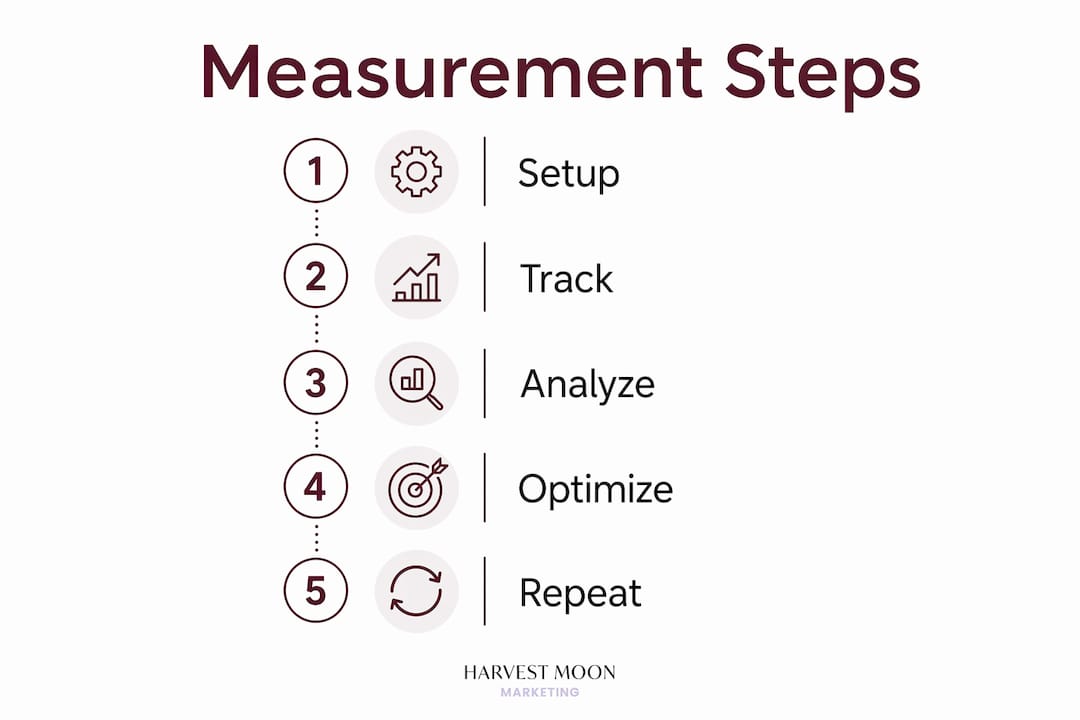
How to set up conversion tracking for precise ROI measurement
Conversion tracking is where most ROI measurement breaks down in practice. The most common error is recording that a conversion occurred without passing the revenue value associated with it. Passing conversion value rather than just the conversion event gives bidding algorithms and your own reporting the signal they need to reflect actual revenue impact.
Your CRM is the most reliable source of revenue validation. When a lead converts to a paying client, that revenue figure should flow back into your reporting, either manually or through an automated CRM integration. This closes the loop between marketing activity and financial outcome, which is the only way to calculate marketing ROI with real accuracy. Harvestmoonmktg builds this kind of closed-loop tracking into every campaign it manages, connecting Google Ads performance to downstream revenue rather than stopping at the lead.
Conversion tracking best practices to follow:
- Assign a monetary value to every conversion event, even if it is an estimated average order value or lead value
- Use a single conversion action per goal to avoid double-counting in your reports
- Align your attribution window across all platforms (30-day click, for example) so comparisons are valid
- Verify pixel firing with browser developer tools or Google Tag Assistant before launching any campaign
- Integrate your CRM with your ad platforms to import offline conversions and close the revenue loop
What mistakes do marketers make when measuring ROI?
The most damaging mistake in ROI measurement is treating attributed conversions as equivalent to caused conversions. Last-click attribution, still the default in many platforms, assigns full credit to the final touchpoint before a conversion. This systematically over-rewards bottom-funnel channels like branded search while under-valuing the awareness and consideration activity that created the demand in the first place.
Attribution methods typically differ by 10 to 20 percent due to differences in counting windows and methodologies. That gap is normal, but it must be audited and reconciled rather than ignored. ROI dashboards that do not deduplicate conversions or align attribution windows produce inflated results that lead to poor budget decisions.
Easier-to-measure lower-funnel ROI can distort budget priorities since true return often occurs over longer time horizons. Source: Adweek
Common pitfalls and how to fix them:
- Over-crediting last click. Fix: switch to a data-driven attribution model in Google Ads and layer in MTA across channels.
- Duplicated conversions. Fix: audit your tag setup and use a single conversion action per goal.
- Misaligned attribution windows. Fix: standardise windows across all platforms before comparing results.
- Missing offline revenue data. Fix: import CRM revenue back into your ad platforms using offline conversion imports.
- Stale measurement models. Fix: recalibrate MMM and review attribution settings every quarter.
Poor data quality compounds every one of these problems. Before you invest in sophisticated modelling, confirm that your foundational tracking is clean and consistent. Review the digital marketing metrics that matter most to your business before building your reporting stack.
What Harvestmoonmktg has learned about ROI measurement
After working across dozens of service business campaigns, the pattern I see most often is this: marketers choose one measurement method, trust it completely, and then make budget decisions based on a partial view of reality. The fix is not to find the perfect model. It is to run multiple models simultaneously and treat disagreements between them as signals worth investigating.
Incrementality testing is the most underused tool in most marketing budgets. A simple holdout test, where you pause spend in one geography or audience segment for two to four weeks, will tell you more about true campaign impact than months of attribution data. Most businesses avoid it because it feels like leaving revenue on the table. In practice, the insight it generates pays back far more than the short-term cost.
The other thing I would stress is data ownership. ROI tracking fails when marketing, sales, and finance each maintain separate definitions of a conversion or a lead. Cross-team alignment on definitions, attribution windows, and revenue attribution is not a technical problem. It is a governance problem, and it needs a human solution before any software can help.
— Harvest
How Harvestmoonmktg helps you measure and improve campaign ROI
Harvestmoonmktg builds campaign tracking infrastructure that connects ad spend directly to revenue, not just leads. Whether you are running Google Ads campaigns for direct lead generation or using email marketing to retain and re-engage existing clients, every campaign Harvestmoonmktg manages is built with closed-loop tracking from day one. That means conversion values, CRM integration, and attribution settings configured before a single dollar is spent. If your current reporting leaves you guessing about which channels are actually driving revenue, explore the full range of marketing services Harvestmoonmktg offers and find out what a properly tracked campaign looks like.
FAQ
What is the formula to calculate marketing ROI?
Marketing ROI is calculated as: (Revenue from marketing minus marketing cost) divided by marketing cost, multiplied by 100. Accurate calculation requires assigning revenue values to conversions, not just counting conversion events.
Why do my ad platforms show different ROI figures?
Attribution methods typically differ by 10 to 20 percent due to differences in counting windows and methodologies. Auditing your setup and reconciling differences across platforms produces a more reliable estimate.
What is the difference between MTA and MMM?
Multi-touch attribution (MTA) distributes credit across individual touchpoints and is best for daily campaign decisions. Marketing mix modelling (MMM) uses historical data to estimate channel-level incrementality and is better suited for strategic budget planning.
How often should I review my ROI tracking setup?
Review your conversion tracking setup quarterly and recalibrate any MMM or attribution models at the same time. Stale models built on outdated data produce misleading budget recommendations.
What is the most common ROI tracking mistake?
Over-crediting last-click attribution is the most common error. It rewards bottom-funnel channels while ignoring the upstream activity that generated demand, which distorts budget allocation over time.


