
PPC return on investment is the measure of profit generated for every dollar spent on pay-per-click advertising campaigns. Unlike ROAS (return on ad spend), which tracks gross revenue relative to ad cost, ROI PPC accounts for your actual margins, making it the more meaningful number for service-based businesses where profit per client varies widely. Google Ads and GA4 are the two platforms most commonly used to gather the data needed for this calculation, yet most marketing managers still rely on surface-level metrics that obscure what their campaigns are actually earning.
How to calculate ROI for PPC campaigns accurately
The standard PPC ROI calculation is straightforward: subtract your total ad spend from the profit generated by those ads, divide by ad spend, and multiply by 100. The formula looks like this: ((Profit from PPC – Ad Spend) ÷ Ad Spend) × 100 = ROI %. The critical word here is profit, not revenue. If you substitute gross revenue, you get a number that looks impressive but tells you nothing about whether the campaign is actually making you money.
For service businesses, this distinction matters more than almost anywhere else. A law firm paying $80 per click and closing clients at a 40% margin needs a completely different ROI benchmark than a SaaS company with 80% margins. The inputs that make or break your ppc roi calculation are conversion value, attribution window, and whether your offline outcomes (signed contracts, booked appointments, completed consultations) are feeding back into your ad platform.
Here is a step-by-step framework to get the calculation right:
- Define your profit-aligned conversion value. Use contribution margin per lead or per closed client, not the invoice total. Offline conversion adjustments keyed to click IDs improve bidding accuracy by reflecting actual contribution margin.
- Set your attribution window deliberately. A 30-day window suits most service businesses; longer sales cycles may need 60 or 90 days.
- Import offline conversions. Connect your CRM or booking system to Google Ads so that closed deals, not just form fills, register as conversion events.
- Separate brand and non-brand campaigns. Brand search inflates reported numbers because those users were already looking for you.
- Reconcile platform data with backend revenue. Manual cross-platform reconciliation is error-prone; automation improves decision making significantly.
Pro Tip: When feeding conversion values into Google Ads Smart Bidding, use your average contribution margin per closed client rather than the total contract value. Smart Bidding optimises on whatever value you provide, and if that value is not profit-aligned, the algorithm will chase revenue instead of profitability.
How do attribution models affect PPC ROI measurement?
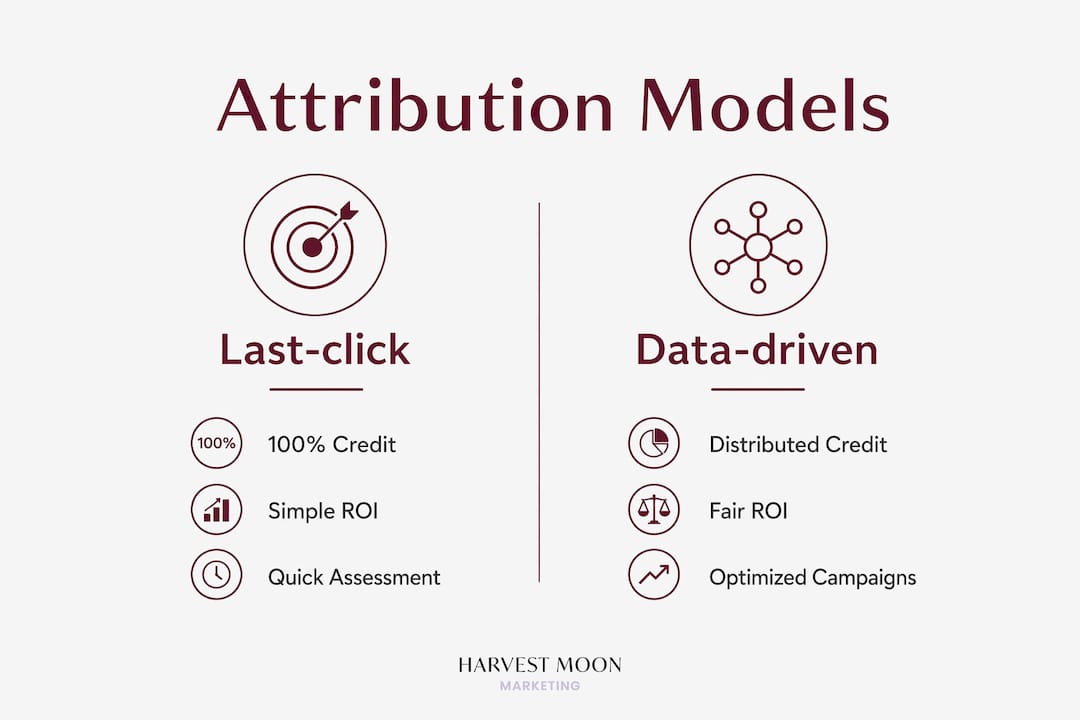
Attribution models determine which touchpoints in a customer journey receive credit for a conversion, and the model you choose can dramatically change your reported ROI. Last-click attribution assigns 100% of the credit to the final ad a user clicked before converting. This approach consistently overstates the value of retargeting and brand search campaigns while ignoring the prospecting campaigns that introduced the client to your business in the first place. Comparing ROAS across multiple attribution models identifies channels that benefit from others’ work versus those independently driving sales.
The table below summarises how each model affects your perception of PPC ROI:
| Attribution model | Credit distribution | ROI impact | Best use case |
|---|---|---|---|
| Last-click | 100% to final click | Overstates retargeting | Short, single-touch journeys |
| First-click | 100% to first click | Overstates prospecting | Brand awareness analysis |
| Time-decay | More credit to recent clicks | Favours closing campaigns | Longer sales cycles |
| Data-driven | Fractional, algorithm-based | Most balanced view | Campaigns with 30+ monthly conversions |
| Linear | Equal credit across all clicks | Neutral baseline | Multi-step service funnels |
Reported ROAS includes all attributed conversions, inflating value especially for brand search. This is why reported ROAS is typically the highest number you will see and also the least reliable one for budget decisions. The more useful metric is incremental ROAS, which measures the true revenue lift caused by your ads by removing baseline demand. Incremental ROAS accurately answers the question of whether you should increase budget for a given channel.
For service businesses running Google Ads, data-driven attribution redistributes credit more fairly across funnel stages, elevating upper-funnel signals and giving Smart Bidding a more complete picture of what is actually driving clients through the door.
Pro Tip: Run a holdout or geo experiment before making major budget decisions based on reported ROAS. Marketing mix modelling can statistically estimate incremental revenue without pausing campaigns, giving you lift estimates to guide budget allocation.
What strategies improve ROI in PPC for service businesses?
Improving PPC return on investment in a service context comes down to one principle: optimise for profit, not volume. More clicks and more conversions are only valuable if the clients they bring in are worth more than they cost to acquire. PPC optimisation involves refining keywords, bids, ad copy, and landing pages continuously to maximise ROI and reduce wasted spend.

The most impactful lever for most service businesses is negative keyword management. Generic terms attract browsers, not buyers. A plumbing company bidding on “how to fix a pipe” is paying for traffic that will never convert. Tightening your keyword list to high-intent, service-specific terms reduces cost per acquisition and lifts your ROI without touching your bids at all.
Beyond keywords, here are the practices that consistently move the needle:
- Align Smart Bidding with profit values. Smart Bidding requires 30+ conversions per month to train algorithms effectively. Below that threshold, manual or enhanced CPC bidding is often more reliable.
- Improve landing page relevance. A landing page that mirrors the ad’s promise reduces bounce rate and increases conversion rate. For service businesses, this means specific pages for specific services, not a generic homepage.
- Use contribution margin as conversion value rather than lead count or revenue. This is the single most underused tactic in service-based PPC.
- Review search term reports weekly. Irrelevant queries drain budget faster than almost any other issue.
- Monitor Quality Score. CTR, CPC, CPA, ROAS, and Quality Score are the core KPIs that connect cost efficiency to profitability. A low Quality Score raises your CPC and suppresses your ad position simultaneously.
What tools help you track and measure PPC ROI?
Accurate ROI measurement requires more than a Google Ads dashboard. The data you need lives across your ad platform, your website analytics, and your CRM, and connecting those three sources is where most service businesses fall short.
Connecting GA4 with Google Ads enables measurement of multi-touch attribution and real ROAS, surpassing last-click default metrics. GA4 reports sessions, engagement, and conversions while allowing you to switch attribution models and see how your numbers change. This is the minimum setup every service business running PPC should have in place.
For businesses with longer sales cycles, server-side tracking adds another layer of accuracy. Server-side tracking moves conversion reporting from browser pixels to server APIs, bypassing ad blockers and iOS tracking restrictions. This means fewer lost conversions and a more complete picture of what your campaigns are actually producing.
Here is a practical implementation sequence:
- Link GA4 to Google Ads and confirm conversion import is active.
- Set up offline conversion imports from your CRM using Google’s Click ID (GCLID).
- Implement server-side tracking via Google’s Conversion API or a tool like Hyros.
- Build a centralised dashboard that pulls ad spend and verified revenue into one view.
- Review attribution model comparisons monthly and adjust bidding strategy accordingly.
Pro Tip: Centralised dashboards that integrate ad spend with backend revenue data provide a single source of truth for ROI across platforms. Manual reconciliation between Google Ads, GA4, and your CRM introduces errors that compound over time and distort your optimisation decisions.
Why ROI PPC is more than a number
At Harvestmoonmktg, we have seen service businesses double their ad spend chasing a reported ROAS that looked strong on paper but was masking a negative ROI once margins were factored in. The number on the dashboard was technically accurate. It just was not answering the right question.
The shift that changes everything is moving from “how much revenue did these ads generate?” to “how much profit did these ads generate, and would that profit have happened without them?” Those are two very different questions, and most platforms are only set up to answer the first one. Maximising ROI in PPC means building the infrastructure to answer the second.
Offline conversion adjustments are not a nice-to-have for service businesses. They are the mechanism that connects what happens in your CRM to what your bidding algorithm does next. Without them, you are asking Smart Bidding to optimise toward a proxy metric instead of the outcome you actually care about. Patience matters here too. Attribution sophistication takes time to implement correctly, and the results compound over months, not days.
— Harvest
How Harvestmoonmktg helps service businesses improve PPC ROI
Harvestmoonmktg specialises in Google Ads management built around profit-focused tracking, not vanity metrics. For service-based businesses, that means setting up offline conversion imports, aligning Smart Bidding with contribution margin values, and building dashboards that connect ad spend to actual closed revenue. If your current campaigns are reporting strong ROAS but you are not seeing it in your bottom line, the problem is almost always in the measurement layer. Explore the full range of PPC and lead generation services Harvestmoonmktg offers, or get in touch to discuss how profit-aligned tracking can change what your campaigns are optimising toward.
FAQ
What is ROI PPC and how does it differ from ROAS?
ROI PPC measures profit relative to ad spend, while ROAS measures gross revenue relative to ad spend. ROI is the more meaningful metric for service businesses because it accounts for your actual margins rather than top-line revenue.
How do I calculate PPC ROI accurately?
Use the formula: ((Profit from PPC – Ad Spend) ÷ Ad Spend) × 100. The key is using profit per closed client as your conversion value, not total revenue, and importing offline conversions from your CRM into Google Ads.
Why does my reported ROAS look high but my ROI feels low?
Reported ROAS includes all attributed conversions, inflating value especially for brand search campaigns where users would have converted regardless of the ad. Incremental ROAS, which isolates the lift caused by your ads, is typically much lower and far more accurate for budget decisions.
How many conversions do I need for Smart Bidding to work properly?
Smart Bidding requires at least 30 conversions per month to train its algorithm effectively. Below that threshold, manual bidding or enhanced CPC tends to produce more predictable results for service-based campaigns.
What is the best attribution model for service-based PPC?
Data-driven attribution is the most balanced option for service businesses with sufficient conversion volume, as it distributes credit across all touchpoints rather than assigning it entirely to the last click. For businesses with fewer conversions, time-decay attribution better reflects the longer consideration cycles typical of service purchases.


