
A digital product funnel is an operational map that guides potential customers through predictable stages, from first contact to repeat purchase. The standard framework covers five stages: lead magnet, email nurture, tripwire, core product, and upsell or cross-sell. This structure matters because static listings yield zero revenue for 44% of creators. A funnel replaces passive hope with a system that qualifies, warms, and converts strangers into paying customers automatically.
What is a digital product funnel and how does each stage work?
A digital product funnel creates a predictable buying path where each stage feeds automatically into the next, removing the need for manual sales effort at every step. Understanding each stage lets you build with purpose rather than guesswork.
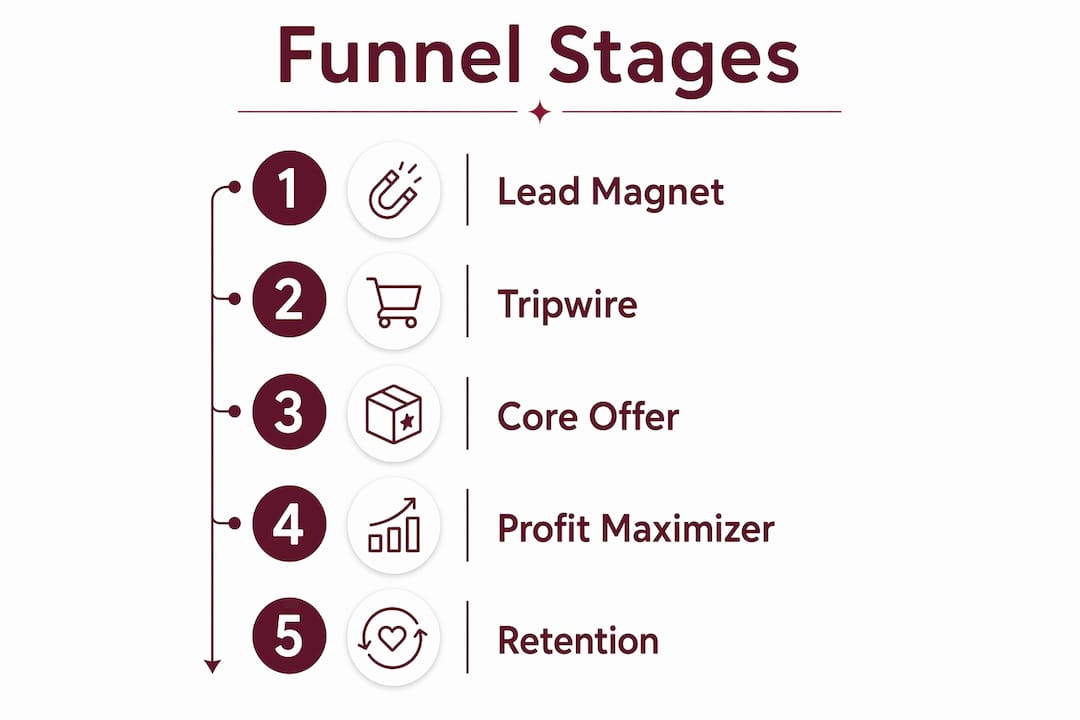
The five stages work as follows:
- Lead magnet. A free resource, such as a checklist, template, or short video, offered in exchange for an email address. The lead magnet is your top-of-funnel entry point. It attracts the right audience and starts the relationship.
- Email nurture. A sequence of emails that builds trust, demonstrates your expertise, and prepares the subscriber for a low-cost purchase. Good email nurture sequences deliver value first and sell second.
- Tripwire. A low-priced offer, typically $5–$15, designed to convert a subscriber into a buyer. The tripwire’s purpose is psychological: it breaks buying inertia and makes the next purchase feel natural.
- Core product. Your main offer at a higher price point. By the time a customer reaches this stage, they have already experienced your value twice. Conversion rates at this stage are significantly higher than cold traffic.
- Upsell or cross-sell. An offer made immediately after purchase, when buying intent is at its peak. This stage raises average order value without acquiring a new customer.
Pro Tip: Do not launch all five stages at once. Build the lead magnet and core product page first, confirm they convert, then add the tripwire and upsell.
How does segmentation improve funnel performance?

Static funnels send every lead through the same path regardless of their situation. Conditional logic and segmentation route leads to the most relevant offer based on their answers or behaviour, which improves qualification and reduces drop-offs.
A simple segmentation question at the opt-in stage, such as “What is your biggest challenge right now?”, lets you send different email sequences to different groups. A creator struggling with pricing gets different content than one struggling with traffic. Each group receives messages that match their actual situation, which increases the likelihood they will act.
| Funnel type | Lead routing | Conversion strength |
|---|---|---|
| Static funnel | All leads see the same path | Lower, due to irrelevant messaging |
| Segmented funnel | Leads routed by response or behaviour | Higher, due to relevant messaging |
Long-form sales pages also play a direct role in conversion. Sales pages need 5,000+ characters of copy to address objections fully at the decision stage. Thorough product detail builds trust and gives buyers the confidence to proceed. Short pages leave objections unanswered and cost you the sale.
Pro Tip: Add social proof, such as testimonials or results screenshots, near the call to action on your sales page. Research on social proof in sales cycles shows it reduces hesitation at the moment buyers are closest to committing.
What are common funnel mistakes and how do you avoid them?
The most common mistake entrepreneurs make is building too many funnel stages before any of them have been tested. Premature complexity causes funnel bloat, which produces high drop-off rates that are nearly impossible to diagnose because there are too many variables.
A simple funnel with two assets outperforms a complicated one with eight untested steps. Start with a lead magnet and a clear product page. Once those two assets convert reliably, you have a baseline. Then you add stages one at a time and measure the effect of each addition.
The second major mistake is relying entirely on marketplace traffic. Marketplace traffic lacks control over the visitor’s path and repeat engagement. When you own your email list, you control when and how you reach your audience. That control is the difference between a business and a listing.
A clear product page is non-negotiable at any funnel stage. Every product page must answer five questions for the buyer:
- What is this product?
- Who is it for?
- What problem does it solve?
- What is included?
- How do I access it after purchase?
If your page cannot answer all five clearly, buyers will leave. Clarity converts. Ambiguity does not.
Converting website visitors into leads also depends on removing friction at the opt-in stage. A complicated sign-up form or a vague lead magnet offer will cost you subscribers before your funnel even begins.
How should you price digital products within a funnel?
Pricing within a funnel follows a progression of small wins. Low-ticket offers in the $17–$47 range build trust before you ask for a larger commitment. Asking a cold lead to spend $197 on a first purchase creates friction. Asking them to spend $17 after a free lead magnet is a much smaller leap.
The tripwire sits at the entry point of paid offers. Buyers who make a small purchase are 60–70% more likely to buy a premium product later. That statistic explains why the tripwire exists. Its goal is not revenue. Its goal is to create a buyer, because buyers buy again.
Pricing errors that cause funnel drop-offs include:
- Jumping from free to expensive. Skipping the tripwire stage removes the psychological bridge between subscriber and buyer.
- Underpricing the core product. A price that feels too low signals low quality. Price your core product at a level that reflects its actual value.
- No upsell after purchase. Post-purchase buying intent is the highest it will ever be. Not offering an upsell at that moment leaves revenue on the table.
- Inconsistent pricing across the funnel. If your tripwire costs $9 and your next offer costs $497, the gap is too large. Add a mid-tier offer to bridge the jump.
A well-structured pricing progression builds trust at each stage. Buyers feel they are getting consistent value, and each purchase makes the next one easier to justify.
How Harvestmoonmktg can support your funnel
Building a digital product funnel requires two things working together: the right structure and the right traffic. Harvestmoonmktg is a full suite digital marketing agency that helps entrepreneurs build both. The team specialises in email marketing services that power the nurture stages of your funnel, keeping leads engaged until they are ready to buy. For entrepreneurs who want to attract consistent organic traffic to their funnel’s top, Harvestmoonmktg’s SEO services are built for local and small businesses. For faster results, Google Ads is the most direct path to qualified funnel traffic. If you want a team that understands how each channel feeds your funnel, Harvestmoonmktg is worth a conversation.
FAQ
What is a digital product funnel in simple terms?
A digital product funnel is a step-by-step system that moves a stranger from discovering your product to buying it and buying again. Each stage is designed to build trust before asking for a larger commitment.
How many stages does a digital product funnel need?
A functional funnel needs at least two stages: a lead magnet and a product page. The five-stage framework of lead magnet, nurture, tripwire, core product, and upsell is the standard for maximising revenue.
What is a tripwire in a sales funnel?
A tripwire is a low-priced offer, typically $5–$15, placed early in the funnel to convert subscribers into buyers. Buyers who purchase a tripwire are 60–70% more likely to buy a higher-priced product later.
Why is email marketing critical to a digital funnel?
Email marketing gives you direct, owned access to your audience. Unlike marketplace traffic, owning your email list means you control when and how you reach leads, which is the foundation of repeat sales.
How long should a digital product sales page be?
A high-conversion sales page needs at least 5,000 characters of copy to address buyer objections fully. Short pages leave questions unanswered and reduce conversion rates at the decision stage.


