
Referral marketing is a structured customer acquisition method that turns satisfied customers into active advocates by incentivising them to share your business with their network. The industry term is “referral programme,” and it operates as a closed-loop system where every share, click, and conversion is tracked and rewarded. Referral programmes reduce customer acquisition costs by 30–70%, a significant advantage given how expensive paid acquisition has become. Referred customers are also 84% more likely to trust a recommendation from a friend than from an ad. That trust is the engine behind the entire system.
How referral marketing works: the five-stage process
Referral marketing works through a five-step closed-loop process: Invite, Share, Capture, Qualify, and Reward. Each stage has a specific function, and skipping one breaks the chain.
-
Invite. Your business presents an existing customer with a referral offer. This happens via email, a post-purchase confirmation page, or a loyalty milestone notification. The timing matters more than most businesses realise.
-
Share. The customer receives a unique referral link or code and shares it with their network. That unique identifier is what makes accurate attribution possible. Without it, you cannot tell which customer drove which conversion.
-
Capture. When a new prospect clicks the link, the system records the referral source and stores it. Tracking technologies like cookies and device fingerprinting tie the prospect back to the original advocate, even if the prospect takes a few days to convert.
-
Qualify. The referral attribution window typically runs 7–30 days. Calibrating that window to your actual sales cycle is critical. A window that is too short misses legitimate conversions; one that is too long invites fraud.
-
Reward. Once the referred customer completes a qualifying purchase, the system issues rewards to both parties automatically. Automated reward fulfilment eliminates manual errors and keeps advocates engaged.
Pro Tip: Set your attribution window to match your average sales cycle length, not an arbitrary default. A service business with a two-week consideration period needs at least a 21-day window to capture most legitimate referrals.
The closed-loop design is what separates a referral programme from a simple “tell a friend” ask. Every step is measurable, which means you can test, adjust, and improve it like any other marketing channel. For a broader look at measuring marketing ROI, Harvest Moon Marketing covers the key metrics worth tracking.

Why double-sided rewards outperform single-sided ones
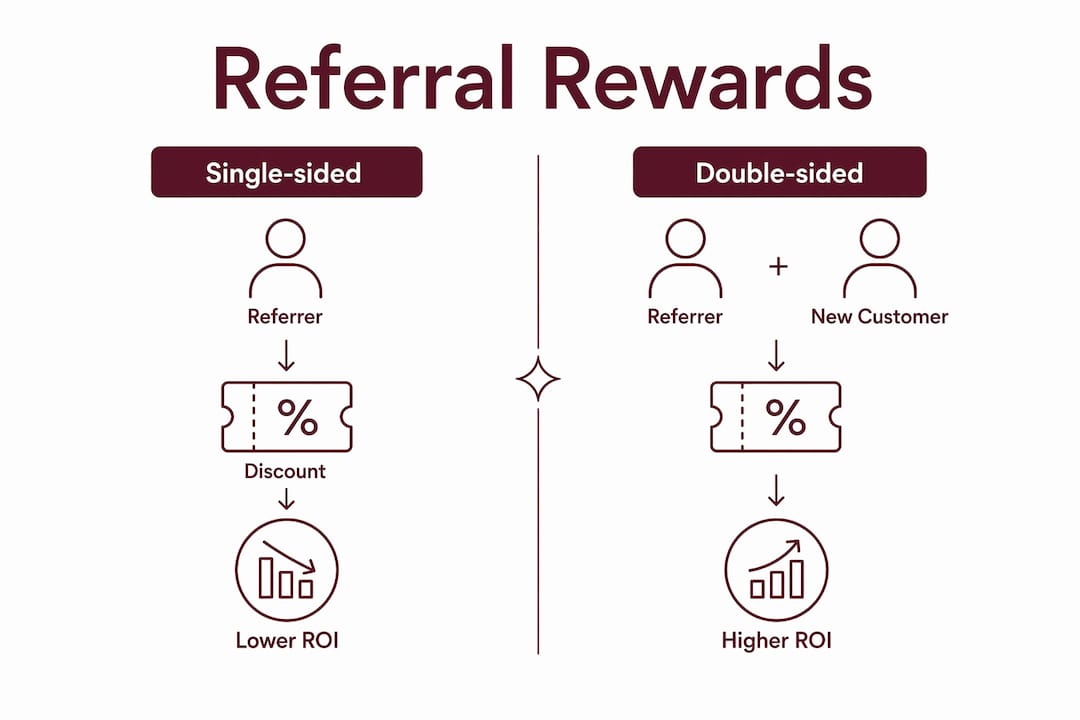
The reward structure is the single biggest lever in a referral programme. A single-sided programme rewards only the referrer. A double-sided programme rewards both the referrer and the new customer.
78% of referral programmes now use double-sided reward structures. That figure reflects a clear industry consensus: giving value to both parties removes the friction that kills participation.
| Reward type | Who benefits | Typical value | Best suited for |
|---|---|---|---|
| Single-sided discount | Referrer only | 10–15% off | Low-margin services |
| Double-sided discount | Both parties | 15–20% off each | Mid-to-high margin services |
| Store credit | Both parties | Fixed dollar amount | Subscription or repeat-purchase models |
| Tiered/milestone rewards | Referrer (escalating) | Increases with volume | High-volume advocate programmes |
Double-sided programmes deliver up to 10× the ROI of single-sided ones. The reason is behavioural: a customer who feels they are giving their friend a genuine benefit shares more willingly and more often than one who feels they are simply earning a discount for themselves.
Tiered or milestone-based rewards add a gamification layer. Escalating incentives motivate your best advocates to keep referring rather than stopping after one or two successful referrals.
Pro Tip: Align your reward value with your average order value and margin. A $20 discount on a $50 service is generous. The same $20 on a $500 contract barely registers. Match the reward to the perceived value of the ask.
Building customer loyalty through relationship marketing is the broader context here. Referral rewards work best when they reinforce an existing positive relationship, not when they feel transactional.
What are the benefits of referral marketing for businesses?
Referral marketing delivers advantages that most paid channels cannot replicate, because it operates on trust rather than interruption.
- Lower acquisition costs. Referral programmes cut CAC by 30–70% compared to traditional paid channels. That reduction compounds over time as your advocate base grows.
- Higher-value customers. Referred customers spend 25% more on their first order and deliver twice the lifetime value of non-referred customers. They also convert faster because they arrive with pre-built trust.
- Compounding referral growth. Referred customers are three times more likely to refer their own contacts. This creates a multiplier effect that grows your programme without additional spend.
- Measurable ROI. The closed-loop system ties every reward to a confirmed purchase. You know exactly what each referral cost and what it generated.
- Brand credibility. A referral is a personal endorsement. 25–30% of sales for some service brands come through referral, which signals that trust-based acquisition can become a primary channel, not just a supplement.
“Referred customers are sold to by friends, not ads. They enter the sales funnel with higher trust, convert at better rates, and stay longer. Referral marketing is primarily a trust-leverage strategy, and that trust is the asset most paid channels cannot buy.”
The referral contagion effect amplifies these benefits further. Referred customers make 31–57% more referrals than customers acquired through other channels. Programmes that ignore this downstream effect undervalue their total ROI by 20–36%.
How to implement a referral programme that actually performs
Execution separates programmes that grow from ones that stall. The mechanics matter, but so does the timing and the experience you create for your advocates.
- Trigger referrals at peak satisfaction moments. The best time to ask for a referral is immediately after a positive experience, such as a completed project, a loyalty milestone, or a strong customer service interaction. Timing referrals correctly during high-intent moments improves both participation and conversion rates.
- Reduce sharing friction to a single step. Pre-filled messages and one-tap sharing significantly improve referral rates. Requiring a login or multiple clicks before sharing causes drop-off. Make it as easy as forwarding a text.
- Personalise the referral ask. Generic “refer a friend” messages underperform. Segment your advocates by service type, tenure, or satisfaction score and tailor the message accordingly. A long-term client deserves a different ask than a first-time customer.
- Integrate referral prompts across the customer lifecycle. Post-purchase emails, invoice follow-ups, and loyalty programme notifications all create natural referral moments. Brands that integrate referral prompts throughout the customer journey compound their growth rather than relying on a single touchpoint.
- Automate fraud prevention. Device fingerprinting and purchase confirmation before reward issuance eliminate most abuse. Pay rewards only after a confirmed, non-refunded purchase.
- Test and refine continuously. Track referral rate, conversion rate, and reward redemption rate as separate metrics. Each one tells you something different about where the programme is losing momentum.
Pro Tip: Run an A/B test on your referral message copy before scaling. A subject line change or a different reward framing can shift participation rates significantly without changing the underlying programme structure.
For service businesses looking to scale referral efforts with digital support, Harvest Moon Marketing’s guide on referral scaling explains why organic referrals alone rarely reach their full potential without a supporting digital infrastructure.
How Harvest Moon Marketing supports your acquisition strategy
Referral programmes generate high-quality leads, but they work best when paired with channels that keep your brand visible and credible. Harvest Moon Marketing is a full-suite digital marketing agency that helps service businesses build acquisition systems that compound over time. SEO services ensure your business ranks when referred prospects search for confirmation before converting. Google Ads fill the pipeline during periods when referral volume is lower, providing a direct and measurable lead flow. Together, these channels reinforce the trust that referral marketing builds, giving prospects multiple reasons to choose you.
FAQ
What is referral marketing in simple terms?
Referral marketing is a structured programme that rewards existing customers for introducing new customers to your business. It uses unique links or codes to track and attribute each referral accurately.
How does referral tracking work?
Each advocate receives a unique referral link or code. When a new prospect uses it and completes a qualifying purchase within the attribution window (typically 7–30 days), the system confirms the referral and issues the reward automatically.
What is the difference between single-sided and double-sided referral rewards?
A single-sided programme rewards only the referrer. A double-sided programme rewards both the referrer and the new customer. Double-sided structures deliver up to 10× the ROI because they give both parties a genuine reason to participate.
How much can referral marketing reduce acquisition costs?
Well-implemented referral programmes reduce customer acquisition costs by 30–70%. Referred customers also spend 25% more on their first order and deliver twice the lifetime value of non-referred customers.
When is the best time to ask a customer for a referral?
The best time is immediately after a peak satisfaction moment, such as a completed project, a loyalty milestone, or a positive service interaction. Timing the ask to high-intent moments significantly improves participation and conversion rates.


