
Most service business owners think content marketing means posting a few blog articles or sharing updates on social media. That assumption is costing them leads. Content marketing is actually a strategic marketing approach focused on creating and distributing valuable, relevant, and consistent content to attract and retain a clearly defined audience, with the objective of driving profitable customer action. This guide cuts through the noise and gives you a clear, practical understanding of what content marketing really is, how it works, and how to use it to grow your service business in 2026.
Key Takeaways
| Point | Details |
|---|---|
| Strategy over tactics | Content marketing only works when guided by a strategy tuned to your business goals and audience. |
| Value attracts business | Relevant, consistent content draws in service customers far more than pushy ads. |
| Quality beats quantity | More content does not outperform better content—focus on expertise and purpose. |
| Audience-first is key | Successful content marketing always starts with understanding and solving your audience’s needs. |
Defining content marketing for service businesses
With a clear purpose set, let’s break down exactly what content marketing means for your service business.
A lot of agencies and consultants throw the term around loosely. The result? Business owners end up publishing content that goes nowhere. Real content marketing is not about filling a blog with words or hitting a weekly posting schedule. It is about delivering the right information to the right people at the right moment, with a clear business goal behind every piece.
“Content marketing is a strategic marketing approach focused on creating and distributing valuable, relevant, and consistent content to attract and retain a clearly defined audience, with the objective of driving profitable customer action.”
Notice three words in that definition: valuable, relevant, and consistent. Each one matters. Valuable means the content actually helps your audience solve a problem or make a better decision. Relevant means it speaks directly to the people you want to serve. Consistent means it shows up reliably enough to build trust over time. Remove any one of those three, and you are just producing noise.
For service businesses specifically, this distinction is critical. You are not selling a product someone can pick up off a shelf. You are selling expertise, trust, and outcomes. Your content has to do the heavy lifting of demonstrating all three before a prospect ever picks up the phone.
Here is what separates genuine content marketing from generic content production:
- Strategic intent: Every piece connects to a business goal, whether that is generating leads, building authority, or shortening the sales cycle.
- Audience specificity: Content is created for a defined segment, not for everyone.
- Measurable outcomes: You track what is working and adjust based on data, not gut feelings.
- Buyer journey alignment: Content speaks to prospects at different stages, from awareness to decision.
- Consistency over time: Results compound. A single blog post does nothing. A library of relevant content builds authority month after month.
We work with content marketing for different industries ranging from professional services to home improvement, and the pattern is always the same: the businesses that treat content as a strategic asset outperform those that treat it as a checkbox. If you are in the trades, contractor marketing strategies built around educational content can dramatically reduce the cost of acquiring each new customer.
How content marketing works: Pull vs. push strategies
After defining content marketing, it is crucial to understand how it operates differently from traditional marketing approaches.

Traditional advertising is a push strategy. You pay to put a message in front of people, whether they want to see it or not. Think TV commercials, display ads, cold email blasts, or direct mail. The message goes out, most people ignore it, and you hope a small percentage responds. It works, but it is expensive, interruptive, and stops the moment you stop paying.
Content marketing is the opposite. It is a pull strategy: instead of pushing ads at people, it attracts an audience by providing content connected to what they care about. When someone searches for “how to choose a commercial HVAC contractor” and finds your detailed guide, they come to you already interested. That changes the entire dynamic of the relationship.
Here is a simple breakdown of how a prospect moves from discovery to engagement through content:
- Awareness: A potential client searches for an answer to a problem they have. Your content appears in search results, social feeds, or an email newsletter.
- Engagement: They read your article, watch your video, or download your guide. They find it genuinely useful.
- Trust building: They explore more of your content. They start to see you as a credible expert, not just another vendor.
- Consideration: They compare you to alternatives. Your content has already answered their objections and demonstrated your expertise.
- Conversion: They contact you, book a call, or request a quote. The sale is warmer because the relationship started before the first conversation.
| Marketing approach | Mechanism | Cost model | Lead quality | Longevity |
|---|---|---|---|---|
| Push (paid ads) | Interrupts audience | Pay per impression/click | Variable | Stops when budget stops |
| Pull (content) | Attracts audience | Upfront creation cost | Generally higher | Compounds over time |
Pro Tip: If your sales team reports that prospects “don’t know what you do” or “need a lot of hand-holding,” that is a content gap problem. Educational content does the pre-selling before your team ever gets on a call, which shortens sales cycles and improves close rates.
The comparison above is not an argument against paid advertising. Many service businesses need both. But content marketing builds an asset that keeps working long after you create it. A well-optimized article written today can generate leads for years.
Strategy is the secret: Why content marketing succeeds or fails
Once you grasp the mechanics, it is time to understand what makes content marketing consistently successful for service companies.
Here is the uncomfortable reality: most service businesses that try content marketing and fail do so because they skipped the strategy step. They started producing content without defining who they were writing for, what channels those people use, or how they would measure success. Without those anchors, content drifts. It becomes what the Content Marketing Institute calls “informational spam,” content that exists without business impact.
The data backs this up. Enterprise marketers with strong strategies report 68% rate their marketing as highly or somewhat effective, compared to 59% for the broader B2B group. That gap is not about budget. It is about having a documented plan.
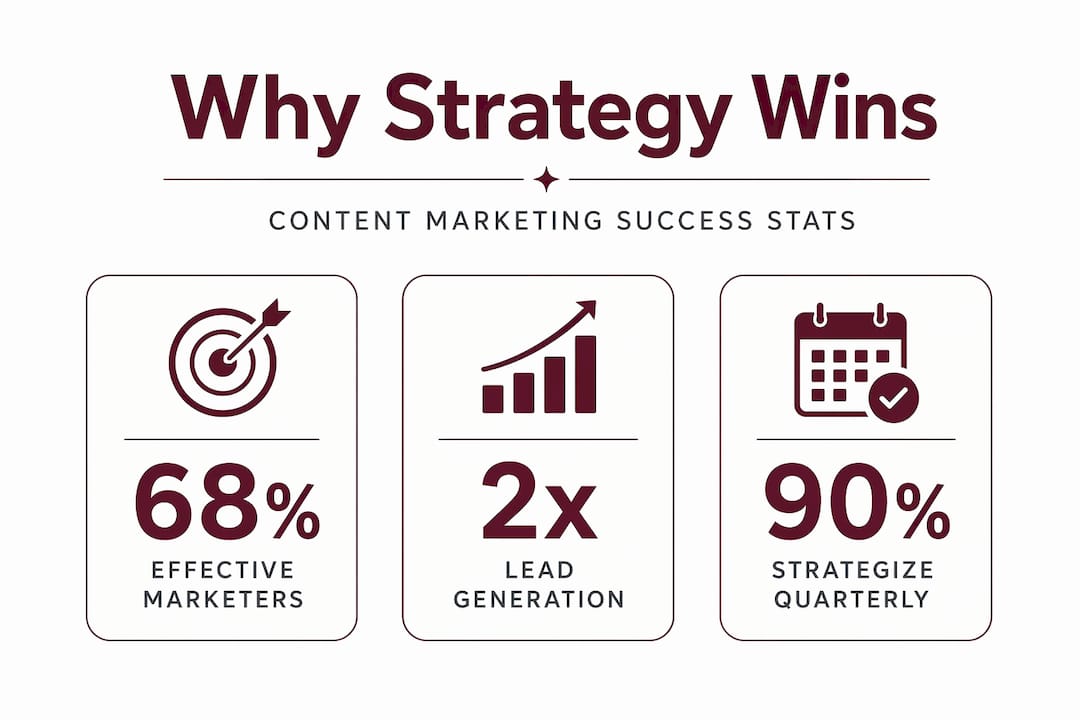
| Content approach | Reported effectiveness rate |
|---|---|
| Documented strategy in place and improving | 68% (enterprise) |
| Broader B2B cohort (mixed strategy maturity) | 59% |
| No documented strategy | Significantly lower |
A solid content strategy for a service business includes these components:
- Defined audience: Who are you writing for? What are their roles, challenges, and goals? A marketing manager at a mid-size construction firm has very different concerns than a solo accountant.
- Channel selection: Where does your audience actually spend time? LinkedIn? Google search? Email? Pick channels based on data, not preference.
- Content formats: Long-form articles, short social posts, video walkthroughs, and email sequences each serve different purposes. Match format to channel and buyer stage.
- Buyer journey mapping: Create content for awareness (they have a problem), consideration (they are evaluating solutions), and decision (they are ready to buy).
- Measurement framework: Define what success looks like. Organic traffic? Lead form submissions? Email open rates? Without metrics, you cannot improve.
Pro Tip: Block one hour per quarter to review your content performance against your business goals. If a piece of content is not contributing to traffic, leads, or authority, either update it or retire it. Busywork content dilutes your brand. If you want expert help setting this up, our content strategy sessions are a practical starting point.
Tactics and examples: Content marketing in action for service brands
Now that strategy is clear, let’s bring it to life with practical actions and successful real-world examples.
Knowing what content marketing is and having a strategy are necessary. But you also need to know what to actually create. For service businesses, certain content types consistently outperform others because they align naturally with how buyers research and evaluate service providers.
According to B2B content marketing research, service-based B2B organizations need an audience-first focus, aligning content with the buyer journey and demonstrating expertise, rather than producing content purely for search volume. That distinction matters because it shifts your question from “what keywords should I rank for?” to “what does my ideal client actually need to know before they hire someone like me?”
High-impact content types for service brands include:
- Case studies: Show real results for real clients. Nothing builds credibility faster than a specific, measurable outcome. “We helped a regional law firm reduce their cost per lead by 40% in 90 days” is more convincing than any tagline.
- How-to guides: Answer the questions your prospects are already searching for. A cybersecurity firm writing “How to conduct a basic IT security audit for small businesses” attracts exactly the right audience.
- Email newsletters: Keep your existing contacts warm and top of mind. A consistent, valuable newsletter keeps you in the conversation even when prospects are not actively buying.
- Service explainer content: Break down what you actually do, how it works, and what clients can expect. Many service buyers hesitate because they do not understand the process.
- Social media content: Short, educational posts that demonstrate expertise without requiring a long read. Social media content works best when it drives people deeper into your content ecosystem.
- Email marketing sequences: Automated sequences that nurture leads over time. Email marketing examples for service businesses often include onboarding sequences, re-engagement campaigns, and educational drip series.
The 68% effectiveness rate for enterprise marketers with documented strategies is not a coincidence. When content is built around a specific audience and a clear goal, it performs. When it is built around “we should probably post something this week,” it does not.
Common pitfalls and how to avoid them
Even armed with the right tactics, avoiding common hazards ensures your effort pays off.
Many service businesses invest time and money into content marketing and see little return. Usually, the problem is not the content itself. It is one of these recurring mistakes:
- No clear audience definition: Writing for “everyone” means connecting with no one. If your content does not speak directly to a specific type of client, it will not resonate with anyone.
- Overreliance on quantity: Publishing five mediocre articles a week is worse than publishing one excellent one. Volume without quality erodes trust rather than building it.
- Neglecting measurement: If you are not tracking which content drives traffic, leads, or conversions, you are flying blind. Set up basic analytics from day one.
- Shallow expertise: Surface-level content that could have been written by anyone does nothing to differentiate you. Your content needs to reflect genuine knowledge and real experience.
- Ignoring the buyer journey: Publishing only awareness-stage content means you attract curious readers but never convert them. You need content at every stage of the decision process.
For 2026 specifically, AI tools have made it easier than ever to produce content at scale. But the biggest barriers for B2B marketers still include producing enough quality content, differentiating it, and aligning it to the buyer journey. AI does not solve those problems. Strategy and subject-matter depth do.
Pro Tip: Before you publish any piece of content, ask yourself: “Would my best client find this genuinely useful, or does it just make us look busy?” If the answer is the latter, rewrite it or scrap it. Our lead generation packages are built around content that actually converts, not content that just fills a calendar.
The uncomfortable truth: Quality over quantity still wins in 2026
With the foundations in place, it is worth pausing for a candid insight seldom shared by industry insiders.
Every few months, a new tool or platform promises to solve the content problem. Post more. Automate more. Use AI to generate 50 articles a week. The pitch is seductive, especially for busy service business owners who know they need to be doing more marketing.
Here is what we have seen firsthand: the service businesses generating the most consistent leads from content are not the ones posting the most. They are the ones posting the most relevant content for their specific audience. There is a real difference.
AI-generated content is now flooding every industry. Search engines are getting better at identifying it, and more importantly, buyers are getting better at ignoring it. When everything sounds the same, the businesses that win are the ones with a distinct point of view, real client stories, and genuine expertise embedded in their content. A real case study built around actual client results will always outperform a generic “10 tips” article written by an AI with no industry context.
The B2B content marketing data confirms this: differentiation and buyer journey alignment remain the hardest challenges, even as AI handles more of the production work. That means the competitive advantage in content marketing has shifted. It used to be about who could produce the most. Now it is about who can produce the most useful. For service businesses, that is actually good news. You have expertise your competitors do not. The goal is to get that expertise into content that your ideal clients can find and trust.
Consistency still matters. But consistency of quality beats consistency of volume every time.
Taking the next step: Expert support for your content strategy
With a smart, sustainable content strategy in mind, you may be wondering how to put this into practice quickly and effectively.
Building a content marketing engine from scratch takes time, expertise, and the right systems. Most service business owners know what they want to achieve but struggle to find the bandwidth to execute consistently. That is where working with an experienced team makes the difference between a strategy that sits in a document and one that actually drives leads.
At Harvest Moon Marketing, we offer a full range of marketing services designed specifically to help service businesses attract, engage, and convert their ideal clients through strategic content. From content planning and creation to distribution and measurement, we handle the heavy lifting so you can focus on delivering great work for your clients. Ready to see what a real content strategy looks like for your business? Book a consultation and let’s map out a plan that fits your goals and your market.
Frequently asked questions
How does content marketing differ from traditional advertising?
Content marketing attracts customers by providing useful content relevant to their interests, while traditional advertising pushes products or services directly at them. As research confirms, content marketing works as a pull strategy, drawing in prospects who are already looking for answers rather than interrupting them.
Why is a documented content strategy important?
A documented content strategy ensures efforts are aligned with real business goals and avoids wasting time on ineffective content. Without it, content can drift into production without business impact, consuming resources without generating measurable results.
What content types work best for service businesses?
Service brands benefit most from case studies, how-to guides, email newsletters, and informative social content tailored to their audience’s journey. The key is an audience-first focus that demonstrates expertise rather than simply chasing search volume.
Is AI-generated content enough to drive leads in 2026?
AI can help with production, but results come from quality, differentiation, and aligning content to the buyer’s specific needs. The biggest barriers for B2B marketers in 2026 remain producing quality content and aligning it to the buyer journey, challenges that AI alone cannot solve.


