
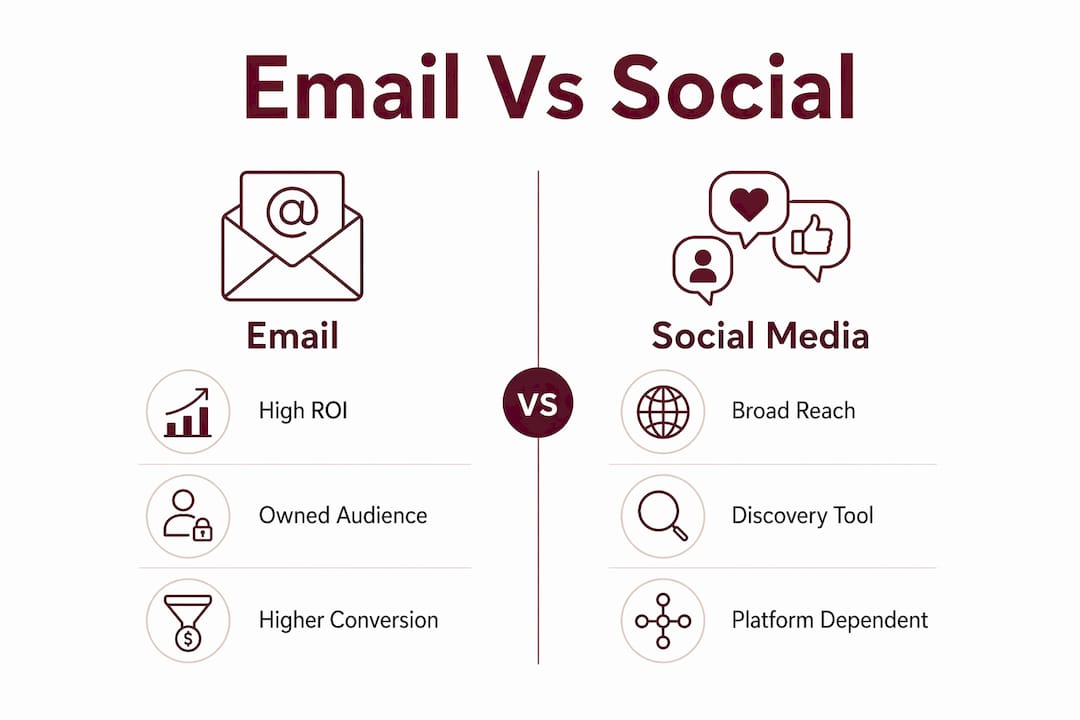
Email marketing is defined as a direct, permission-based channel where businesses communicate with subscribers who have explicitly opted in to receive messages. That distinction is the core reason why email beats social media reach in every meaningful metric: ownership, conversion, and return on investment. While social platforms attract attention, email drives revenue. The gap between the two channels is not subtle. Email marketing delivers approximately $36 to $42 for every $1 spent, compared to roughly $2 to $3 for social media. That is a 10–15 times difference in financial return, and it shapes every decision Harvestmoonmktg makes when advising clients on where to invest their marketing budgets.
Why email beats social media reach in ROI and conversions
The financial case for email is straightforward. Email conversion rates reach approximately 4.24%, compared to 0.59% for social media. That means email converts at roughly seven times the rate of social platforms. For a service business sending 5,000 emails, that gap translates directly into more booked appointments, more consultations, and more revenue per campaign.

| Metric | Email marketing | Social media |
|---|---|---|
| ROI per $1 spent | $36–$42 | $2–$3 |
| Purchase conversion rate | ~4.24% | ~0.59% |
| Audience ownership | Full | None |
| Algorithm dependency | None | High |
The cost structure of email reinforces the ROI advantage. Sending an email to your entire list costs a fraction of what paid social promotion costs to reach the same number of people. Social media organic reach has declined sharply over the past decade, meaning most posts reach only a small percentage of your followers without paid promotion. Email lands directly in the inbox every time.
Pro Tip: Segment your list by customer behaviour before each campaign. Subscribers who opened your last three emails respond at significantly higher rates than your full list, and targeting them first protects your sender reputation.
Do you actually own your social media audience?
The most underappreciated email marketing advantage is audience ownership. Your email list is a business asset you control completely. Social media reach can drop dramatically overnight when a platform changes its algorithm, with no warning and no recourse. Businesses that built their entire audience on a single social platform have experienced exactly this, watching engagement collapse after algorithm updates they had no part in creating.
Email lists are different in a structural way. You can export your subscriber data at any time, move it to a new platform, and continue communicating with your audience regardless of what any tech company decides to do. That portability makes your list a genuine business asset, not a borrowed one.
The benefits of email over social extend to privacy law as well. Email relies on first-party data that remains under your control, while social media tracking has been significantly disrupted by privacy changes such as Apple’s App Tracking Transparency framework. Social platforms depend on third-party data signals that are becoming less reliable every year. Email sidesteps that problem entirely because the subscriber gave you their information directly.
Key risks of relying solely on social media for audience reach:
- Algorithm shifts can cut organic reach without notice or explanation
- Platform decline means your audience may migrate away, as seen with multiple platforms over the past decade
- Account suspension can remove access to your followers instantly
- Data inaccessibility means you cannot export your social following to another channel
- Policy changes can restrict the type of content you are permitted to post
Pro Tip: Treat every social media follower as a lead, not a customer. Your goal on social is to move that person onto your email list, where you own the relationship.
How do social media and email work together?
Social media excels at discovery and attracting audiences who have never heard of your business. Email excels at converting those audiences into paying customers and keeping them engaged over time. These are not competing channels. They solve different problems at different stages of the customer relationship.
Treating social media and email as equivalent is a strategic mistake. Social media provides reach and awareness. Email provides revenue attribution and predictability. Measuring both channels with the same metrics leads to poor budget decisions.
| Goal | Best channel | Why |
|---|---|---|
| Brand awareness | Social media | Wide reach, shareable content |
| Lead generation | Social media | Discovery and cold audience targeting |
| Nurturing prospects | Direct, personalised communication | |
| Driving conversions | Higher conversion rate, owned audience | |
| Customer retention | Consistent, permission-based contact | |
| Community building | Social media | Public engagement and interaction |
Successful marketers use social media as a top-of-funnel tool to generate leads, then move those prospects to email for direct sales and relationship building. Social followers are passive. Email subscribers have actively chosen to hear from you. That distinction in intent explains the conversion gap between the two channels.
Email engagement strategies that maximise reach in 2026
Knowing that email outperforms social media is only useful if your campaigns are built to take advantage of it. The effectiveness of email marketing depends on relevance, personalisation, and respecting subscriber attention. Poor execution erodes the very advantages that make email powerful.
These email engagement strategies consistently improve open rates, click rates, and conversions for service businesses:
-
Segment your list by behaviour. Group subscribers by what they have opened, clicked, or purchased. Relevant emails get read. Generic blasts get ignored or unsubscribed from.
-
Personalise beyond the first name. Reference the subscriber’s industry, location, or past interaction with your business. A plumber in Calgary responds differently to an email that acknowledges local seasonal demand than to a generic service promotion.
-
Build your list continuously alongside social. Use social media content to drive sign-ups. A lead magnet, a free resource, or a newsletter promise gives followers a reason to move from passive to subscribed.
-
Set a consistent send frequency and stick to it. Subscribers who know when to expect you are less likely to unsubscribe. Erratic sending creates distrust and increases spam complaints.
-
Write subject lines that reflect the email content exactly. Misleading subject lines inflate open rates temporarily and destroy long-term trust. Accurate subject lines attract the right readers and filter out those who are not ready to engage.
For a detailed walkthrough of building campaigns that convert, the email marketing best practices guide from Harvestmoonmktg covers segmentation, timing, and list-building tactics specific to service businesses in 2026.
Every internet user has an email address without needing a specific app or platform preference. No single social media platform comes close to that level of universal accessibility. That reach, combined with the ownership and conversion advantages of email, is why the channel continues to outperform social media year after year.
How Harvestmoonmktg builds email programmes that outperform social
Harvestmoonmktg works with service businesses that want to build marketing that they own and control. Email marketing is the channel that delivers consistent returns for existing customers, keeping your business top of mind between purchases and referrals. The team at Harvestmoonmktg builds permission-based email programmes from the ground up, including list segmentation, campaign planning, and performance tracking. For businesses already active on social media, Harvestmoonmktg integrates both channels so that social drives awareness and email drives revenue. If you want to understand how digital marketing channels fit together for a service business, or you are ready to put email to work alongside your social media presence, Harvestmoonmktg offers the expertise to make both channels perform their proper roles.
FAQ
What is the ROI difference between email and social media?
Email marketing delivers approximately $36 to $42 for every $1 spent, while social media returns roughly $2 to $3. That makes email 10–15 times more financially efficient than social media as a marketing channel.
Why does email have a higher conversion rate than social media?
Email subscribers have actively opted in to receive messages, which signals higher purchase intent than a passive social media follower. Email conversion rates reach approximately 4.24%, compared to 0.59% for social media.
Can social media replace email marketing?
Social media cannot replace email marketing because the two channels serve different purposes. Social media builds awareness and attracts new audiences; email converts and retains them.
What makes an email list more valuable than social media followers?
An email list is a portable, owned asset that you control completely. Social media followers are tied to a platform whose algorithm and policies can change at any time, reducing your reach without warning.
How does email marketing use first-party data?
Email marketing collects subscriber information directly from the person who signs up, making it first-party data that you own. Social media tracking relies on third-party signals that privacy changes, such as Apple’s App Tracking Transparency, have made less reliable.


