
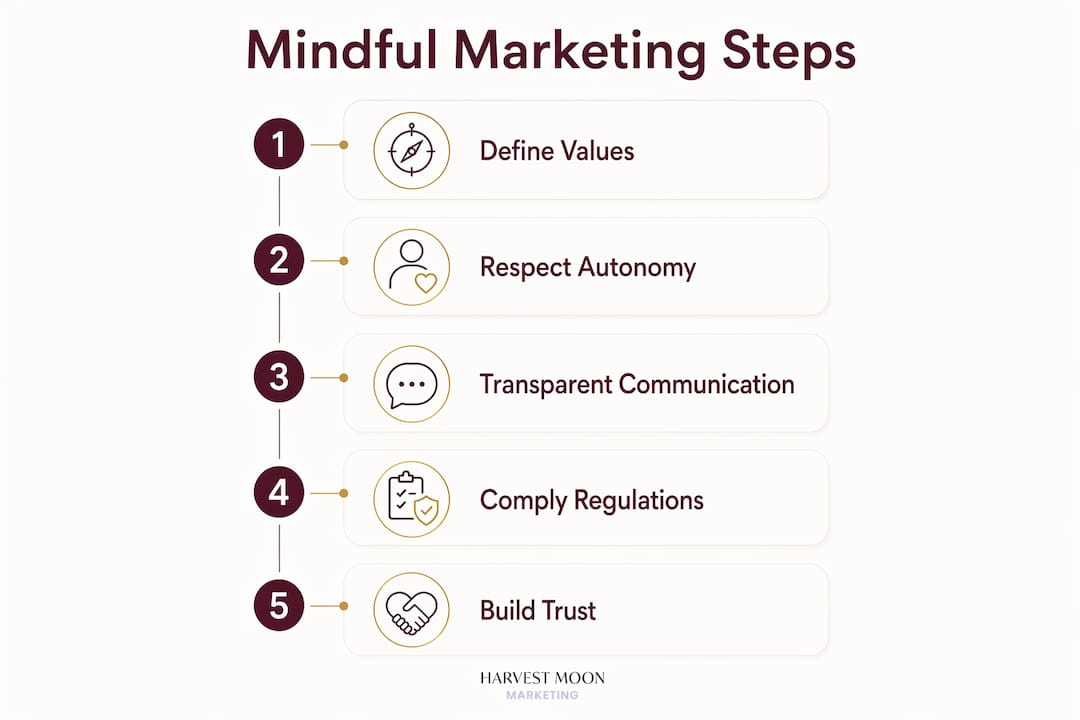
A mindful marketing approach is defined as a strategy that centres consumer values, respects user autonomy, and builds genuine trust through transparency and ethical design. This is not a campaign tactic or a brand refresh. It is a structural commitment that shapes how you build audiences, write copy, design landing pages, and manage customer relationships. In 2026, with California’s CPRA enforcement tightening and consumers increasingly alert to manipulation, understanding this approach is no longer optional for serious marketers. This article covers the core principles, regulatory requirements, UX best practices, and how to embed mindful marketing into your broader business operations.
What is a mindful marketing strategy and why does it matter?
A mindful marketing strategy is built on one foundational idea: your marketing should serve the consumer, not just convert them. According to Andi Cross, purpose-driven marketing is a structural business commitment that shapes product development, hiring, partnerships, and communication. It is not a single campaign. That distinction matters because most businesses treat purpose as messaging. Real mindful marketing makes purpose visible in every touchpoint.
The benefits of this approach are concrete, not abstract:
- Reduced churn: Customers who trust your brand stay longer. Authenticity creates loyalty that discounts cannot.
- Better engagement: Mindful content marketing improves brand awareness and loyalty by fostering intentional consumer interaction.
- Reputation protection: Brands that avoid manipulative design avoid the regulatory and public relations consequences that follow dark patterns.
- Long-term revenue: Trust compounds. A customer who feels respected refers others and returns without paid re-engagement.
The opposite of mindful marketing is not aggressive marketing. It is careless marketing. Brands that use hidden fees, fake urgency, or confusing opt-out flows are not just being pushy. They are eroding the consumer relationship and exposing themselves to legal risk.
Pro Tip: Audit your existing email sequences and landing pages for any language that creates false urgency or obscures cancellation terms. These are the first places mindful marketing breaks down in practice.

How do privacy regulations shape mindful advertising techniques?
Privacy law is now one of the clearest external forces defining what ethical advertising looks like. Under CPRA Section 1798.135, businesses must honour opt-out signals including the Global Privacy Control (GPC) through technical means. GPC is the only explicitly recognised compliant opt-out signal in California as of Q2 2026. That means suppressing tracking pixels and excluding opted-out users from remarketing audiences at the technical level, not just in your privacy policy copy.
Here is what that looks like in practice:
- Integrate GPC signals into your marketing automation platform. Consent status must feed directly into audience-building logic, not sit in a separate compliance document.
- Audit your pixel and tag setup. Firing a Meta or Google pixel on a page visited by a GPC user is a compliance breach, regardless of what your privacy notice says.
- Review your remarketing audiences. Any audience built without consent filtering is potentially non-compliant and should be rebuilt.
- Document your suppression logic. Regulators want evidence of technical implementation, not just policy intent.
“Failing to integrate opt-out signals into marketing automation risks marketing that appears mindful in copy but breaches user consent technically.” — CPRA Q2 2026 Guidance
The FTC’s position on dark patterns reinforces this. Enforcement focuses on the effect of a design on user autonomy, not the intent behind it. A confusing cancellation flow is potentially unlawful whether or not you meant it to be confusing. Regulators prioritise the most egregious cases like subscription traps and hidden fees, but milder deceptive designs still carry real consumer backlash risk. The practical takeaway is to audit entire user experience flows, not just your disclosures.
What does mindful UX look like on a landing page?
Landing page design is where mindful advertising techniques become visible to the consumer. The goal is a high signal-to-noise ratio: one clear value proposition, one primary call to action, and no design elements that create confusion or pressure.
The recommended content sequence for mindful landing pages is:
| Stage | Element | Purpose |
|---|---|---|
| 1 | Hero section | State the primary outcome clearly, visible on mobile without scrolling |
| 2 | Proof point | Social proof, credentials, or a specific result |
| 3 | Micro-commitment | Low-friction next step (e.g., a short form or a single question) |
| 4 | Deeper content | Full explanation, FAQs, or detailed service information |
This sequence works because it manages cognitive load. Mindful UX design reduces uncertainty and decision paralysis by providing clear hierarchy and fewer choices. The page functions as a stress-reduction mechanism, not just an aesthetic choice. Consumers with limited attention make faster, more confident decisions when the path forward is obvious.
Transparency in your privacy notice belongs on the landing page, not buried in a footer link. State clearly what data you collect, how you use it, and whether you run remarketing. This is not just a legal requirement. It is a trust signal that mindful consumers notice and respond to positively.
Pro Tip: Replace any countdown timer that resets on page reload with a genuine deadline or remove it entirely. False urgency is one of the most common dark patterns on service business landing pages, and it actively damages trust with informed buyers.
How do you embed mindful marketing into your broader brand strategy?
Mindful marketing thrives as an organisational commitment, not a campaign layer. Purpose-driven marketing earns consumer trust over time. Superficial cause-marketing strategies lack authenticity and consumers recognise the difference quickly.
Embedding this approach across your business means making decisions in several areas simultaneously:
- Product and service alignment: Your marketing cannot promise values your product does not deliver. If you claim to respect customer time, your onboarding process must reflect that.
- Hiring and partnerships: The people and organisations you associate with signal your values. Partnerships with brands that use manipulative practices undermine your own positioning.
- Honest progress reporting: Brands that report honestly about both successes and failures earn greater trust than those with only polished success narratives. Documenting real outcomes, including setbacks, builds credibility with audiences who have seen too many empty commitments.
- Owned channel strategy: Owned digital channels like email, in-product messaging, and newsletters form the backbone of mindful engagement. They convert attention into repeated customer relationships without depending on platform algorithms. For service businesses, email marketing best practices are the most direct way to maintain respectful, ongoing communication with existing clients.
Purpose is a multi-year trust-building strategy. It shows up in how you handle a complaint, how you write a cancellation confirmation, and how you respond when a campaign underperforms. The brands that get this right do not treat mindful marketing as a differentiator. They treat it as the baseline.
For a broader view of how these principles connect to measurable outcomes, the digital marketing metrics that matter in 2026 reflect exactly this shift toward engagement quality over volume.
How Harvestmoonmktg supports a mindful marketing strategy
Harvestmoonmktg is a full-suite digital marketing agency that builds campaigns around transparency, compliance, and genuine consumer engagement. If you are ready to move beyond surface-level tactics, Harvestmoonmktg offers SEO services built around authentic, user-focused content that earns trust and improves measurable engagement over time. For staying top of mind with existing clients, the email marketing programmes Harvestmoonmktg manages are designed to respect subscriber preferences and deliver real value in every send. Whether you are building a privacy-aware audience strategy or aligning your brand messaging with your actual operations, Harvestmoonmktg brings the expertise to make it work.
FAQ
What is a mindful marketing approach?
A mindful marketing approach is a strategy that prioritises consumer values, transparency, and user autonomy across all marketing touchpoints. It combines ethical design, purpose-driven branding, and privacy-compliant audience targeting to build long-term trust.
How does mindful marketing differ from traditional marketing?
Traditional marketing optimises primarily for conversion. Mindful marketing optimises for consumer trust and long-term relationship quality, treating ethical design and honest communication as non-negotiable rather than optional.
What are dark patterns and why do they matter in mindful advertising?
Dark patterns are design practices that impair user choice through hidden information, confusing language, or manipulative flows. The FTC evaluates them based on their effect on user autonomy, making deceptive UX potentially unlawful regardless of intent.
Does mindful marketing apply to small and mid-sized businesses?
Mindful marketing applies to any business that wants to build lasting customer relationships. For service businesses in particular, trust and reputation are the primary drivers of referrals and retention, making this approach directly tied to revenue.
How does CPRA affect mindful advertising in 2026?
CPRA requires businesses to honour Global Privacy Control signals through technical suppression of tracking and audience exclusion. Compliance must be built into marketing automation, not just stated in a privacy policy.


